
The Circadian Advantage: How to Align Your Life With Your Natural Rhythms
"Sleep is the single most effective thing we can do to reset our brain and body health each day." — Matthew Walker
Deep within your cells, a clock is ticking.
It's not a metaphorical clock or a spiritual concept. It's a literal biological mechanism — ancient protein machinery that evolved over billions of years, regulating the rhythms of every living thing on Earth, from bacteria to humans.
This is your circadian rhythm. And whether you know it or not, it's governing far more of your life than you realize.
Your energy levels throughout the day? Circadian. Your cognitive sharpness at different hours? Circadian. Your hunger patterns, body temperature, hormone release, immune function, even your mood? All circadian.
When you work with this rhythm, everything flows. Sleep comes easily. Energy is abundant. Focus is sharp. Mood is stable.
When you work against it — staying up late, sleeping in, eating at odd hours, flooding your eyes with artificial light at night — everything struggles. You feel chronically tired, foggy, irritable. Your health suffers. Your performance drops.
In this comprehensive guide, you're going to learn how to harness the circadian advantage: aligning your life with your biology to unlock peak performance and well-being.
Part 1: Understanding Your Body's Clock
The Master Clock: How Circadian Rhythms Work
At the center of your brain, in a region called the suprachiasmatic nucleus (SCN), sits your master clock. This tiny cluster of about 20,000 neurons receives light signals from your eyes and uses them to set your internal time.
But you don't have just one clock. Nearly every cell in your body has its own circadian rhythm, governed by "clock genes" that turn on and off in roughly 24-hour cycles. Your liver has a clock. Your gut has a clock. Your heart has a clock.
The master clock in the SCN acts like a conductor, synchronizing all these peripheral clocks into a coordinated symphony.
When everything is aligned, the orchestra plays beautifully. When clocks fall out of sync — due to irregular schedules, shift work, jet lag, or chronic disruption — the result is metabolic chaos.
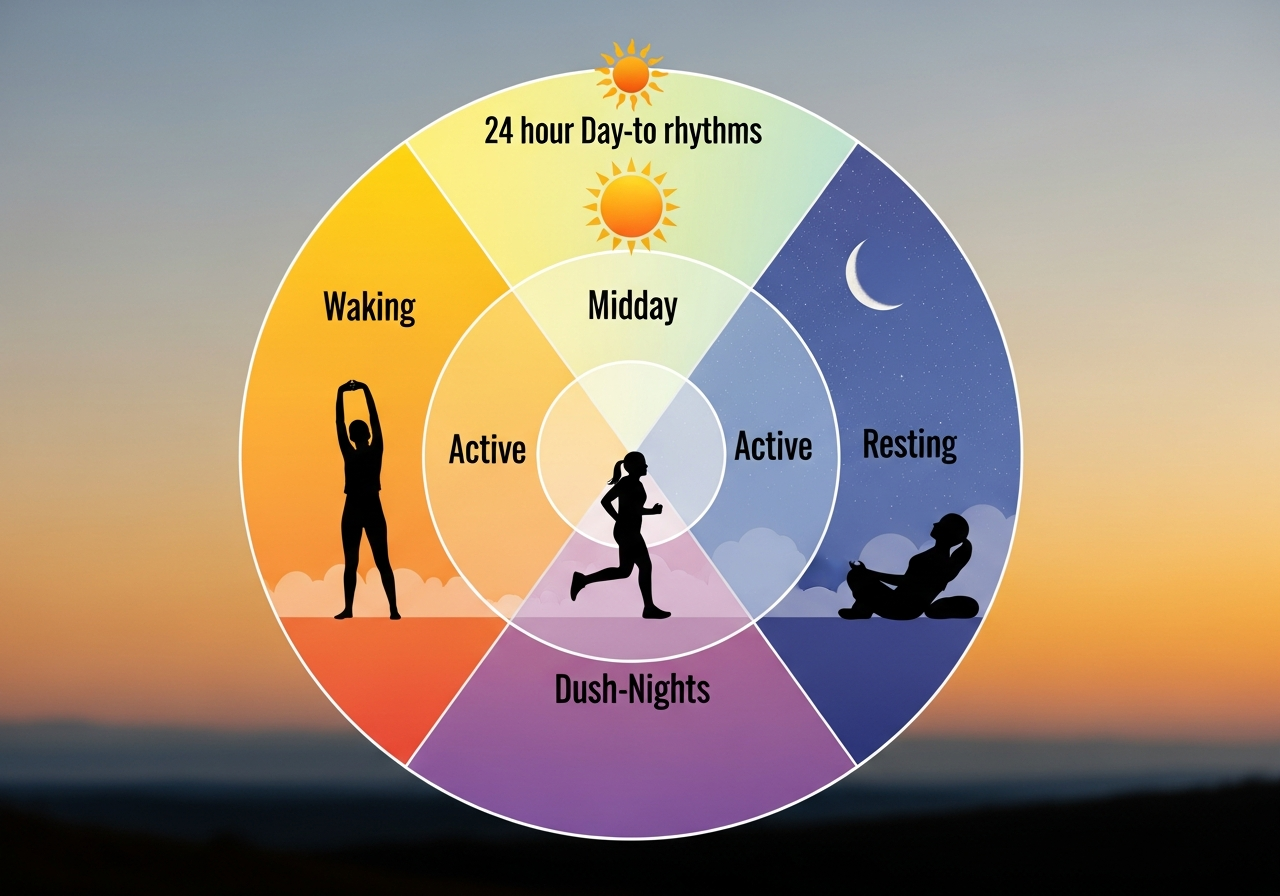
The Daily Rhythm of Productivity
Your biological clock creates predictable patterns throughout the day:
6:00 AM - 8:00 AM: The Awakening Cortisol levels surge, body temperature rises, melatonin production stops. This is your body's natural alarm clock. Waking with the sunrise aligns perfectly with this shift.
8:00 AM - 12:00 PM: Peak Cognitive Function Most people experience their highest levels of alertness, concentration, and logical thinking in the late morning. This is the ideal time for your most demanding intellectual work.
12:00 PM - 2:00 PM: The Post-Lunch Dip Blood flow diverts to digestion. Alertness drops naturally. This is a good time for routine tasks, administrative work, or even a short nap.
2:00 PM - 6:00 PM: Physical Peak Body temperature is highest. Reaction time is fastest. Muscle strength and coordination peak. This is the optimal window for exercise and physically demanding tasks.
6:00 PM - 9:00 PM: Wind-Down Melatonin production begins in preparation for sleep. Body temperature starts dropping. This is the time to transition from activity to rest.
9:00 PM - 6:00 AM: Recovery The body shifts into repair mode. Growth hormone is released. Memory consolidates. Immune function activates. This is when the magic of recovery happens — if you're actually sleeping.
Understanding this rhythm is the first step. Working with it is the key to the circadian advantage.
Part 2: The Foundation — Mastering Sleep
Why Sleep Is Everything
Let's be blunt: If your sleep is broken, nothing else matters.
You can have the perfect diet, the optimal workout routine, and the best meditation practice. If you're not sleeping well, you're operating at a fraction of your capacity and accumulating health risks.
The research is overwhelming. Poor sleep is linked to:
- Impaired cognitive function and memory
- Reduced emotional regulation
- Weakened immune system
- Increased risk of heart disease, diabetes, and obesity
- Shortened lifespan
One night of poor sleep impairs cognitive function as much as being legally drunk. Chronic sleep deprivation is a slow-motion disaster.
Conversely, optimizing your sleep is the highest-leverage intervention available. When sleep is good, everything else gets easier.
The Architecture of Good Sleep
Quality sleep isn't just about time in bed. It's about structure.
Light Sleep (Stages 1-2): The transition phases, about 50% of total sleep.
Deep Sleep (Stage 3): The physically restorative phase. This is when growth hormone is released, tissues repair, and the body recovers. You need adequate deep sleep to feel rested.
REM Sleep: The mentally restorative phase. This is when memories consolidate, emotional processing occurs, and dreams happen. Cognitive function depends on adequate REM.
A healthy sleep architecture cycles through these stages multiple times per night, with more deep sleep early and more REM later.
The Sleep Optimization Protocol
Here's a systematic approach to maximizing your sleep quality:
1. Anchor Your Wake Time
Wake at the same time every day — including weekends. This is the single most powerful intervention for regulating your circadian rhythm.
Variable wake times confuse your body clock. Consistent wake times anchor it.
2. Get Morning Light
Within the first hour of waking, get exposure to bright light, ideally sunlight. This signals to your master clock that day has begun and sets the cascade for proper evening melatonin production.
Go outside for at least 10-15 minutes. If that's impossible, use a bright light therapy lamp.
3. Respect the Caffeine Cutoff
Caffeine has a half-life of 5-7 hours. That means if you drink coffee at 3 PM, half of it is still in your system at 10 PM.
Set a firm caffeine cutoff by early afternoon — typically no later than 2 PM.
4. Create a Sleep Runway
Your body can't go from full throttle to sleep instantly. You need a transition period.
Begin winding down 60-90 minutes before bed. Dim the lights. Stop intense work. Avoid stimulating content. Do calming activities: reading, gentle stretching, conversation.
5. Control Light at Night
Artificial light, especially blue light from screens, suppresses melatonin and delays sleep onset.
In the evening:
- Dim household lights
- Use blue light blocking glasses if using screens
- Enable night mode on devices
- Avoid screens entirely in the last hour before bed (ideal)
6. Optimize Your Sleep Environment
Temperature: Cool is better. Most people sleep best around 65-68°F (18-20°C).
Darkness: Blackout curtains or a sleep mask. Even small amounts of light disrupt sleep.
Quiet: Use earplugs or white noise if needed.
Comfort: A quality mattress and pillow are worth the investment.
7. Avoid Alcohol Near Bedtime
Alcohol may help you fall asleep but destroys sleep architecture. It suppresses REM, causes fragmented sleep, and leads to early waking.
If you drink, stop at least 3-4 hours before bed.
Part 3: The Morning Advantage — How to Start Your Day Right
Your morning sets the tone for your entire day. A aligned morning routine harnesses your circadian advantage from the start.
The First Hour Protocol
The first hour after waking is critically important. What you do here creates cascading effects throughout the day.
1. Wake Consistently
Same time every day. Use a gentle alarm if needed, or better yet, train yourself to wake naturally.
2. Embrace the Light
Open curtains immediately. Go outside if possible. Let your body know that day has begun.
3. Hydrate
After hours of sleep, you're dehydrated. Drink a full glass of water before anything else.
4. Delay Caffeine (Optional but Beneficial)
Cortisol is naturally highest in the first 90 minutes after waking. Delaying caffeine until after this peak can prevent energy crashes later and reduce tolerance buildup.
5. Move Your Body
Even light movement — stretching, a walk, some bodyweight exercises — activates your systems and increases alertness.
6. Avoid the Phone
Don't check email, social media, or news in the first hour. These put you in reactive mode, responding to others' agendas before you've even set your own.
Designing Your Morning Routine
Based on circadian principles, here's a template for an optimized morning:
5:30-6:00 AM: Natural Wake Wake with sunrise or a sunrise-simulating alarm. No snooze.
6:00-6:15 AM: Hydration and Light Drink water. Open curtains or go outside. Let the light in.
6:15-6:45 AM: Movement Exercise, yoga, a walk — something that gets blood flowing.
6:45-7:00 AM: Mindfulness Meditation, journaling, or simple silence. Start the day centered.
7:00-7:30 AM: Nourishment A healthy breakfast that supports stable energy.
7:30-8:00 AM: Planning Review your priorities. Set intentions for the day.
8:00 AM onward: Peak Cognitive Work Tackle your most important, demanding tasks while your brain is sharpest.
Part 4: The Midday Strategy — Protecting Your Energy
The Post-Lunch Dip
Between roughly noon and 2 PM, there's a natural dip in alertness. This isn't a sign that something's wrong — it's a normal circadian phenomenon.
Fighting this dip with stimulants and willpower is counterproductive. Working with it is smarter.
Options for the early afternoon:
- Take a nap. A 10-20 minute power nap can restore alertness without grogginess. Don't nap longer or later than 3 PM, or you'll disrupt night sleep.
- Do lower-intensity tasks. This isn't the time for your most creative or demanding work. Handle administrative tasks, routine emails, simple maintenance.
- Get outside. A brief walk in daylight can help push through the dip and resets alertness.
The Afternoon Surge
After the post-lunch dip, there's typically a second wind in the late afternoon. Many people experience renewed focus from about 3-6 PM.
This is a great time for:
- Creative work
- Collaborative projects
- Exercise (body temperature and coordination peak here)
Use this window before the evening wind-down begins.
Part 5: The Evening Transition — Preparing for Quality Sleep
The Wind-Down Period
Just as your morning sets up your day, your evening sets up your night.
The transition from the active day to restful sleep doesn't happen instantly. Your body needs time to shift gears.
Starting 2-3 hours before bed:
Reduce stimulation. No intense workouts, no heated arguments, no stressful work. Lower the intensity of everything.
Dim the lights. Begin transitioning to lower light levels. This signals to your brain that night is approaching.
Stop eating. Allow at least 2-3 hours between your last meal and sleep. Digestion interferes with quality sleep.
Limit fluids. Reduce liquid intake to avoid middle-of-the-night bathroom trips.
The Pre-Sleep Ritual
In the final 30-60 minutes before bed, create a consistent routine that signals to your body it's time to sleep.
This might include:
- Reading (physical book, not screen)
- Gentle stretching or yoga
- Journaling or gratitude practice
- Dimly lit conversation with loved ones
- A warm bath or shower (the subsequent body temperature drop promotes sleepiness)
The key is consistency. When you do the same things in the same order before bed, your body learns to associate them with sleep.
Part 6: Navigating Disruptions
Shift Work and Irregular Schedules
If your job requires irregular hours, you're fighting biology. Complete alignment may not be possible, but damage can be minimized:
- Keep whatever routine you can consistent
- Use light strategically: bright light during work hours, complete darkness during sleep
- Wear blue-light blocking glasses during night shifts
- Make sleep a non-negotiable priority
- Consider speaking with a sleep specialist
Jet Lag
When traveling across time zones, your internal clock takes time to adjust — roughly one day per time zone crossed.
Strategies:
- Pre-adjust. Start shifting your schedule a few days before travel.
- Use light strategically. Get bright light at the appropriate times in your new zone.
- Time your meals. Eating aligns peripheral clocks.
- Consider melatonin. A small dose at the new bedtime can help reset your rhythm.
Social Jet Lag
Many people live with chronic misalignment between their social schedule (weekdays) and natural rhythm (weekends). This "social jet lag" has real health consequences.
Minimize it by:
- Keeping wake times consistent across the week
- Not sleeping in more than 1 hour later on weekends
- Aligning social events with your natural rhythm when possible
Conclusion: Live in Rhythm
Your body is a product of millions of years of evolution, shaped by the rising and setting of the sun. Fighting that heritage is a losing battle.
The modern world offers endless opportunities to disrupt your circadian rhythm: artificial light at all hours, stimulants and depressants on demand, screens that never sleep, schedules divorced from sunrise and sunset.
You can follow the crowd into this dysregulation, accepting chronic fatigue, brain fog, and accelerated aging as normal.
Or you can choose differently.
You can align your life with your biology. Wake with the sun. Sleep in darkness. Eat when your body expects food. Move when your body expects movement. Rest when your body calls for rest.
This is the circadian advantage. Not fighting your nature, but harnessing it. Not forcing performance, but optimizing the conditions for it to emerge.
When you're in rhythm, everything flows. Energy is abundant. Focus is sharp. Mood is stable. Health is robust.
This is how humans are meant to live. Return to it.
Action Steps: Claim Your Circadian Advantage
Anchor your wake time. Choose a consistent wake time and stick to it every day — including weekends — for the next two weeks.
Get morning light. Within the first hour of waking, get at least 10-15 minutes of bright light, ideally outdoors.
Set a caffeine cutoff. No caffeine after 2 PM (or earlier if you're sensitive).
Create your wind-down routine. Design a consistent 60-minute pre-sleep routine and practice it every night.
Optimize your sleep environment. Make your bedroom cool, dark, and quiet. Invest in blackout curtains or a sleep mask.
Track and adjust. Monitor your sleep quality for two weeks. Notice patterns. Refine your approach.
Your biology is waiting to support you. Align with it, and watch everything improve.