
Ikigai: The Japanese Secret to Finding Your Purpose and Living a Meaningful Life
"He who has a why to live for can bear almost any how." — Friedrich Nietzsche
In the southern islands of Japan lies Okinawa, a place unlike anywhere else on Earth.
The people there live extraordinarily long lives. Okinawa has more centenarians per capita than any other place in the world. But what's remarkable isn't just how long they live — it's how they live.
Okinawan elders are active, engaged, and happy well into their 90s and 100s. They garden, fish, spend time with family, and participate in their communities. They don't merely exist; they thrive.
Scientists and researchers have studied Okinawa for decades, looking for the secret. They've analyzed the diet (rich in vegetables, low in processed food), the social structures (strong community ties), and the lifestyle (constant moderate activity).
But there's one factor that stands out above all others — one that can't be replicated by eating more tofu or walking more steps:
Ikigai.
Ikigai (pronounced ee-key-guy) is a Japanese concept that roughly translates to "a reason for being." It's the answer to why you get up in the morning. It's the intersection of what you love, what you're good at, what the world needs, and what you can be paid for.
When asked about their longevity, Okinawan elders consistently point to their ikigai as the source of their vitality. Having a clear sense of purpose, they say, gives them something to wake up for.
In this comprehensive guide, you're going to discover how to find your own ikigai — your unique reason for being — and how it can transform not just the length but the quality of your life.
Part 1: Understanding Ikigai — The Philosophy of Purpose
What Ikigai Really Means
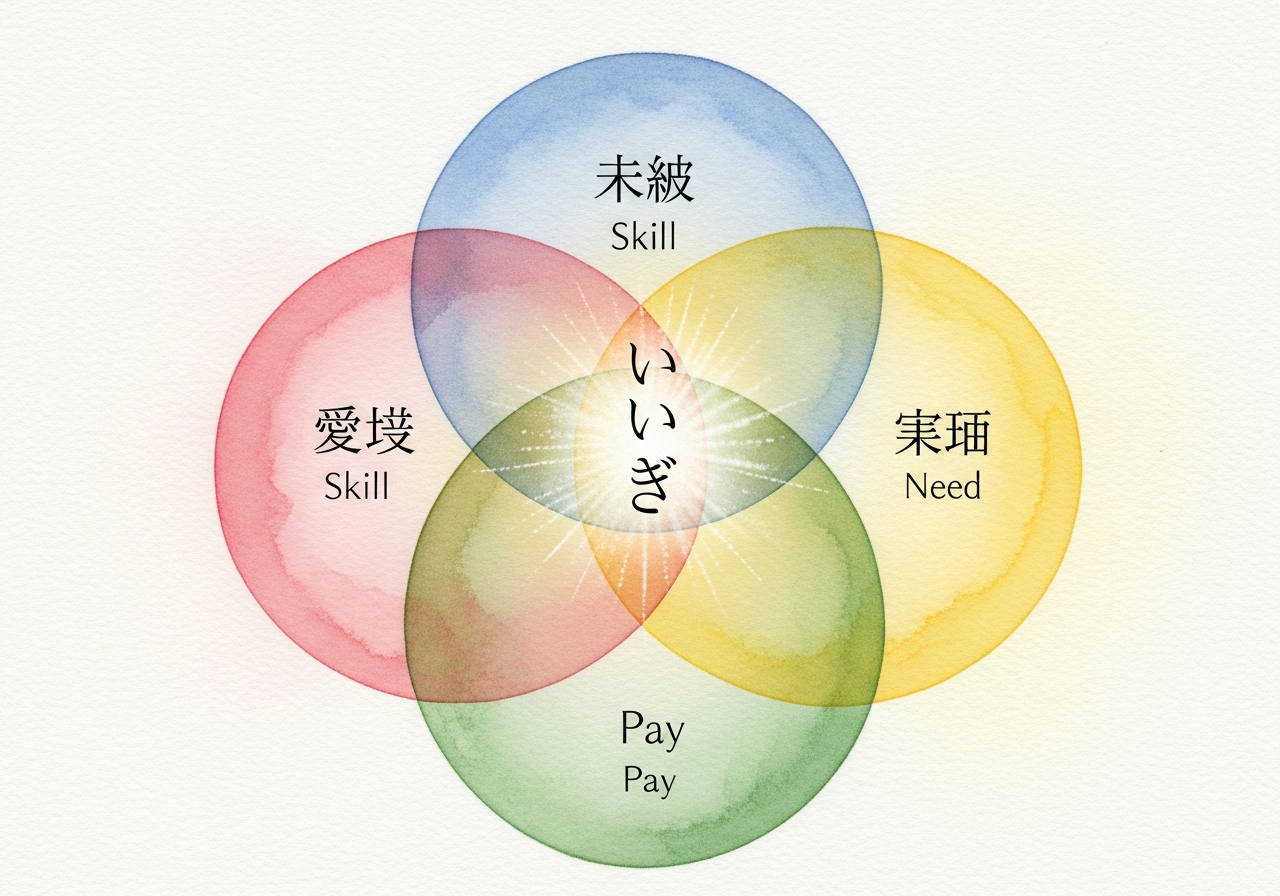
In the West, ikigai is often represented as a Venn diagram of four overlapping circles:
- What you love (passion)
- What you're good at (profession)
- What the world needs (mission)
- What you can be paid for (vocation)
Where all four circles overlap is said to be your ikigai.
This model is useful, but it's actually a Western interpretation. The Japanese understanding of ikigai is broader and more nuanced.
In Japan, ikigai isn't necessarily about grand life purpose or career. It can be something simple: tending a garden, spending time with grandchildren, crafting pottery, participating in community activities. It's less about finding your "one true calling" and more about having reasons to get up each morning with joy.
An Okinawan fisherman might say his ikigai is the sea. A grandmother might say it's her garden. A calligrapher might say it's the brush. These aren't world-changing missions — they're sources of daily meaning.
This distinction matters. The Western "find your passion" culture can create anxiety — as if there's one perfect purpose you must discover or you've failed. The Japanese approach is gentler. Ikigai is about cultivating meaning in your actual life, whatever that looks like.
The Science of Purpose
While ikigai is a philosophical concept, the science behind it is solid.
Research consistently shows that having a sense of purpose is linked to:
Longer life. Studies have found that people with a strong sense of purpose have a significantly reduced risk of death from all causes.
Better health. Purpose is associated with lower rates of heart disease, stroke, and cognitive decline.
Greater happiness. People with purpose report higher life satisfaction and lower rates of depression and anxiety.
Resilience. A clear why helps you navigate hardship. Purpose gives suffering meaning.
Viktor Frankl, the Holocaust survivor and psychiatrist, built his entire therapeutic approach (logotherapy) around this insight. Having witnessed unimaginable suffering, he concluded that the primary human drive is not pleasure (as Freud thought) but meaning.
"Those who have a 'why' to live," he observed, "can bear with almost any 'how.'"
Part 2: The Four Dimensions of Ikigai
Let's explore each dimension of the ikigai framework in depth.
Dimension 1: What You Love
This is the realm of passion and fascination. What activities make you lose track of time? What topics endlessly interest you? What would you do even if no one paid you?
Questions to explore:
- As a child, what did you love doing?
- What activities make hours feel like minutes?
- What topics do you read or learn about for pure enjoyment?
- When you have free time with no obligations, what do you choose to do?
- What gives you a sense of joy and aliveness?
Common traps:
- Confusing what you think you should love with what you actually love.
- Letting others' expectations shape your answers.
- Dismissing what you love as impractical or unimportant.
Dimension 2: What You're Good At
This is the realm of talent and skill. What comes naturally to you? What have you developed competence in? Where do you add value that others can't easily replicate?
Questions to explore:
- What do people come to you for help with?
- What have you been praised for repeatedly?
- What skills have you developed through practice?
- Where do you perform above average with less effort?
- What would colleagues or friends say is your superpower?
Common traps:
- Undervaluing skills that come easily to you (if it's easy for you, it must not be special — wrong!).
- Focusing only on formal qualifications rather than natural abilities.
- Confusing current skill with potential (you can develop new skills).
Dimension 3: What the World Needs
This is the realm of contribution and service. What problems call to you? What suffering moves you to action? Where do you feel compelled to help?
Questions to explore:
- What injustices or problems make you angry enough to act?
- What needs do you notice that others overlook?
- What would you want to change about the world?
- Who do you want to serve or help?
- What legacy do you want to leave?
Common traps:
- Thinking the need must be global or dramatic (the world also needs good parents, teachers, friends, neighbors).
- Being so focused on "changing the world" that you ignore your actual sphere of influence.
- Letting guilt or obligation, rather than genuine care, drive this dimension.
Dimension 4: What You Can Be Paid For
This is the realm of economic value. What will people exchange money (or other resources) for? What meets market demand?
Questions to explore:
- What skills do employers currently pay for?
- What problems do people pay to solve?
- What opportunities exist for monetizing your interests and abilities?
- What economic value can you create?
Common traps:
- Thinking money is dirty or incompatible with purpose.
- Pursuing money at the expense of the other dimensions.
- Ignoring economic reality in favor of pure idealism.
Part 3: Finding Your Ikigai — The Discovery Process
Ikigai is not discovered through thinking alone. It emerges through a combination of reflection, exploration, and action.
Step 1: Deep Reflection
Before exploring the outer world, explore your inner world.
The Life Audit
Look back at your life and identify:
- Moments when you felt most alive
- Activities that put you in a state of flow
- Accomplishments you're genuinely proud of
- Times when you felt you were contributing something meaningful
The Values Clarification
What matters most to you? Not what should matter, but what actually does? Common values include: freedom, creativity, connection, achievement, security, growth, adventure, service, family, health, wisdom.
Rank your top 5 values. These are clues to your ikigai.
The Death Meditation
Imagine you have one year left to live. What would you regret not doing? What would you want to be remembered for? What suddenly seems urgent and what suddenly seems trivial?
Step 2: Active Exploration
Reflection can only take you so far. At some point, you have to test your hypotheses in the real world.
The 20-Minute Experiment
Have an inkling that something might be part of your ikigai? Spend 20 minutes actually doing it. Then reflect: Did it feel like you? Did time slow down? Did it energize or drain you?
The Side Project Method
Start a small project on the side that combines elements of what you love, what you're good at, and what contributes value. Treat it as an experiment. Pay attention to how you feel.
The Conversation Approach
Talk to people who seem to have found their ikigai. Ask them about their journey. Often, their path will illuminate possibilities for yours.
Step 3: Intersection Mapping
Now bring it all together. Draw the four-circle Venn diagram on a piece of paper:
- What you love
- What you're good at
- What the world needs
- What you can be paid for
Brainstorm items for each circle. Then look for overlaps. Where do multiple circles intersect?
Two-circle overlaps:
- Love + Good At = Passion (fulfilling but may not have purpose or pay)
- Love + Need = Mission (meaningful but may not have skill or pay)
- Good At + Paid For = Profession (sustainable but may not have meaning or passion)
- Need + Paid For = Vocation (practical but may not have passion or mastery)
Three-circle overlaps are closer. Four-circle overlap is ikigai.
You may not find a perfect four-circle overlap immediately. That's okay. Ikigai is often cultivated, not just discovered.
Part 4: Living Your Ikigai — Making It Real
Finding your ikigai is not a one-time event but an ongoing practice.
Start Where You Are
You don't need to quit your job or overhaul your life to begin living your ikigai. Start by integrating elements of it into your current life.
If your ikigai involves creativity, schedule creative time each week. If it involves connection, invest more in relationships. If it involves learning, commit to ongoing education.
Full alignment may take years. Direction matters more than immediate perfection.
Cultivate the Small Joys
Remember: Japanese ikigai isn't just about grand purpose. It's about daily reasons for being.
What small things bring you joy? Morning tea. A walk in nature. Time with loved ones. A hobby that engages you.
Protect these. Build your life around them. They are the fabric of a meaningful life.
Be Willing to Evolve
Your ikigai will change over time. The purpose that fit you at 25 may not fit at 45. The activities that once engaged you may lose their charge.
This is natural. Ikigai is not a destination but a continuous unfolding. Stay curious. Keep exploring. Let your purpose evolve with you.
Embrace the Journey
The search for ikigai is itself meaningful. The questions themselves have value, even before you find the answers.
Many people who claim to have found their purpose report that it came unexpectedly, often after extended periods of searching. The search prepares you to recognize ikigai when it appears.
Part 5: Common Obstacles to Ikigai
Obstacle 1: "I Don't Have a Passion"
Many people feel they don't have an obvious passion. Nothing lights them up. Nothing feels like a calling.
Reframe: Passion often develops through engagement, not before it. Try things. Develop skills. Give yourself time. Passion frequently follows mastery in a surprising area.
Obstacle 2: "I Have Too Many Interests"
Some people feel scattered — interested in too many things to focus.
Reframe: Your ikigai doesn't have to be one thing. It can be a unique combination — a synthesis of multiple interests that no one else has in quite the same way.
Obstacle 3: "What I Love Doesn't Pay"
The tension between passion and practicality is real.
Reframe: This doesn't have to be all-or-nothing. Maybe your paying work is in one area and your purpose is in another. Maybe you can find creative ways to monetize your passion. Maybe you build a bridge gradually over time.
Obstacle 4: "I'm Too Old to Find Purpose"
Some people feel they've missed their window.
Reframe: Purpose is not just for the young. Some people find their deepest ikigai in their later decades. The Japanese elders who most embody ikigai are often in their 80s and 90s.
Conclusion: Your Reason for Being
Every morning, somewhere in Okinawa, an elderly man rises before dawn to tend his garden. A woman in her 90s walks to the community center to teach traditional crafts. A retired fisherman goes to sea because the sea is in his blood.
They don't think of themselves as remarkable. They're just living according to their ikigai — their reason for being.
What's yours?
Maybe you know already. Maybe you're still discovering. Maybe it will take years more to fully articulate.
That's okay. The search itself is part of the way.
What's important is that you engage with the question. That you refuse to sleepwalk through life without asking why you're here. That you take seriously the possibility that you have something unique to contribute, something that brings you alive, something the world needs.
Ikigai isn't just a path to longevity (though the evidence suggests it helps). It's a path to genuine fulfillment. To a life that feels worth living. To morning after morning that you're actually glad to wake up for.
Your ikigai is waiting. Go find it.
Action Steps: Begin Your Ikigai Journey
Do the Life Audit. Identify your peak moments, flow states, and proud accomplishments.
Clarify your values. What are your top 5? How well does your current life reflect them?
Draw the diagram. Brainstorm what belongs in each of the four circles.
Find the intersections. Where do your circles overlap? What clues does this reveal?
Run a 20-minute experiment. Pick one possible ikigai element and try it this week.
Connect with someone who inspires you. Ask about their purpose journey.
Your reason for being is not something you find once and keep forever. It's something you cultivate, nurture, and let evolve. Start today.