
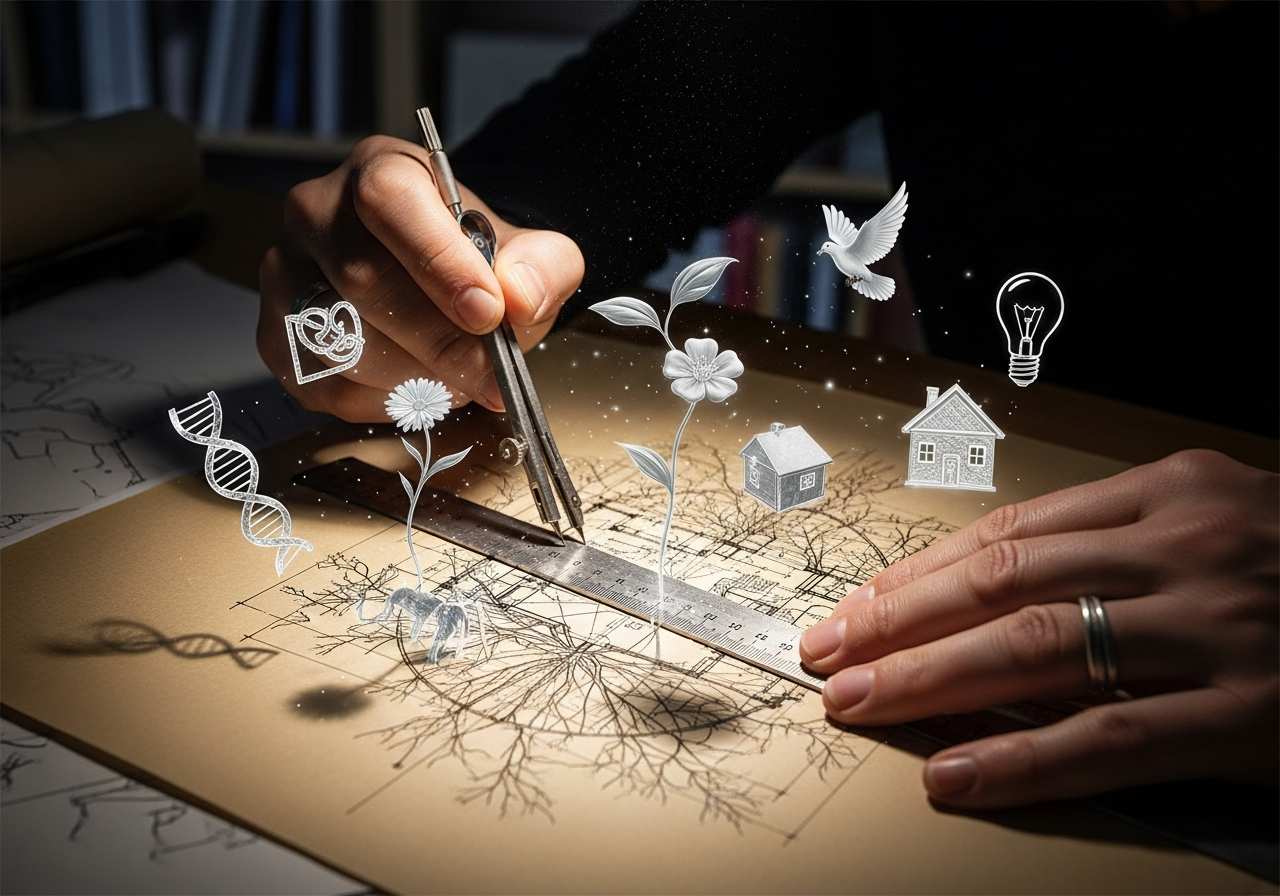
Radical Life Design: The Complete Guide to Architecting Your Ideal Existence
"Life is not something that happens to you. It's something you participate in." — Jim Carrey
Most people don't design their lives. They default into them.
They drift from school to job to relationship to house to routine, following the path of least resistance, doing what's expected, never asking if this life is actually what they want.
And then one day — maybe at 30, maybe at 50, maybe on their deathbed — they look around and wonder: How did I get here? Is this really my life?
This is the tragedy of the unexamined life: not that it's necessarily bad, but that it was never consciously chosen. It just happened.
There's another way.
Radical Life Design is the practice of stepping back from your default path, getting clear on what you actually value and want, and intentionally structuring your existence around those priorities.
It's treating your life not as something that happens to you, but as something you create.
In this comprehensive guide, you're going to learn exactly how to do it.
Part 1: Why Life Design Matters
The Default Path
The default path is the life you end up with if you never consciously choose. It's shaped by:
- Social expectations: What your family and culture tell you success looks like
- Inertia: Doing what you've always done because change is effortful
- Fear: Avoiding risk and staying in the familiar zone
- Comparison: Pursuing what others seem to value rather than what you truly want
- Busyness: Being too occupied with daily tasks to ask bigger questions
The default path isn't inherently bad. Sometimes it leads somewhere good. But if you don't examine it, you can't know if it's yours.
What Life Design Offers
When you consciously design your life, you:
Gain clarity. Instead of vague dissatisfaction, you have clear knowledge of what you want.
Make better decisions. Every choice becomes easier when you know what you're optimizing for.
Increase alignment. Your daily actions connect to your deeper values and vision.
Reduce regret. At the end, you'll know you tried to create something meaningful.
Unlock energy. Working toward what you truly want is more energizing than drifting.
Life design doesn't guarantee success or happiness. But it dramatically increases the odds that you end up somewhere you actually want to be.
Part 2: The Foundations of Life Design
Foundation 1: Self-Knowledge
You cannot design a life that fits you if you don't know who you are.
Self-knowledge includes understanding:
Your values — What matters most to you? Not what should matter, but what actually does?
If you value freedom, a highly structured corporate career will chafe no matter how much money it pays. If you value connection, solitary work will empty you regardless of its other merits.
Your strengths — What are you naturally good at? What comes easily to you but seems hard for others?
Designing your life around your strengths is far more effective than constantly fighting your weaknesses.
Your interests — What genuinely fascinates you? What would you pursue if no one was watching and no money was involved?
Your personality — Are you introverted or extroverted? Risk-tolerant or risk-averse? Spontaneous or structured?
Design a life that works with your nature, not against it.
Foundation 2: Vision
Once you know yourself, you need a vision of what you're designing toward.
Vision is not a detailed plan. It's a direction. A North Star. An image of a future that calls to you.
Questions to clarify vision:
- What does your ideal ordinary day look like in 5-10 years?
- What would you want people to say about you at your funeral?
- What accomplishments would make you deeply proud?
- What kind of person do you want to become?
- What experiences do you want to have?
Your vision will evolve over time. That's fine. You just need something to orient toward.
Foundation 3: Priorities
You cannot have everything. Life design requires choices — saying yes to some things, which means saying no to others.
Once you have vision, distill it into priorities. What are the 3-5 things that matter most?
Common priority domains:
- Family and relationships
- Career and contribution
- Health and vitality
- Financial security/freedom
- Personal growth and learning
- Creative expression
- Adventure and experience
- Service and impact
- Spirituality and inner life
Different seasons of life may emphasize different priorities. But knowing what's on top of your list right now helps you make decisions.
Part 3: The Life Design Process
Let's walk through a concrete process for designing your life.
Step 1: The Life Audit
Before designing where you're going, understand where you are.
Rate each life domain on a scale of 1-10:
- Career/Work
- Finances
- Health/Fitness
- Relationships (romantic, family, friendships)
- Personal Growth/Learning
- Fun/Recreation
- Physical Environment
- Contribution/Service
- Spiritual/Inner Life
For each low score, briefly note what's missing or wrong.
This audit shows you where the gaps are — where design intervention is most needed.
Step 2: Define Your Non-Negotiables
What are the elements that must be present in your ideal life, no matter what?
These might be:
- "I must be able to work from anywhere."
- "I need time every day for physical activity."
- "My work must have meaning beyond money."
- "I must have deep connection with a life partner."
- "I need significant time in nature."
Non-negotiables become constraints in your design. They're the things you won't compromise on.
Step 3: Create Your Ideal Day
One of the most powerful life design exercises is describing your ideal ordinary day — not a vacation or special occasion, but a regular Tuesday in your dream life.
Write a detailed description:
- What time do you wake up?
- Where are you?
- What do you do in the morning?
- What work occupies your day?
- Who do you interact with?
- What do you do for meals?
- What's your evening like?
- What time do you go to bed?
- How do you feel throughout the day?
Be specific. Include sensory details. Make it vivid.
This exercise reveals a lot about what you actually want — often things different from what you thought.
Step 4: Identify the Gaps
Compare your ideal day (and your vision) to your current reality.
Where are the biggest gaps?
Maybe your ideal day involves mornings for creative work, but currently you start with meetings at 8am. Maybe it includes living near mountains, but you're stuck in a flat urban area. Maybe it includes meaningful work, but you're in a soul-crushing job.
These gaps are your design targets.
Step 5: Design Experiments
For each major gap, design experiments — low-risk ways to test changes before fully committing.
Instead of: Quit your job to become a writer Experiment: Write for one hour each morning for three months
Instead of: Move across the country Experiment: Visit for an extended stay; work remotely for a month
Instead of: Launch a full business Experiment: Build a minimum viable product and test market response
Experiments protect you from expensive mistakes while gathering real data about what works for you.
Step 6: Build the Bridge
Between your current reality and your ideal life is a bridge that must be built piece by piece.
Some gaps can be closed immediately (rearranging your morning routine). Others take years (building a side business to replace your income).
Create a rough timeline:
- What can you change this month?
- This quarter?
- This year?
- In the next 3-5 years?
You don't need every detail. But you need direction and a sense of sequence.
Part 4: Designing Your Days
The big vision matters, but life is lived in days. If you don't design your days, you've designed nothing.
The Architecture of a Day
Your typical day needs structure. Not rigidity, but intentional design.
Morning (Foundation) How you start sets the tone. A chaotic, reactive morning creates a chaotic, reactive day. A calm, intentional morning creates the opposite.
Design a morning routine that:
- Protects you from immediate external demands
- Includes practices that center and energize you
- Sets clear intentions for the day
Core Hours (Production) During your most energized hours, do your most important work. Protect this time ruthlessly. No meetings, no email, no interruptions.
What's the one thing that, if accomplished, would make this a successful day? Do that first.
Trailing Hours (Maintenance) Handle the administrative necessities — emails, calls, logistics. These are important but should never consume prime creative time.
Evening (Recovery) Transition out of work mode. Allow genuine rest. Connect with loved ones. Prepare for sleep. The evening sets up tomorrow.
The Weekly Rhythm
Beyond days, design your week.
Maybe Mondays are for planning and meetings. Tuesdays and Wednesdays are for deep creative work. Thursdays are for communication and collaboration. Fridays are for review and administrative closure.
Different roles and work types can occupy different days, reducing the cost of context-switching.
The Three Layers
Think of your time in three layers:
Layer 1: The Essential The things that, if you don't do them, everything falls apart. Health basics. Key work. Core relationships. These get protected first.
Layer 2: The Important The things that matter for long-term thriving but can be postponed short-term. Strategic projects. Development. Relationships that need investment.
Layer 3: The Optional The things that would be nice but aren't essential. Social obligations. Nice-to-have tasks. Entertainment.
Many people fill their days with Layer 3, leaving no room for Layer 2 — and then wonder why they feel busy but unfulfilled.
Part 5: Overcoming Resistance to Life Design
You will encounter resistance. Here's how to handle the most common forms.
"I don't have time."
This is almost never true. You have the same 24 hours as everyone else. The question is how you use them.
Life design doesn't require hours of daily effort. Start with one hour per week for reflection and planning. Start with small daily adjustments. Build from there.
"I have too many obligations."
Some obligations are real. Many are assumed or self-imposed.
Examine each obligation:
- Is this truly required?
- What would happen if I said no or did less?
- Is this aligned with my priorities?
You may find more flexibility than you thought.
"I don't know what I want."
This is common — and temporary. You discover what you want through exploration, not pure thought.
Try things. Run experiments. Pay attention to what energizes and what drains you. Clarity emerges from action.
"It's too late to change."
It's not. People reinvent their lives at 30, 50, 70, even 80. The best time to plant a tree was 20 years ago. The second best time is now.
What's true is that life design gets harder with more accumulated commitments. But harder isn't impossible.
"I'm afraid of being selfish."
Designing a life that works for you is not selfish. You can only pour from a full cup. A life that drains you leaves nothing to give.
Moreover, an aligned life ripples out. When you're thriving, you're a better partner, parent, friend, and contributor.
Conclusion: Your Life, Your Design
Here is the central truth of life design:
You are creating your life whether you mean to or not.
Every day, by your choices and non-choices, you're building something. The only question is whether you're doing it consciously or by default.
Default living feels safe, but it's a form of subtle self-betrayal — handing your one precious life over to circumstance and social expectation.
Radical life design takes that power back. It says: This is my existence. I will be intentional about it. I will ask hard questions and make hard choices. I will create what I want rather than accept what I get.
This isn't arrogance. It's responsibility.
Will you succeed in creating your ideal life? Maybe not fully. There will be constraints, disappointments, external forces beyond your control.
But you will have tried. You will have aimed at something meaningful. You will have lived as the author of your story rather than a passenger.
And that — win or lose — is a life worth living.
Go design it.
Action Steps: Begin Your Life Design
Complete the Life Audit. Rate each domain of your life 1-10. Identify the biggest gaps.
Clarify your non-negotiables. What must be present in your ideal life? Write them down.
Describe your ideal day. In vivid detail, write out what your ideal ordinary day looks like.
Identify one design target. What's one major gap you want to close? Focus there.
Design an experiment. What's a low-risk way to test moving toward your ideal?
Redesign your morning. Start with the first hour of each day. Make it intentional.
Your life won't design itself. Take the first step today.