
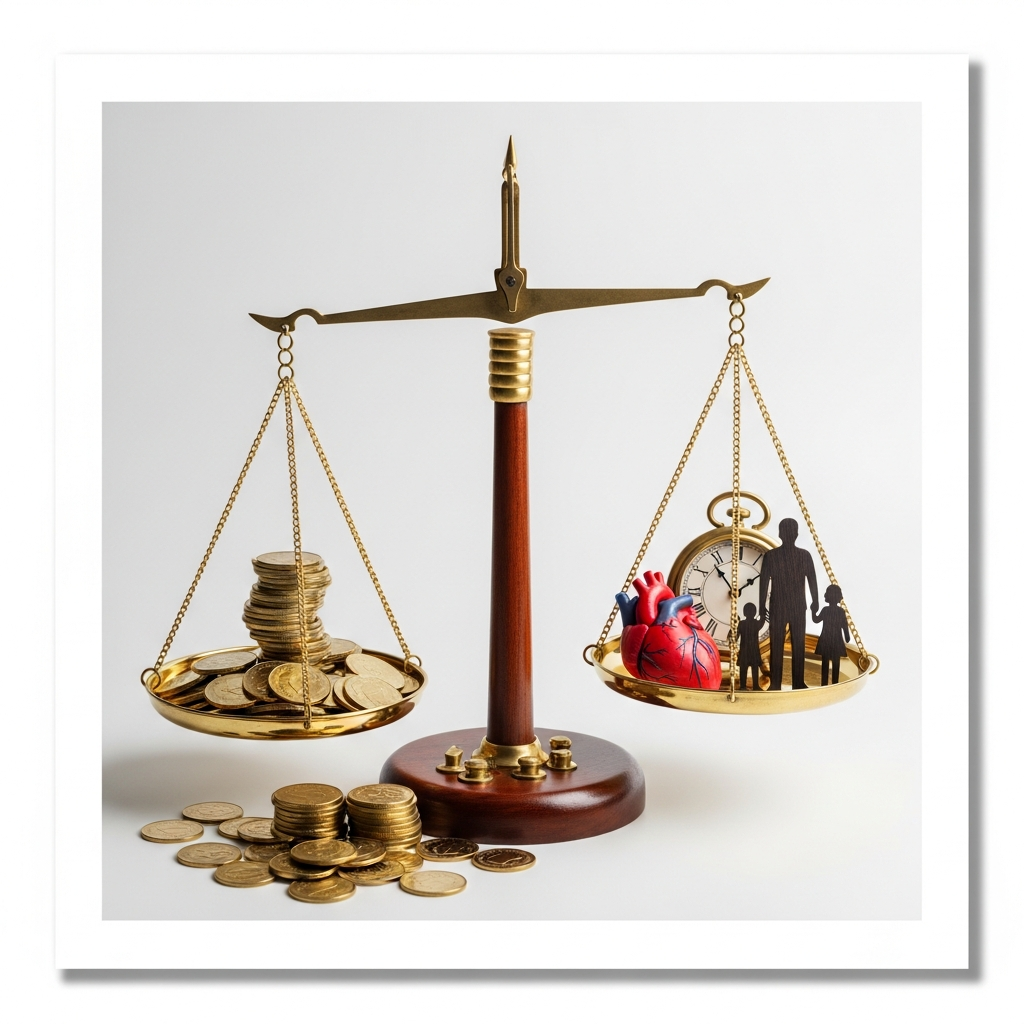
Your Money Your Life: The Complete Guide to Financial Freedom and Life Values
"We buy things we don't need with money we don't have to impress people we don't like." — Dave Ramsey
Let me ask you a question that might change how you think about everything:
When you go to work, what are you really selling?
You might say you're selling your skills, your expertise, your labor. And technically, that's true. But at a deeper level, what you're selling is far more precious than any of those things.
You're selling your life.
Every hour you spend at work is an hour of your one and only existence on this planet. An hour you could have spent with your family, exploring the world, pursuing your passions, or simply sitting in peace. You traded that hour — that piece of your life — for money.
This isn't an argument against work. Work can be meaningful, fulfilling, and essential. But it is an invitation to wake up to the profound transaction you're making every single day and to ask yourself: Am I getting a good deal?
Welcome to the true economics of life.
Part 1: Rethinking Wealth — What Financial Freedom Actually Means
Most people have a distorted relationship with money. They either worship it as the path to all happiness or demonize it as the root of all evil. Both perspectives are wrong and destructive.
The Money Trap: Why More Is Never Enough
Here's a paradox almost everyone experiences: You get a raise, and within a few months, you feel exactly as financially stressed as before. You upgrade your car, your apartment, your lifestyle — and your expenses magically rise to meet (or exceed) your new income.
This is called lifestyle inflation, and it's the silent killer of financial wellbeing.
The hedonic treadmill — the psychological phenomenon where we quickly adapt to improvements in our circumstances — means that more money rarely leads to more satisfaction. Studies consistently show that beyond a certain threshold (roughly $75,000-$100,000 in the United States, adjusted for cost of living), additional income has sharply diminishing returns on daily happiness.
Yet we keep chasing more. Why?
Because we've internalized a false equation: More money = Better life.
But what if the equation is wrong? What if what we actually want isn't money at all, but what we think money will bring us?
What We Really Want (It's Not Money)
When you dig beneath the surface, you realize that money is never the end goal. It's always a means to something else. We want money because we believe it will give us:
- Security: The peace of knowing we're safe and provided for
- Freedom: The ability to do what we want, when we want
- Status: The feeling of being respected and admired
- Experience: The capacity to explore, enjoy, and grow
- Connection: The resources to spend quality time with loved ones
These are the true currencies of a rich life. Money is just one path to them — and often not the most efficient one.
The Real Definition of Financial Freedom
Financial freedom is not having a million dollars in the bank (though that's nice). Financial freedom is when your passive income exceeds your expenses — when you no longer need to trade your time for money.
But let's go even deeper. Ultimate financial freedom is when your relationship with money no longer causes you stress, anxiety, or distraction. It's when money becomes a tool that serves your life values, rather than a master that dictates them.
This is what it means to truly have your money serve your life.
Part 2: The Life-Energy Equation — Understanding the True Cost of Things
Here's a framework that will transform how you think about every financial decision: the Life-Energy Equation.
What Is Life Energy?
Life energy is the time and vitality you exchange for money. When you work, you're not just spending hours — you're spending a portion of your limited life.
To calculate your true hourly wage, you need to account for more than just the money you receive. You also need to account for:
- Commute time: How long does it take to get to and from work?
- Preparation time: How long does it take to get ready, decompress, etc.?
- Work-related expenses: Clothes, meals, transportation, childcare, etc.
- Recovery time: How much time do you need to rest after work?
Let's say your official salary works out to $50 per hour. But when you factor in the hour commute each way, the 30 minutes of preparation, the expensive work clothes, the stress-recovery drinks, and the exhaustion that makes you useless for your own projects — your true hourly wage might be closer to $25 or even $15.
Evaluating Purchases in Life Energy
Once you know your true hourly wage, you can evaluate every purchase in terms of life energy.
That $300 pair of shoes? If your true wage is $20/hour, that's 15 hours of your life.
That $30,000 car upgrade? That's 1,500 hours — or roughly nine months of full-time work.
Suddenly, purchases look very different. The question is no longer "Can I afford this?" but rather "Is this worth this many hours of my one and only life?"
This is what it means to treat your money as your life.
Part 3: Aligning Finances with Values — The Heart of a Rich Life
Once you've awakened to the life-energy equation, the next step is to align your spending and saving with your deepest values.
The Value Audit: Where Does Your Money Actually Go?
Most people have no idea where their money goes. They earn, they spend, they wonder why there's nothing left. This unconsciousness is the enemy of financial freedom.
The first step is radical awareness. For one month, track every single expense. Use an app, a spreadsheet, or a notebook — whatever works for you. At the end of the month, categorize your spending and add it all up.
Then ask yourself: Does this align with my values?
If you claim family is your highest priority but you're spending more on takeout coffee than on family experiences, there's a misalignment. If you say health is important but you're spending nothing on quality food or fitness, there's a gap between what you say and what you do.
Your spending is the truest reflection of your actual values. It doesn't lie.
Conscious Spending: The "Satisfier" Approach
Not all spending is equal. Some purchases genuinely enhance your life. Others are just habitual or driven by social pressure.
In their classic book "Your Money or Your Life," Vicki Robin and Joe Dominguez introduce the idea of evaluating each expense by asking: Did this expenditure bring me fulfillment proportional to the life energy I exchanged for it?
You might discover that your expensive gym membership brings enormous value because it supports your health and sanity. Great — keep it or even upgrade.
You might also discover that your monthly subscription boxes bring only a brief spike of excitement followed by buyer's remorse. Cut them.
This isn't about deprivation. It's about maximizing fulfillment per unit of life energy spent. You can even spend extravagantly — but only on the things that genuinely matter to you.
The Frugality Mindset: More Life, Not Less Stuff
There's a misconception that frugality means deprivation. In reality, intelligent frugality is about trading less valuable things for more valuable things.
When you stop spending money on stuff that doesn't fulfill you, you:
- Need to earn less to cover your expenses
- Can save and invest more
- Move faster toward financial independence
- Have more time for what actually matters
The frugal person isn't suffering. They're liberated. They've opted out of the consumerist treadmill and reclaimed their life.
Part 4: Building Wealth That Serves Your Life
Now let's talk about the other side: how to build wealth in a way that supports your values.
Save the Gap: The Fundamental Wealth Equation
Wealth accumulation is simple (though not easy):
Wealth = Income - Expenses, invested over time.
You can increase wealth by:
- Increasing your income
- Decreasing your expenses
- Increasing the return on your investments
- Extending the time horizon
Most people focus only on #1 (earning more), which is important but limited. The truly wealthy understand that #2 (spending less) is often the more powerful lever. A dollar saved is a dollar freed from taxation that can compound forever.
The Emergency Fund: Buying Your Peace of Mind
Before you invest a single dollar, you need an emergency fund — typically 3-6 months of living expenses in a boring, accessible savings account.
This isn't about getting a good return. It's about security. When you know you can handle a job loss, a medical emergency, or a car breakdown without going into debt, your entire relationship with life changes. You take more strategic risks. You negotiate from strength. You sleep better at night.
This is the foundation of financial freedom.
Investing for Freedom: The Simple Path
For most people, investing should be boring. The evidence is overwhelming: the vast majority of investors are better off putting their money in low-cost, diversified index funds and leaving it there for decades.
This approach won't make you rich overnight. But combined with a high savings rate and enough time, it will almost certainly make you financially independent.
The details of investing are beyond the scope of this article, but the principle is simple: automate your savings, invest in low-cost index funds, and don't touch it until you retire or achieve financial independence.
Part 5: Productivity, Income, and Your Life
Let's talk about the earning side. How do you increase your income without sacrificing your life?
The Productivity Trap: Busy vs. Effective
Our culture worships productivity. We celebrate the "hustle," the 80-hour work weeks, the "rise and grind" mentality.
But here's the uncomfortable truth: Most "productive" people are just busy. They're doing a lot of things, but not necessarily the right things.
True productivity is not about doing more. It's about doing what matters most. It's about identifying the 20% of activities that generate 80% of your results and ruthlessly focusing on those while eliminating or delegating the rest.
This is the difference between being busy and being effective. And it has profound implications for your income.
Increasing Your Earning Power
There are fundamentally two ways to earn more:
Trade more time for money: Work more hours. This has a hard ceiling (24 hours in a day) and usually leads to burnout.
Increase the value of your time: Develop skills that are rare and valuable. Position yourself where your contributions have maximum leverage. Negotiate better. Build assets that earn while you sleep.
The second path is harder but far more rewarding. It's the path of the craftsman, the entrepreneur, the investor.
Ask yourself: What can I do today to make my hour worth more tomorrow?
The Income Side-Effects
There's a point where higher income becomes counterproductive. The hours you work have a cost that goes beyond the direct time.
- Health: Chronic overwork destroys your physical and mental health.
- Relationships: Time not spent with loved ones is connection you'll never get back.
- Purpose: If your work doesn't align with your values, no salary can compensate for the emptiness.
The goal is not maximum income. The goal is optimal income — enough to fund your desired lifestyle and savings rate, without sacrificing the things that money can't buy.
Part 6: Living Your Rich Life
So how does all of this come together? What does a truly rich life look like?
Define Your "Enough"
One of the most important exercises you can do is defining your "enough." How much is enough money? How big is enough house? How much is enough stuff?
Without this definition, you'll always be chasing more. With it, you have a clear finish line — a point where you can say "I've won" and stop sacrificing your life for marginal gains.
Your "enough" should be based on your values, not on what advertising or your neighbors tell you is normal. Some people's enough is a mansion; others' is a tiny house. Both are valid if they're consciously chosen.
The Rich Life Is Not Just Financial
A rich life includes:
- Time wealth: Having enough free time to enjoy yourself, learn, and connect with loved ones.
- Relationship wealth: Deep, nourishing connections with family and friends.
- Health wealth: A body and mind that support your goals and pleasures.
- Purpose wealth: A sense of meaning and contribution.
Money is one ingredient, not the whole recipe. The richest people I know are not necessarily the ones with the biggest bank accounts. They're the ones who have mastered the art of alignment — where their finances, time, relationships, and purpose all support each other.
Work You Love (Or At Least Tolerate)
If you're going to spend a third of your life working, it better be worth it.
For some people, this means finding work they genuinely love — a calling that they'd do for free. For others, it means finding work that's tolerable and that funds a life they love outside of work. Both approaches are valid.
What's not valid is suffering through soul-crushing work for decades, telling yourself you'll "live later" when you retire. Too many people never make it to that "later." And even those who do often find they've forgotten how to live.
Your life is now. Don't wait.
Conclusion: Your Money, Your Life, Your Choice
Here's the fundamental message of this entire guide:
Money is a tool. Your life is the project.
When you understand this deeply, your entire relationship with money transforms. You stop chasing money for its own sake. You stop measuring your worth by your net worth. You stop trading your precious life energy for things you don't need and don't even really want.
Instead, you use money intentionally — as a means to security, freedom, experience, and connection. You build wealth not to hoard it, but to liberate yourself. You work not to escape life, but to enhance it.
This is what it means to have your money serve your life.
It's not easy. It requires waking up from the trance of consumer culture. It requires radical honesty about what you actually value. It requires discipline and patience over years and decades.
But the reward is nothing less than your life back. A life where money is no longer a source of anxiety, but a source of freedom. A life where your daily actions align with your deepest values. A life that, at the end, you can look back on with satisfaction rather than regret.
That life is possible. And it starts with a choice — the choice to take your money and your life seriously.
Make that choice today.
Action Steps: Take Control of Your Finances Today
Calculate your true hourly wage. Factor in all the hidden costs of your job. Be honest.
Track every expense for one month. Use an app or spreadsheet. Radical awareness is the starting point.
Define your "enough." What does a satisfying, meaningful life look like for you? What does it cost?
Conduct a spending audit. Compare your actual spending to your stated values. Where are the gaps?
Start automating your savings. Even 10% of your income, invested consistently, will compound into something significant.
Ask the big question: "Is my current path leading toward the rich life I actually want? If not, what needs to change?"
Your money. Your life. Your choice.