
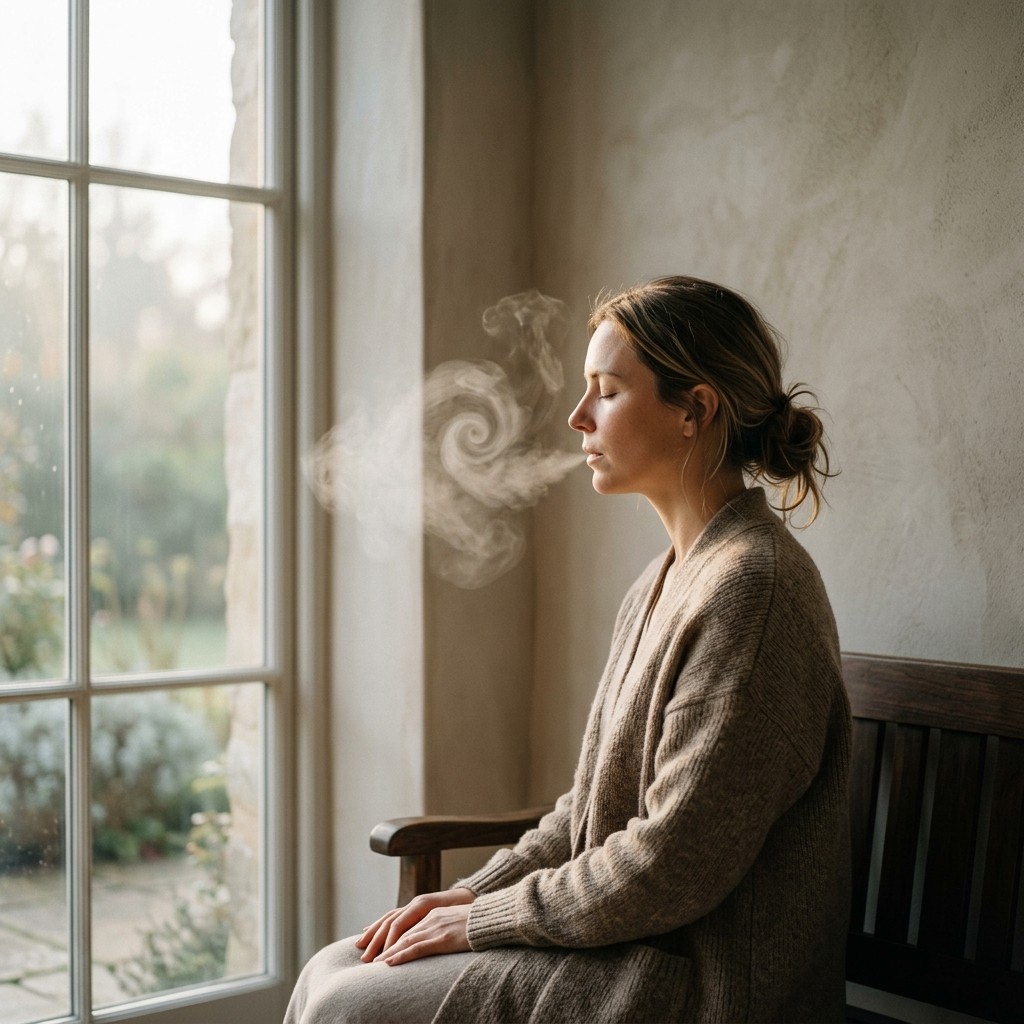
"Breath is the bridge which connects life to consciousness, which unites your body to your thoughts." — Thich Nhat Hanh
Right now, as you read this sentence, you are breathing. You weren't thinking about it a moment ago — your brainstem was handling it automatically, as it has every minute of your life since birth. But the instant your attention landed on it, you gained the option to take over. You could slow it down. Speed it up. Hold it. Make it deep or shallow.
This is something genuinely extraordinary, and most people walk past it their whole lives without noticing. Breathing is the only major autonomic function you can seamlessly switch between automatic and manual control. Your heartbeat runs without you. Your digestion runs without you. Your hormone release, your immune response, your blood pressure — all of it hums along beneath conscious awareness. But breathing has a manual override. And because breathing is wired directly into the systems that govern your stress response, your alertness, and your emotional state, that override is nothing less than a control panel for your entire nervous system.
This is not mysticism. It's physiology, and it has become one of the most actively researched areas in modern neuroscience. Stanford's Andrew Huberman has studied the neural circuitry of breathing. Stanford's Jack Feldman, one of the world's leading respiratory neuroscientists, has spent decades mapping the brainstem circuits that generate and modulate breath. Their work, along with that of many others, has confirmed what contemplative traditions intuited thousands of years ago: how you breathe changes how you feel, think, and perform — in real time, and in ways you can learn to direct.
In this guide, you'll learn the actual science of why breathing controls your state, and you'll walk away with a toolkit of specific, evidence-based protocols. One to calm down fast. One to sharpen focus. One to fall asleep. One to brace under pressure. By the end, you'll understand that the most powerful self-regulation tool you own is one you carry everywhere and pay nothing to use.
Part 1: Why Breathing Controls Your Nervous System
The Two-Way Street Between Breath and Brain
The conventional view of breathing is that it's a passive output — your body decides how stressed or calm it is, and your breathing simply reflects that. Stressed? You breathe fast and shallow. Relaxed? You breathe slow and deep.
That's true, but it's only half the picture. The relationship runs in both directions. Your breathing doesn't just reflect your state — it sets your state. Breathe fast and shallow on purpose, and you can push yourself toward anxiety and alertness. Breathe slow and deep on purpose, and you can pull yourself toward calm. The breath is both a readout of your nervous system and a control input into it.
This bidirectional link exists because of how your nervous system is wired. Your autonomic nervous system has two branches that work in dynamic balance. The sympathetic branch drives "fight or flight" — it raises heart rate, sharpens alertness, mobilizes energy, and prepares you for action. The parasympathetic branch drives "rest and digest" — it slows the heart, promotes recovery, calms the mind. At any moment, your physiology reflects the balance between these two.
Breathing is plugged directly into this system. And the crucial fact is this: inhalation tends to activate the sympathetic branch, and exhalation tends to activate the parasympathetic branch. When you inhale, your heart rate slightly speeds up. When you exhale, it slightly slows down. You can feel this yourself if you place a hand on your chest and breathe slowly — heart rate rises on the in-breath, falls on the out-breath. This phenomenon is called respiratory sinus arrhythmia, and it's the mechanical link that lets you dial your nervous system up or down through the simple ratio of how you breathe.
The practical principle that falls out of this is beautifully simple and worth memorizing: to calm down, emphasize the exhale. To energize and alert, emphasize the inhale. Almost every breathing protocol you'll ever encounter is a variation on this single lever.
The Vagus Nerve: Your Body's Brake Pedal
The main highway of the parasympathetic system is the vagus nerve, a sprawling nerve that wanders from your brainstem down through your chest and abdomen, connecting your brain to your heart, lungs, and gut. It is, in a sense, the brake pedal of your nervous system — when it's active, it slows the heart and promotes the calm, recovery-oriented state.
Slow, deep breathing — especially with extended exhales — stimulates the vagus nerve. Researchers measure the strength of this calming influence through "heart rate variability" (HRV), the subtle variation in time between heartbeats. Higher HRV generally indicates a flexible, resilient, well-regulated nervous system with strong vagal tone. And one of the most reliable ways to increase HRV in the moment is slow breathing at around five to six breaths per minute — far slower than the typical resting rate of twelve to twenty.
Studies of slow-paced breathing, including research summarized in reviews published in journals such as Frontiers in Human Neuroscience, have associated this practice with increased vagal activity, improved HRV, reduced anxiety, and lower blood pressure. The consistency of these findings is part of why breathwork has moved from the yoga studio into clinical and athletic settings.
A Brainstem Cluster That Watches You Breathe
There's a deeper layer to this story, and it's one of the more striking discoveries in respiratory neuroscience. In your brainstem sits a small cluster of neurons called the pre-Bötzinger complex — discovered and studied extensively by Jack Feldman's lab — which acts as the pacemaker that generates the rhythm of your breathing.
What researchers found is that this breathing pacemaker has a direct neural connection to a region of the brainstem (the locus coeruleus) that governs arousal, alertness, and even emotional state. In studies of mice, when scientists silenced a small subset of neurons in this breathing-control area, the animals didn't stop breathing — but they became remarkably calm and relaxed. The link between the breathing rhythm and the arousal center had been cut, and the calming followed.
The implication for you is profound. There is a hardwired, physical circuit connecting the pace of your breath to the level of your arousal and the tenor of your emotions. When you deliberately slow and smooth your breathing, you are sending a signal up that very circuit, telling your arousal system to stand down. This isn't placebo. It's anatomy.
The Carbon Dioxide Connection
There's one more piece of physiology worth understanding, because it dispels a common misconception and explains a great deal about why breathing affects how you feel. Most people assume that the urge to breathe is driven by a need for oxygen. In fact, the primary driver of your breathing is the level of carbon dioxide in your blood. As CO2 rises, sensors in your brainstem and blood vessels register it and create the urge to breathe; the feeling of "air hunger" or breathlessness is largely a CO2 signal, not an oxygen one.
This matters because your tolerance for carbon dioxide is closely linked to your sense of calm or panic. People with a low tolerance for CO2 — who feel the urge to breathe and a sense of suffocation at relatively low levels — tend to be more prone to anxiety and panic, because the same brain regions are involved. The encouraging news is that CO2 tolerance is trainable. Slow breathing practices and certain breath-holds gradually raise your tolerance, which can translate into a calmer baseline and greater resilience to the physical sensations that trigger anxiety. It's another reason that the slow, controlled breathing protocols below do more than soothe you in the moment — practiced regularly, they recalibrate the very chemistry that determines how easily you tip into stress.
Part 2: The Core Breathing Protocols
Now we get practical. Each of the following protocols targets a specific state, and each is grounded in the physiology you just learned. Master a few of these and you'll have a reliable tool for nearly any situation life throws at you.
Protocol One: The Physiological Sigh (Fastest Way to Calm Down)
If you learn only one technique from this entire guide, make it this one. The physiological sigh is the fastest known method to reduce stress and acute anxiety in real time — often within a single breath or two.
It's not a trick someone invented. It's a built-in mechanism your body already does spontaneously — when you cry, when you're falling asleep, when you sob and your breathing settles afterward in those characteristic double-inhale gasps. Researchers identified the physiology behind it, and the work of Huberman's lab at Stanford, in collaboration with David Spiegel, studied its effects when done deliberately.
How to do it:
- Take a full inhale through your nose.
- At the top of that inhale, take a second, sharp, smaller inhale through your nose — sipping in a bit more air to maximally inflate the lungs.
- Then slowly, fully exhale all the air out through your mouth.
That's one physiological sigh. Repeat it one to three times and you'll typically feel a noticeable drop in stress.
Why it works: Your lungs are filled with hundreds of millions of tiny air sacs called alveoli. Under stress, many of them collapse, which causes carbon dioxide to build up in your blood — and rising CO2 is itself a driver of the feeling of anxiety and air hunger. The double inhale re-inflates those collapsed sacs, and the long, full exhale offloads the accumulated carbon dioxide efficiently. The extended exhale also engages the parasympathetic brake. In one published study, a daily five-minute practice of cyclic sighing produced greater improvements in mood and reductions in anxiety than equivalent time spent in mindfulness meditation — a remarkable result for such a simple technique.
Use it the moment you feel a spike of stress: before a difficult conversation, when anxiety surges, when you feel overwhelmed. It's discreet, it's instant, and it works.
Protocol Two: Box Breathing (For Steady Calm and Focus)
Box breathing, sometimes called square breathing, is a balanced technique famously used by Navy SEALs and elite performers to stay calm and clear under pressure. Where the physiological sigh is a fast reset, box breathing is a sustained practice that builds steady, focused composure.
How to do it:
- Inhale through your nose for a count of four.
- Hold your breath for a count of four.
- Exhale through your mouth or nose for a count of four.
- Hold the empty lungs for a count of four.
- Repeat for several minutes.
The "box" is the equal four-sided structure: in, hold, out, hold. You can adjust the count to a length that's comfortable — some people prefer three or five — but keep all four sides equal.
Why it works: The deliberate, slow, equal pattern brings your breathing rate down toward the calming five-or-six-breaths-per-minute range, engaging the parasympathetic system. The breath holds add a layer of focus and present-moment attention — you can't ruminate about the future while counting through a hold. The structure itself is grounding. Box breathing is ideal before a high-stakes performance, in moments of mounting pressure, or as a daily practice to build baseline composure.
Protocol Three: Extended Exhale Breathing (For Deep Relaxation and Sleep)
When the goal is to wind down — to relax deeply or to fall asleep — you want to maximally tilt the balance toward the parasympathetic system. Since the exhale is the parasympathetic lever, you do that by making your exhales distinctly longer than your inhales.
How to do it:
- Inhale gently through your nose for a count of four.
- Exhale slowly through your nose or pursed lips for a count of six to eight.
- Keep the breathing smooth and unforced. Repeat for five to ten minutes.
A popular variation is the 4-7-8 technique popularized by Dr. Andrew Weil: inhale for four, hold for seven, exhale for eight. The long exhale is the active ingredient. Don't worry about hitting exact counts — the principle is simply make the exhale longer than the inhale. A 1:2 ratio of inhale to exhale is a reliable target for relaxation.
Why it works: The extended exhale maximizes vagal activation and the slowing of heart rate that comes with each out-breath. Done lying in bed, it shifts your physiology decisively toward rest and makes the descent into sleep far easier. It's also excellent for de-escalating after a stressful day, before the wind-down period of your evening.
Protocol Four: Cyclic Hyperventilation (For Energy and Alertness)
Not all breathwork is about calming down. Sometimes you need the opposite — a surge of alertness and energy without caffeine. For this, you emphasize the inhale and increase the pace, deliberately activating the sympathetic system. This is the principle behind methods popularized by Wim Hof and rooted in older pranayama practices like "breath of fire."
How to do it (one common form):
- Take 25 to 30 deep, full breaths in fairly rapid succession — a strong inhale, a passive, relaxed exhale, almost like the body is "letting go" on the out-breath rather than forcing it.
- After the final exhale, let the breath out and hold with empty lungs for as long as is comfortable.
- Then take a deep recovery breath and hold for about fifteen seconds.
- Repeat for a few rounds.
Why it works: The rapid deep breathing increases sympathetic activation and releases adrenaline, producing a wave of alertness, energy, and often a tingling or buoyant feeling. Wim Hof's method has been the subject of research — including a study in PNAS in which trained practitioners were able to voluntarily influence their autonomic nervous system and immune response, something previously thought impossible — though it's worth being measured about the broader claims.
An important safety note: This technique can cause lightheadedness and even fainting because of the changes it produces in blood chemistry. Never practice it while standing, in or near water, while driving, or anywhere a brief loss of consciousness could cause harm. Always do it seated or lying down, in a safe place. Treat it with respect. For everyday energy, a few minutes of brisk movement is often a gentler choice.
Part 3: Beyond the Acute — How Daily Breathing Patterns Shape Your Life
The Hidden Cost of Chronic Over-Breathing
The protocols above are tools for specific moments. But there's a deeper layer to breath science concerning how you breathe all day, every day — your default pattern. And here, modern life has quietly created a widespread problem.
Many people are chronic over-breathers. They breathe too fast, too shallow, through the mouth, and from the chest rather than the belly. This pattern keeps the sympathetic nervous system subtly elevated and disrupts the delicate balance of oxygen and carbon dioxide in the blood. Counterintuitively, over-breathing doesn't get more oxygen into your tissues — by blowing off too much carbon dioxide, it actually impairs the release of oxygen from your blood into your cells, a relationship known as the Bohr effect.
The journalist James Nestor, in his widely read book Breath, surveyed both modern research and historical practices and made a compelling case that the way most people in industrialized societies breathe is suboptimal — and quietly contributing to fatigue, anxiety, poor sleep, and other ills. His central, recurring themes: breathe through your nose, breathe slowly, and breathe less than you think you need to.
The Case for Nasal Breathing
One of the most actionable takeaways from breath science is the simple injunction to breathe through your nose, not your mouth, as your default — during the day, during exercise where possible, and especially during sleep.
Your nose is not just a passageway; it's a sophisticated air-conditioning and filtration system. It warms, humidifies, and filters incoming air. Critically, the nasal passages produce nitric oxide, a molecule that helps dilate blood vessels and improves the efficiency of oxygen uptake in the lungs. Nasal breathing also naturally slows your breathing rate and encourages the deeper, diaphragmatic pattern that supports parasympathetic balance.
Mouth breathing, by contrast, bypasses all of these benefits, tends to be faster and shallower, dries out the airway, and is associated with poorer sleep quality and disrupted breathing during the night. If you wake up with a dry mouth or know you snore, your daytime and nighttime breathing pattern is worth attention.
Diaphragmatic Breathing: Breathe From the Belly
The other foundational habit is breathing from your diaphragm — the large dome-shaped muscle beneath your lungs — rather than from your upper chest. When you breathe diaphragmatically, your belly expands on the inhale and falls on the exhale, your lower lungs fill fully (where blood flow is richest), and the gentle movement of the diaphragm itself helps stimulate the vagus nerve.
Chest breathing, by contrast, is the shallow, anxious pattern your body defaults to under stress. The problem is that for many people, stress breathing has become their everyday breathing — a chronic state that signals "low-grade emergency" to the nervous system around the clock.
To practice diaphragmatic breathing: Lie down and place one hand on your chest and one on your belly. Breathe so that the hand on your belly rises while the hand on your chest stays relatively still. The inhale fills you from the bottom up. Practice this for a few minutes daily until belly breathing becomes your unconscious default.
Part 4: Building Your Personal Breath Practice
Matching the Tool to the Moment
You now have a toolkit. The art is in deploying the right tool at the right time. Here's a simple map:
When you feel a sudden spike of stress or anxiety: One to three physiological sighs. Fastest reset available.
When you need to stay calm and focused under sustained pressure: Box breathing for several minutes. Steady composure.
When you want to wind down, relax deeply, or fall asleep: Extended exhale breathing or 4-7-8. Tilt hard toward the parasympathetic.
When you need energy and alertness: Cyclic hyperventilation — but only in a safe, seated, or lying position. Or a gentler approach of brisk movement.
As an everyday foundation: Nasal breathing and diaphragmatic breathing as your defaults, plus a few minutes of slow breathing daily to build vagal tone.
A Daily Five-Minute Practice
Beyond using breath reactively in stressful moments, there's real value in a short daily practice that builds your baseline. The research on slow breathing suggests that regular practice strengthens vagal tone and HRV over time, raising your resilience so you're starting from a calmer, more regulated place to begin with.
A simple daily protocol:
- Sit comfortably with a straight spine.
- Breathe through your nose, from your diaphragm.
- Slow your pace to roughly five to six breaths per minute — about a five-second inhale and a five-second exhale, or with a slightly longer exhale.
- Continue for five minutes, letting your attention rest on the sensation of the breath.
Done daily, this trains both your nervous system and your attention. It's a small investment with compounding returns.
The Attention Bonus
There's one more benefit worth naming. Breath practice is, at its core, a form of attention training. To follow your breath, you have to keep bringing your wandering mind back to a single object — the same skill at the heart of mindfulness meditation. Every time you do, you're strengthening the neural circuits of focus and self-regulation. So a breathing practice gives you two gifts at once: a regulated nervous system, and a more disciplined, present mind.
This is why breath sits at the center of so many contemplative traditions across human history. Long before anyone could measure HRV or image the pre-Bötzinger complex, practitioners discovered through direct experience that the breath was the doorway to the mind and the body alike. Modern science has simply caught up to confirm what they knew: the breath is the one lever you can always reach for, and it moves your entire inner world.
Breath as an Anchor for Emotional Regulation
There's a deeper reason the breath is such a uniquely powerful tool for managing your emotional life, and it has to do with the nature of emotion itself. Emotions are not purely mental events floating in your head — they are deeply embodied, expressed through and partly constituted by your physiology, including your breathing pattern. Fear has a breath signature. So do anger, calm, and joy. Because the relationship runs both ways, you can reach into an emotional state and shift it by changing the breathing that accompanies it.
This gives you a remarkable degree of agency over your inner experience. When a wave of difficult emotion arises — anger flaring in an argument, anxiety mounting before a deadline, grief washing over you — you cannot simply decide to feel differently. But you can change how you breathe, and in doing so, you can influence the physiological substrate of the emotion, taking some of the charge out of it and creating space to respond rather than react. The breath becomes an anchor: a stable point you can always return to in the midst of emotional turbulence, a way of staying present and regulated when your mind wants to spin out. Practiced over time, this turns the breath into something like an emotional steering mechanism — not a way to suppress or deny what you feel, but a way to meet it with steadiness and choose your response with more freedom.
Conclusion: The Tool You Always Have
In a world of expensive wellness gadgets, supplements, and apps, it's easy to overlook the most powerful self-regulation tool you own — the one you've had since your first breath and will keep until your last. It requires no equipment, no subscription, no special place. It works in a board meeting, a hospital waiting room, a traffic jam, a sleepless 3 a.m. It is silent, instant, and free.
What changes everything is moving from breathing unconsciously to breathing with intention. Most people let their breath be dictated by their state — anxious mind, anxious breath, in a spiral that feeds itself. You now know how to reverse the flow: to use the breath to dictate the state. To calm yourself when you're activated. To sharpen yourself when you're dull. To soothe yourself into sleep. To steady yourself under fire.
This is the breathing edge. Not a technique you'll use once and forget, but a lifelong relationship with the one autonomic function you can command. Take the controls. The dial has been in your hands all along.
Breathe on purpose, and watch how much of your inner life comes within reach.
Action Steps: Master Your Breath
Learn the physiological sigh first. Practice the double-inhale, long-exhale a few times now so it's automatic when you need it. Use it the next time you feel a spike of stress.
Switch to nasal breathing as your default. Throughout the day, catch yourself mouth-breathing and switch to your nose. Consider it for light exercise and, if you tend to mouth-breathe at night, look into it as a sleep issue.
Build a five-minute daily slow-breathing practice. Sit, breathe diaphragmatically through your nose at about six breaths per minute, and let your attention rest on the breath. Do it daily for two weeks and notice the shift in your baseline.
Use extended-exhale breathing for sleep. When you get into bed, do five to ten minutes of 4-7-8 or simple longer-exhale breathing to ease the descent into sleep.
Keep box breathing ready for pressure. Before any high-stakes moment, run a few minutes of equal-count box breathing to arrive calm and clear.
Practice diaphragmatic breathing until it's automatic. Spend a few minutes daily, hand on belly, retraining your default breath to come from the diaphragm rather than the chest.
Respect the safety rules. If you explore energizing cyclic hyperventilation, do it only seated or lying down in a safe place — never near water, while driving, or standing.
Your nervous system is listening to every breath. Start sending it the signals you choose.