

"Becoming a manager is a profound psychological adjustment, a transformation." (Linda A. Hill, Becoming a Manager)
Here is a statistic that should change how you think about the most common promotion in working life.
After analyzing engagement data from 2.7 million employees across more than 100,000 teams, Gallup concluded that managers account for at least 70% of the variance in team engagement. Not company culture. Not pay. Not perks. The single person sitting one rung above you explains the majority of the difference between a team that's thriving and a team that's quietly checked out.
Now hold that next to a second, quieter statistic. The same body of research on first-time managers finds that nearly 44% of new managers feel unprepared for the role, and the overwhelming majority wish they'd received more training before they were handed it.
Put those two facts together and you arrive at the central paradox of becoming a manager: it is one of the highest-leverage roles in any organization, and one of the least prepared-for. Most people are promoted into it for being excellent at a completely different job, and then left to figure out the actual work by trial and error.
This guide is an attempt to shorten that trial-and-error period. It draws on the people who have studied this transition most carefully, Harvard's Linda Hill, who spent years following new managers through their first year; executive coach Marshall Goldsmith; Facebook's youngest design VP, Julie Zhuo; Intel's legendary Andy Grove; Kim Scott of Radical Candor; and the data scientists inside Google who reverse-engineered what their best managers actually do. The throughline across all of them is the same, and it is worth saying plainly at the start:
What made you a great team member is not what will make you a great team leader. In fact, some of it will actively get in your way.
Part 1: The Great Misconception
Most people walk into management carrying a fundamentally wrong mental model of what the job is. They imagine the promotion as a reward: more authority, more autonomy, more control. The reality is almost the opposite.
Linda Hill of Harvard Business School spent years studying new managers in real time, watching them stumble through their first year, and published the definitive account in Becoming a Manager. Her central finding is counterintuitive and, for many, deflating: new managers expect the role to bring greater power and independence, but it actually makes them more dependent on others, not less. You no longer deliver through your own effort. You deliver through your team. And the formal authority you imagined came with the title turns out to be far weaker than the authority that has to be earned.
As Hill puts it in her HBR article "Becoming the Boss," new managers must learn that "power derives from credibility with subordinates" rather than from the position on the org chart. The badge gets you the office. It does not get you the followership.
This is where Marshall Goldsmith's famous title lands like a hammer: What Got You Here Won't Get You There. Goldsmith, who has coached more Fortune 500 CEOs than almost anyone alive, observed that the behaviors that earn you a promotion (being the smartest in the room, having the answers, out-executing everyone) become liabilities at the next level. His one-line distillation of the manager's required shift is worth taping to your monitor:
"Successful people become great leaders when they learn to shift the focus from themselves to others." (Marshall Goldsmith)
Goldsmith also names a trap that catches the newly powerful with eerie precision:
"The higher you go in an organization, the more your suggestions become interpreted as orders. Getting praise can be dangerous because it becomes easy to delude yourself when all you hear are positive things." (Marshall Goldsmith)
Read that twice. The moment you become the boss, your offhand "maybe we should try X" stops being a suggestion and becomes a directive that twelve people reshuffle their week around. Your relationship to your own words changes overnight, and most new managers don't notice until they've accidentally steamrolled their team three times.
Peter Drucker drew the cleanest line between the two jobs decades ago:
"Management is doing things right; leadership is doing the right things." (Peter F. Drucker)
As an individual contributor, you were paid to do things right, to execute with excellence. As a manager, you are increasingly paid to ensure the right things are being done, by other people, to a standard you may no longer personally control. That is a different job. Not a bigger version of the old one. A different one.

Part 2: From Doer to Multiplier: The Identity Shift
If there is one mental reframe that separates managers who thrive from managers who burn out, it is this: your output is no longer your own.
Andy Grove, the engineer who built Intel into a giant and then wrote the management classic High Output Management, gave us the formula that every new manager should internalize:
"The output of a manager is the output of the organizational units under his or her supervision or influence." (Andy Grove, High Output Management)
Sit with the implication. If you spend your day heroically doing the work yourself (writing the report, fixing the bug, closing the deal), you may feel productive, but by Grove's definition you have produced almost nothing as a manager, because none of it scaled through your team. The hours you pour into individual heroics are, in the language Grove made famous, low-leverage activities.
"The art of management lies in the capacity to select from the many activities of seemingly comparable significance the one or two or three that provide leverage well beyond the others and concentrate on them." (Andy Grove)
A one-on-one that unblocks an engineer for the next month? High leverage. A piece of clear written context that prevents ten people from going the wrong direction? High leverage. Doing a junior person's task for them because it's faster than explaining it? Low leverage, and it quietly trains your team to depend on you.
Julie Zhuo, who became a manager at Facebook at 25 and later wrote The Making of a Manager, frames the same idea in the most usable way I've found. She argues a manager's entire job reduces to improving three things: purpose, people, and process, to get the highest possible multiplier on the team's collective output:
"Your role as a manager is not to do the work yourself, even if you are the best at it... Your role is to improve the purpose, people, and process of your team to get as high a multiplier effect on your collective outcome as you can." (Julie Zhuo, The Making of a Manager)
Notice the phrase "even if you are the best at it." This is the hardest pill for high performers. You were the best at it. That's why you got promoted. And now the most valuable thing you can do is deliberately not do the thing you're best at, so that someone else can learn to do it, even if they do it at 80% of your quality this quarter. Because 80% from five people compounds into far more than 100% from one exhausted you.
Zhuo also offers the most concrete piece of first-week advice in the entire literature. Rather than walking in with a plan to fix everything, walk in with questions. In your early one-on-ones, ask each person to describe their "dream manager": What did a past manager do that helped you most? How do you like to be recognized? What kind of feedback actually lands for you? You are not just gathering data; you are signaling, on day one, that this relationship will be built around them, not around your need to look in charge.

Part 3: The First 90 Days: Surviving the Traps
The early days set the trajectory. Michael Watkins built an entire field around this idea in The First 90 Days, the most widely used framework for leadership transitions. His core message: transitions are periods of acute vulnerability, and the most dangerous instinct is the one that feels most virtuous: the urge to prove yourself immediately.
Watkins calls this the action imperative, and his description of it is unnervingly accurate:
"It comes a little out of the imposter syndrome... that sense of I need to prove myself, show that they made the right decision in promoting me. And that pressure can lead you to do things that you're perhaps not fully ready to do, or that are not informed enough or socialized enough. And that can create a vicious cycle if you're not careful." (Michael Watkins)
The new manager, terrified of looking like they don't deserve the role, starts making decisions before they understand the terrain, reorganizing before they've earned trust, and announcing changes before they've listened. Each premature move erodes a little credibility, which increases the anxiety, which drives more premature moves. The cycle eats people alive in their first quarter.
Watkins names a second trap that follows directly from Part 1: mistaking the title for authority. New managers assume that because the org chart now says "manager," people will follow. They won't, not really, not in the ways that matter, until you've shown them you're worth following.
His prescription is to spend the early period in disciplined diagnosis before action. Different situations demand different approaches. Watkins's STARS model distinguishes a Startup from a Turnaround from Accelerated growth from Realignment from Sustaining success, and the right first moves are wildly different for each. A turnaround rewards bold, fast change; a sustaining-success situation punishes it. The competent new manager's first job is not to act; it is to correctly read which situation they're actually in.
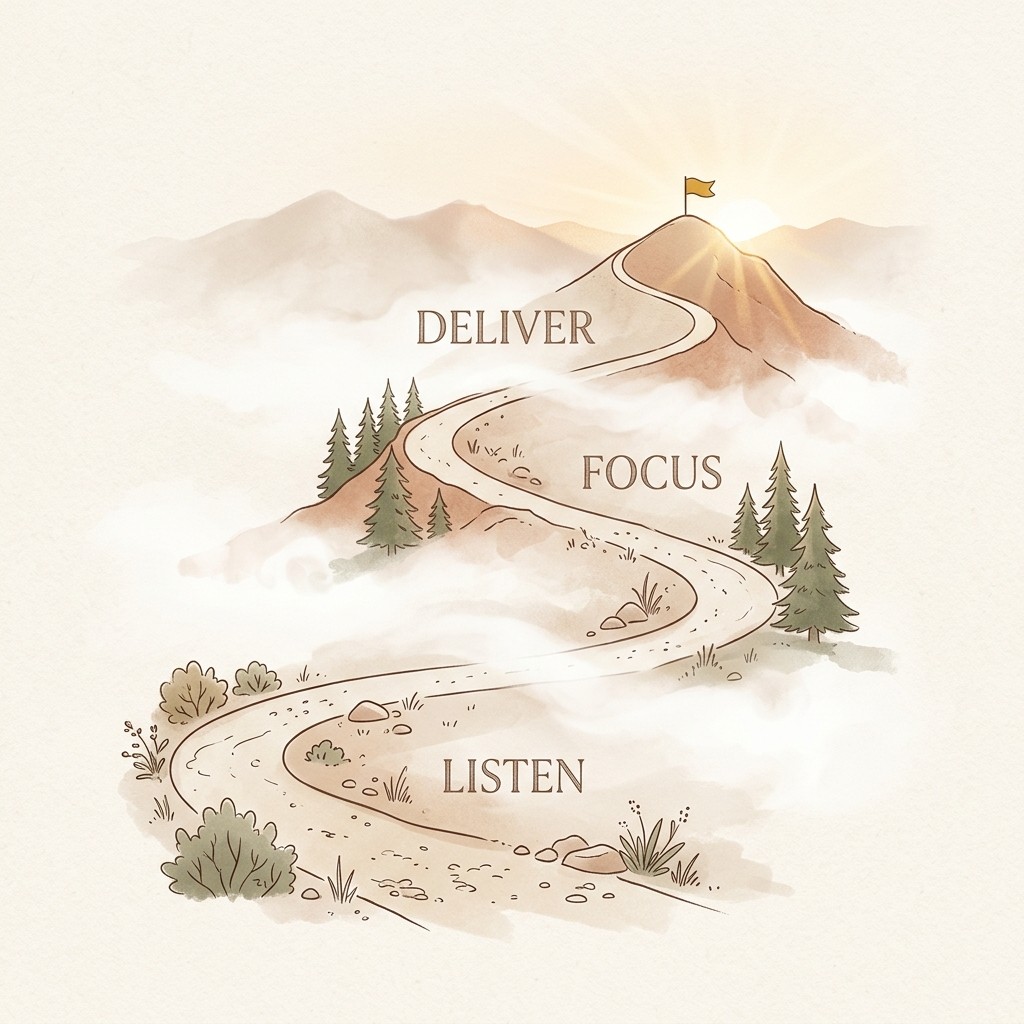
A practical translation of all this into a first-90-days arc:
The first thirty days are for learning and listening. Meet everyone. Ask more than you tell. Map how work actually flows versus how the org chart says it flows. Resist every urge to announce a vision.
The next thirty are for focusing. By now you can see the one or two things that, if improved, would change everything, the high-leverage points Grove described. Pick them deliberately and let the rest wait.
The final thirty are for early, visible, shared wins, small successes that build your team's confidence in you and your confidence in yourself, credited generously to the people who did the work.
Part 4: Leading the People You Used to Sit Beside
Of all the challenges, this is the one that keeps new managers awake at night: managing your former peers. Yesterday you complained about leadership together over lunch. Today you are leadership. The research and the practitioner accounts agree that this is the single most emotionally fraught part of the transition.
Linda Hill's work explains why it's so hard. The new manager craves to be liked, they've just left the peer group and don't want to be exiled from it, but the role requires making decisions that not everyone will like. Managers who optimize for being liked end up unable to hold standards, give hard feedback, or make unpopular calls. The relationship has structurally changed, and pretending it hasn't helps no one.
The healthiest move is to name the change directly rather than let it fester as an awkward unspoken thing. A version of this conversation, drawn from how experienced managers describe handling it:
"I know this is a little strange for both of us. Last month we were peers, and now I'm your manager. I'm not going to pretend that's not weird. What I can promise is that I'll be fair, I'll be transparent about decisions, and I'll always tell you where you stand. I'd rather we talk about the awkward stuff openly than tiptoe around it. So, what are you worried might change? Let's get it on the table."
Naming it disarms it. You acknowledge the reality, set the expectation that you'll now sometimes wear a different hat, and invite the concern into the open where you can address it.
The subtler trap is favoritism, real or perceived. Your old work friends will, consciously or not, expect insider access and lenient treatment. Granting it poisons the whole team's trust in your fairness. The discipline here is to be scrupulously consistent in how you treat everyone, which sometimes means being slightly more formal with your friends than feels natural, precisely to avoid the appearance of a backchannel.

Part 5: The Discipline of Delegation
Almost every struggling new manager has the same root problem: they won't let go. They keep the meaty work for themselves because they trust their own hands, and they hand off only scraps. The result is a manager drowning in execution and a team starved of growth.
Camille Fournier, who rose from engineer to CTO and wrote The Manager's Path, is blunt that delegation is not optional: it is the job. Her key reframe is that delegation succeeds when you focus on outcomes, not daily oversight. The new manager's instinct is to delegate a task and then hover, correcting every keystroke. That isn't delegation; it's micromanagement with extra steps, and it teaches your people nothing except that you don't trust them.
Fournier offers a usable sorting test. Look at a task along two axes: how frequent it is and how complex it is, and let that guide you:
Tasks that are frequent and simple (routine reviews, status summaries, standard requests) should be delegated immediately and fully; doing them yourself is pure waste of your leverage.
Tasks that are infrequent and simple are often faster to just do yourself, don't over-engineer the handoff.
Tasks that are frequent and complex are your richest teaching opportunities: invest in training someone to own them, because that investment pays back every single time the task recurs.
Tasks that are infrequent and complex, the high-stakes, rare judgment calls, are usually where the manager genuinely should stay close.
The deeper truth, echoed by Google's own research below, is that delegation is the primary mechanism by which you develop people. Every meaningful thing you keep for yourself is a growth opportunity you've quietly stolen from someone on your team. As the discomfort of letting go fades, what replaces it is a team that gets stronger while your own calendar gets saner, the compounding return Grove promised.

Part 6: Feedback and the Courage to Be Honest
If delegation is the skill new managers most avoid, feedback is the one they most botch. The instinct, especially for the newly promoted who want to be liked, is to soften everything into mush, or to avoid the hard conversation entirely. Kim Scott, who managed teams at Google and Apple before writing Radical Candor, gave this failure mode a name that has stuck: Ruinous Empathy.
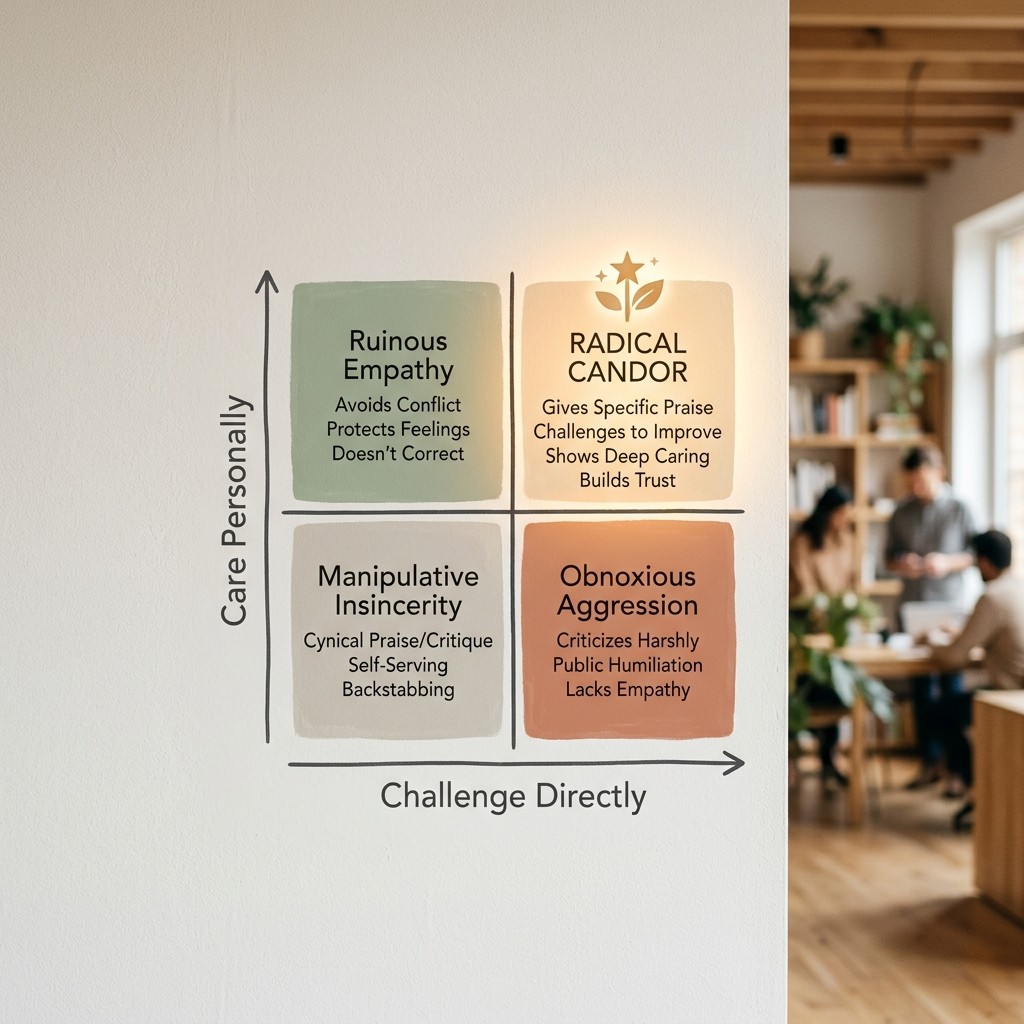
Scott's framework rests on two dimensions that every manager must hold at once: Care Personally and Challenge Directly. Plot them against each other and you get four quadrants. The goal is the top-right: Radical Candor, where you challenge someone because you care about them. The other three are all failure modes:
Obnoxious Aggression is challenging without caring: harsh, belittling feedback that wins the argument and loses the person.
Manipulative Insincerity is neither caring nor challenging: political, back-stabbing, gutless.
And Ruinous Empathy, the one that snares almost every new manager, is caring without challenging. As Scott describes it:
"Ruinous Empathy is what happens when you want to spare someone's short-term feelings, so you don't tell them something they need to know." (Kim Scott, Radical Candor)
It feels kind. It is actually cruel, because you are withholding the information a person needs to improve, protecting your own comfort while their performance, and their career, quietly stalls. The most caring thing you can do is tell people the truth, clearly and soon, in a way that makes obvious you're on their side.
What does that sound like in practice? Specific, timely, and framed around behavior and impact rather than character. Compare these two attempts at the same feedback:
Ruinous Empathy: "Hey, no big deal at all, the presentation was great, really, maybe just tighten it up a touch next time if you get a chance, but honestly it was fine!"
Radical Candor: "I want to give you some direct feedback because I think you're going to be excellent at this. In today's presentation, you opened with eight minutes of background before the recommendation, and I watched two execs lose the thread. Next time, lead with the recommendation in the first ninety seconds, then support it. Want to rehearse the new opening together before Thursday?"
The second version cares more, not less. It's specific, it's actionable, it assumes the person's competence, and it offers help. That combination is the whole game.
Part 7: There Is No Single Right Style
New managers often ask: what kind of manager should I be? As if there's one correct answer to copy. The research says the question itself is flawed. The best managers are not consistent in style; they are deliberately inconsistent, matching their approach to the person and the moment.
This is the core finding of Daniel Goleman's landmark HBR research. Goleman, who brought emotional intelligence into the business mainstream, studied thousands of executives and identified six distinct leadership styles: Coercive, Authoritative, Affiliative, Democratic, Pacesetting, and Coaching, each grounded in different emotional-intelligence competencies and each suited to a different situation. His conclusion is the part most people miss:
"The most effective leaders... use most of [the styles] in a given week, seamlessly and in different measure, depending on the business situation." (Daniel Goleman, Leadership That Gets Results)
A crisis with a looming deadline may call for the authoritative or even directive style. A talented but stuck employee calls for the coaching style. A demoralized team that's been through hell calls for the affiliative, people-first style. The manager with only one mode, usually the pacesetting "watch me, now keep up" style that high performers default to, will be effective in exactly the narrow band of situations that suits it, and counterproductive everywhere else.
Goleman's underlying point is that this flexibility is downstream of emotional intelligence: self-awareness to know your own default and its limits, and social awareness to read what the moment actually requires. You can't choose a style you can't see the need for. Which is why the manager's inner work, knowing yourself, is not soft stuff. It's the foundation everything else stands on.
Part 8: What the Best Managers Actually Do: The Google Data
For years, a faction inside Google quietly believed managers didn't matter much, that great engineers could mostly manage themselves. So the company did what Google does: it ran the data. The result, Project Oxygen, is one of the most rigorous internal studies of management effectiveness ever conducted, and its first finding demolished the premise. Managers didn't just matter; teams with the best managers were measurably happier, performed better, and had dramatically lower turnover.
Then Google reverse-engineered what those best managers did, distilling it into a list of behaviors that has since been refined to ten. The striking thing, for any new manager, is how little of it is about technical brilliance and how much is about ordinary human decency practiced consistently. The Project Oxygen behaviors of Google's highest-performing managers include:
Being a good coach, guiding rather than dictating. Empowering the team and not micromanaging, the delegation discipline from Part 5, validated by data. Creating an inclusive environment that shows genuine concern for people's success and well-being. Being productive and results-oriented. Communicating well, listening as much as sharing. Supporting career development and giving specific, actionable feedback. And making firm decisions, weighing options carefully, then committing and standing behind the call.
Notice what is not at the top of the list: being the smartest engineer, having all the answers, technical heroics. Google found that the single most important manager behavior was being a good coach, and that technical expertise, the thing high performers are most proud of, ranked dead last among the eight original behaviors. The promotion that felt like a reward for your expertise turns out to value a completely different set of muscles.

Part 9: Managing the Hardest Person: Yourself
Every new manager eventually discovers that the most difficult person to lead is themselves. Three inner battles recur across nearly every account.
The first is impostor syndrome. Watkins traced the action imperative directly back to it: the gnawing fear that you've been found out, that you don't belong in the chair. The antidote isn't fake confidence; it's recognizing that feeling unqualified is nearly universal among new managers and is not evidence that you are unqualified. Linda Hill's entire body of work reframes the early floundering not as personal failure but as a normal, expected developmental stage. Everyone who becomes good at this was once bad at it. The discomfort is the curriculum, not a verdict.
The second is the identity grief of giving up the craft. You were a great engineer, designer, analyst, or salesperson. That was your identity and your source of pride. Management asks you to slowly let that go and find a new source of self-worth, one that comes from other people's growth rather than your own output. This is a genuine loss, and it's worth grieving honestly rather than pretending the trade is painless. Goldsmith's reframe helps here: the satisfaction doesn't disappear, it relocates: from "I did this brilliant thing" to "I built the conditions for them to do brilliant things." For people wired to achieve, learning to feel that second kind of pride is the deepest part of the whole transition.
The third is energy and boundaries. As an IC, your work had natural edges: you finished a task and it was done. Management is unbounded; there is always another conversation to have, another fire, another person who needs you. New managers routinely try to do their old job and the new one, working nights to keep coding while managing by day, and they crater within months. The discipline is to accept that you've changed jobs, not added one, and to protect the energy that the new job, which is largely emotional labor, quietly consumes.

Part 10: A Practical First-Quarter Playbook
Synthesizing everything above into something you could start Monday:
Week 1: Listen. Hold a one-on-one with every direct report. Ask Zhuo's "dream manager" questions. Ask more than you tell. Write down what you learn. Announce no major changes.
Weeks 2-4: Map. Learn how work actually flows, who the informal leaders are, and what the team is genuinely worried about. If you inherited former peers, have the direct, name-the-awkwardness conversation with each one. Diagnose your STARS situation (are you in a turnaround or a sustaining-success role?), because it changes everything.
Month 2: Focus and delegate. Identify the one or two high-leverage improvements Grove would point you to. Start deliberately handing off the frequent, complex work as teaching opportunities, focusing on outcomes rather than hovering. Begin practicing real feedback, specific, timely, caring, and direct.
Month 3: Deliver and reflect. Drive an early, visible, shared win, and credit it generously to your people. Then step back and ask the honest questions: Where am I still clinging to the old job? Whose growth am I accidentally blocking by doing their work? What style am I overusing, and what does this team actually need from me?
And keep returning to the one idea that anchors all the others. Your job is no longer to be the best individual contributor in the room. It is, in Zhuo's words, to get "as high a multiplier effect on your collective outcome as you can." The day you stop measuring yourself by what you produced and start measuring yourself by what your team became. That's the day you stop being a team member who got promoted and start being a leader.
The Bottom Line
The move from teammate to team leader is not a step up the same ladder. It's a step onto a different ladder entirely, one where the rungs are made of other people's trust, growth, and engagement rather than your own output. The research is remarkably consistent across every source, from Harvard's classrooms to Intel's factories to Google's data warehouses:
The skills that got you promoted won't carry you here. Your authority is earned, not granted. Your output is now your team's output. Letting go of the work is the work. Honest feedback is the kindest thing you can offer. There is no single right style, only the emotional intelligence to read the moment. And the hardest person you'll ever have to manage is the one in the mirror.
Linda Hill called it a transformation, and she was precise in the word choice. You are not learning a few new tasks. You are becoming a different kind of professional. It is disorienting, it is humbling, and, done with intention and the guidance of the people who've mapped the path before you, it is one of the most meaningful evolutions a working life can hold.
Remember the number we started with: managers explain 70% of the difference between a team that thrives and one that withers. That's not a burden. That's the whole point. The job matters more than almost any other precisely because of how much of other people's working lives now run through you. Be the manager you wish you'd had.
*Sources and further reading: Linda A. Hill, Becoming a Manager and "Becoming the Boss," HBR; Marshall Goldsmith, What Got You Here Won't Get You There; Julie Zhuo, The Making of a Manager; Michael D. Watkins, The First 90 Days; Andy Grove, High Output Management; Kim Scott, Radical Candor; Camille Fournier, The Manager's Path; Daniel Goleman, ["Leadersh