
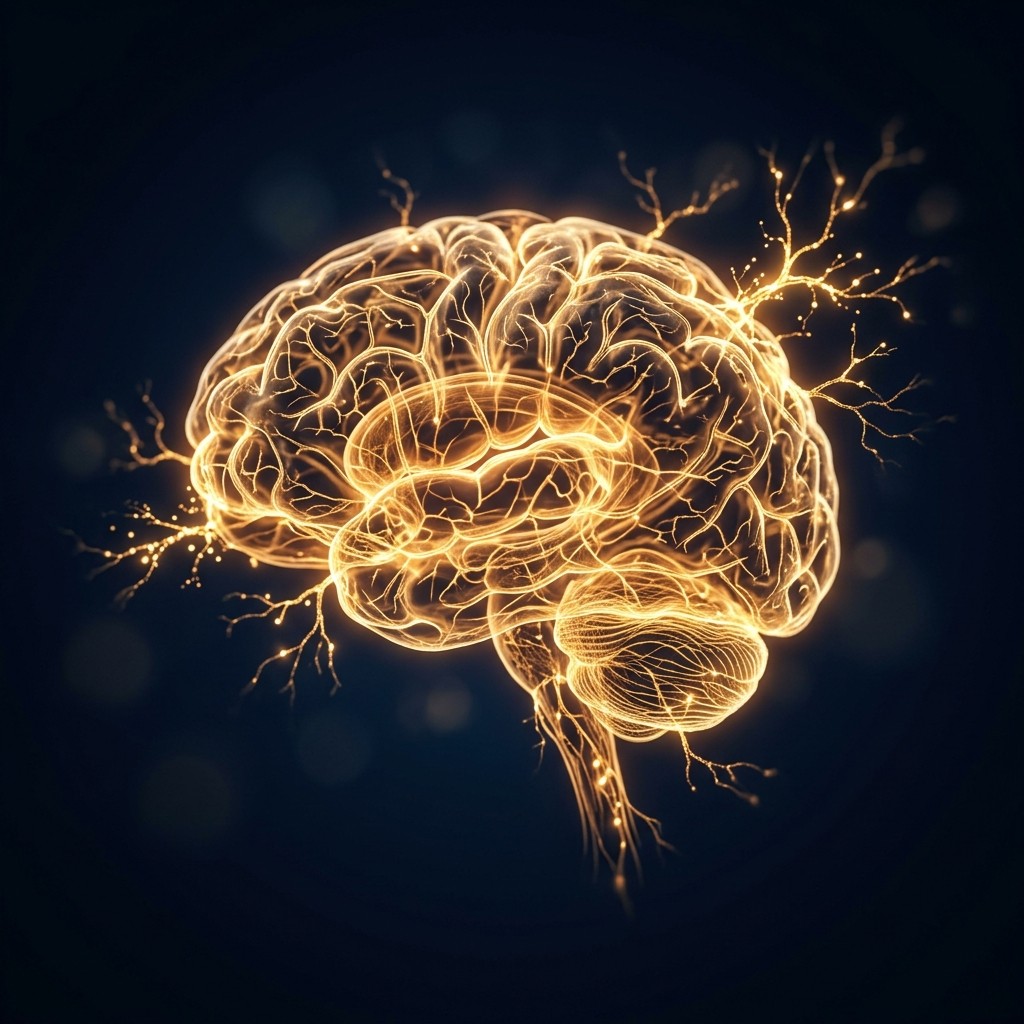
"Neurons that fire together, wire together." — Often attributed to Donald Hebb's principle of neural learning
For most of the twentieth century, science told you a discouraging story about your own brain.
The story went like this: you are born with a certain number of neurons, your brain finishes developing sometime in your twenties, and from there it's all downhill. The wiring is set. The personality is fixed. Whatever you didn't learn as a child — a language, an instrument, a way of being — was largely off the table. The adult brain, in this view, was like dried concrete. Hardened. Finished.
That story was wrong.
Over the past few decades, neuroscience has overturned it so completely that the dogma of the "fixed adult brain" now looks like one of the great scientific errors of the modern era. Your brain is not concrete. It is closer to clay — constantly being shaped, reshaped, and reorganized by your experiences, your attention, and your actions. This property has a name: neuroplasticity. And it operates not just in childhood, but across your entire lifespan, right up until your final breath.
This is not motivational fluff. It is biology. Researchers have watched the brains of London taxi drivers physically enlarge in the regions responsible for spatial memory. They have seen the auditory cortex of blind individuals get recruited for processing touch. They have documented stroke patients regrowing function in undamaged brain regions through deliberate rehabilitation. The capacity for change is built into the very architecture of your nervous system.
In this guide, you're going to learn how that change actually works — the cellular machinery, the chemistry, the conditions that switch plasticity on. More importantly, you're going to learn how to direct it. Because here is the empowering truth that the old story hid from you: you are participating in the rewiring of your brain every single day, whether you intend to or not. The only question is whether you do it consciously, in the direction you choose, or unconsciously, drifting wherever life pushes you.
Let's take the controls.
Part 1: What Neuroplasticity Actually Is
The Living, Self-Modifying Brain
Your brain contains roughly 86 billion neurons, each connected to thousands of others through junctions called synapses. The total number of synaptic connections runs into the hundreds of trillions. This is not a static circuit board. It is a dynamic, living network that is constantly editing itself.
Neuroplasticity is the umbrella term for all the ways your nervous system changes its structure and function in response to experience. It happens at several levels at once:
Synaptic plasticity is the strengthening or weakening of individual connections between neurons. When two neurons are activated together repeatedly, the connection between them grows more efficient — a process called long-term potentiation (LTP). When a connection goes unused, it weakens — long-term depression (LTD). This is the cellular basis of learning and memory.
Structural plasticity involves physical changes: neurons grow new dendritic spines (the tiny protrusions that receive signals), form entirely new synapses, or prune away connections that are no longer useful. Over time, whole regions of cortical "real estate" can be reallocated to different functions.
Neurogenesis — the birth of entirely new neurons — was long thought impossible in adults. We now know it continues throughout life in at least one critical region, the hippocampus, which is central to learning and memory. The work of researchers like Fred Gage at the Salk Institute helped establish that adult human brains continue to generate new neurons.
The takeaway is profound. The brain you have right now is not the brain you were born with, nor is it the brain you'll have a year from now. It is being continuously remodeled by what you do.
The Two Faces of Plasticity
Here is the part most people miss: plasticity is morally neutral. It does not care whether the changes it makes serve you or harm you. It simply reflects what you repeatedly do, think, and attend to.
Practice the piano daily and you build neural circuitry for musical fluency. Practice anxious rumination daily and you build neural circuitry for anxiety. Scroll a feed for three hours every night and you train your attention system to crave fragmented, novelty-seeking stimulation. The same mechanism that lets you master a skill also entrenches your worst habits.
Norman Doidge, the psychiatrist who popularized this science in The Brain That Changes Itself, described this as the "plastic paradox": the very property that gives the brain its flexibility also gives it the capacity to become rigid. A path you walk often becomes a rut. The more you repeat a pattern of thought or behavior, the more automatic and self-reinforcing it becomes — until it feels less like a choice and more like who you are.
This is why directing your plasticity matters so much. You are not choosing whether to rewire your brain. You're only choosing in what direction.
Why the Old "Fixed Brain" Idea Persisted
It's worth understanding why the fixed-brain myth lasted so long, because the residue of it still shapes how you might think about your own potential. Early neuroscience could only study brains after death or through crude lesion studies. The adult brain looked static because the tools to observe its dynamism didn't exist yet.
When modern neuroimaging arrived — fMRI, diffusion tensor imaging, and the ability to track living brains over time — the picture transformed. Eleanor Maguire's now-famous studies of London taxi drivers, published around the turn of the millennium, showed that the posterior hippocampus of drivers who had memorized the city's labyrinthine streets (passing the brutal exam known as "The Knowledge") was measurably larger than that of control subjects. The longer they'd driven, the bigger it got. Their brains had physically grown in response to demand.
If you still carry a quiet belief that you're "too old to learn" or "just not wired for" something, recognize it for what it is: a holdover from a discredited theory. The evidence says otherwise.
The Remarkable Plasticity of Recovery
Perhaps the most dramatic demonstrations of neuroplasticity come from people recovering from brain injury. When a stroke damages the region controlling movement in an arm, the conventional expectation was once that the lost function was simply gone. But rehabilitation research has shown something far more hopeful: with intensive, targeted practice, undamaged regions of the brain can be recruited to take over functions that the damaged area once performed. The brain reorganizes itself, rerouting around the injury.
One striking example is constraint-induced movement therapy, developed by the neuroscientist Edward Taub. In this approach, a stroke patient's healthy arm is restrained, forcing intensive use of the impaired arm through repetitive, challenging practice. The results have been remarkable — patients regaining function that was thought permanently lost, as their brains physically remapped to assign new territory to the impaired limb. Similar principles drive recovery in many forms of brain rehabilitation. These cases are profound proof of concept. If a damaged adult brain can reorganize itself this dramatically through directed practice, then your healthy brain's capacity to learn, change, and grow through the same principles of focused, repetitive challenge is not in question. The machinery of recovery is the same machinery of everyday rewiring — and it works.
Part 2: The Conditions That Switch Plasticity On
If plasticity were happening at full intensity all the time, your brain would be hopelessly unstable — every passing experience would overwrite your hard-won skills. So the brain gates plasticity carefully. It opens the windows for change under specific conditions and keeps them mostly closed the rest of the time.
The good news: those conditions are largely under your control. Understanding them is the difference between effortful practice that goes nowhere and practice that reshapes your brain.
Condition One: Focused Attention
The single most important gatekeeper of adult plasticity is focused, undivided attention.
In childhood, the brain is in a state of near-constant plasticity. A child doesn't need to concentrate to absorb language — it happens automatically. But somewhere around age 25, the brain shifts strategies. It stops rewiring itself for everything and starts requiring a specific signal that says: this matters, pay attention, mark this for change.
That signal is generated by deep focus. When you concentrate intensely on a task — to the point where it's slightly uncomfortable, where distractions fall away — your brain releases a cocktail of neurochemicals that flag the relevant circuits for modification. Andrew Huberman, the Stanford neuroscientist whose lab studies neural plasticity and who has done much to communicate this research publicly, emphasizes that the neurochemicals acetylcholine, epinephrine, and dopamine form the core of this system. Acetylcholine acts like a spotlight, sharpening the focus of neural activity on the circuits you're using. Epinephrine (adrenaline) creates the alertness and mild stress that says something important is happening. Dopamine reinforces and motivates.
The practical implication is stark: multitasking is the enemy of brain change. Divided attention dilutes the very signal that triggers rewiring. If you're trying to learn while glancing at your phone, you're sending your brain a muddled message about what to mark for change. Single-tasking — true, immersive concentration — is not just more pleasant or more productive. It is the biological precondition for plasticity itself.
Condition Two: Errors and Productive Struggle
Here is one of the most counterintuitive findings in the science of plasticity: the feeling of frustration and error is not a sign you're failing. It is the trigger for change.
When you make a mistake — when your prediction doesn't match reality — your brain registers an error signal. This signal, mediated partly by a drop and then surge in neuromodulators, is precisely what tells the nervous system that its current wiring is inadequate and needs updating. Errors release a small amount of the chemicals that open the plasticity window.
This reframes the entire experience of learning. The point where you feel stupid, where the material won't stick, where you keep getting it wrong — that is not the point to quit. That is the point where the rewiring is most available. Comfort and fluency mean your brain has nothing to learn. Struggle means it's adapting.
Researchers who study skill acquisition, including the late Anders Ericsson with his work on "deliberate practice," found that the most effective practice is specifically the kind that lives at the edge of your ability — where you fail often, get immediate feedback, and adjust. Practice that feels easy produces little change. Practice that feels effortful produces a lot.
Lean into the struggle. Seek the edge of your competence. The discomfort is the medicine working.
Condition Three: Rest, Sleep, and Consolidation
Here's the twist that surprises most people: the actual rewiring doesn't happen while you practice. It happens afterward — especially during sleep, and even during brief periods of rest.
When you focus intensely and make errors, you're not rewiring your brain in that moment. You're tagging the relevant circuits and creating the conditions for change. The structural reorganization — the strengthening of synapses, the growth of new connections — occurs during sleep, particularly deep slow-wave sleep and REM. This is why pulling an all-nighter to cram is so counterproductive: you can stuff information in, but without sleep, your brain never does the consolidation work that turns short-term exposure into durable wiring.
Even more remarkable is the discovery of replay during brief waking rest. Research from the lab of Leonardo Cohen at the National Institutes of Health found that when people learned a new motor skill, their brains "replayed" the activity patterns during the short rest breaks between practice attempts — and these compressed replays, occurring in seconds of quiet, appeared to drive a large share of the actual learning. Subjects who took brief pauses learned dramatically faster than the practice time alone would predict.
The lesson: after intense focused learning, give your brain a chance to consolidate. Take short breaks. Don't immediately flood your attention with new input. And above all, protect your sleep, because that is the workshop where the day's tagged changes get built.
Part 3: Directing Your Plasticity On Purpose
You now understand the machinery. Plasticity is real, it runs on attention and error and rest, and it's happening to you constantly. Now let's talk about how to seize the wheel and steer it deliberately.
The Plasticity Protocol for Learning a Skill
Whether you're learning a language, an instrument, a sport, or a professional skill, the same biological principles apply. Here is a structured protocol built directly on the science.
1. Eliminate distraction and generate focus. Before a learning session, remove your phone from the room. Close every unnecessary tab. If your attention won't focus, that's normal — focus is a skill you can build, and you can prime it. A few minutes of any activity that raises alertness (a short walk, a cold splash of water, a few deliberate breaths) increases the epinephrine that primes the plasticity window. Set a clear, single intention for the session.
2. Work at the edge, and embrace errors. Choose material that is hard enough to make you fail regularly — roughly the zone where you succeed maybe 70 to 85 percent of the time. Don't avoid mistakes; chase the feedback they give you. When you get something wrong, don't move on immediately. Notice the error, register it, try again. You are feeding your brain the precise signal it needs.
3. Keep sessions intense but bounded. Deep focus is metabolically expensive and can't be sustained indefinitely. Sessions of roughly 90 minutes or less, with full concentration, beat marathon sessions of distracted effort. Quality of attention matters more than duration.
4. Insert micro-rests during practice. Based on the replay research, build in brief 10-to-30-second pauses where you do nothing — don't check your phone, don't talk, just rest your eyes and let your brain process. These tiny gaps appear to accelerate consolidation of motor and cognitive skills.
5. Sleep on it. Treat sleep as part of your training regimen, not separate from it. The learning you did today gets cemented tonight. Chronic sleep deprivation doesn't just make you tired — it sabotages the consolidation that makes practice pay off.
6. Return and repeat with spacing. Plasticity compounds through repetition over time. Revisit the skill across days and weeks rather than cramming. Spaced repetition aligns with how the brain stabilizes new circuits.
Rewiring Thought Patterns and Emotional Habits
Skills are one thing. But the most life-changing application of neuroplasticity is rewiring entrenched patterns of thought and emotion — anxiety, self-criticism, reactivity, learned helplessness. These too are neural circuits, built through repetition, and they can be remodeled.
The principle behind cognitive behavioral therapy (CBT), one of the most evidence-supported psychological interventions, is essentially applied neuroplasticity. By repeatedly catching a distorted thought, questioning it, and deliberately substituting a more accurate one, you weaken the old circuit and strengthen a new one. It's effortful at first — the old path is deep — but with repetition, the new response becomes more automatic.
The neuroscientist Jeffrey Schwartz, in his work with obsessive-compulsive disorder patients, demonstrated something striking: patients who learned to consciously relabel intrusive thoughts ("this is not me, this is my OCD circuit firing") and redirect their attention to a different activity produced measurable changes in their brain activity over time. They were, quite literally, rewiring their own brains through directed mental effort. Schwartz called this "self-directed neuroplasticity."
The protocol for emotional rewiring:
Notice the pattern. You cannot change a circuit you can't see. Awareness — often built through mindfulness practice — is the first step. Catch the automatic thought or reaction as it happens.
Pause and create space. In that gap between trigger and response lies your power to choose differently. Even a single breath can be enough to interrupt the automatic firing.
Substitute deliberately. Replace the old response with a chosen one — a reframe, a different action, a redirection of attention. This feels awkward and forced at first. That awkwardness is the new circuit being weak. Keep going.
Repeat relentlessly. Single instances don't rewire anything. The pattern only shifts through accumulated repetition. Think in terms of weeks and months, not days.
The Critical Role of Belief
There's a fascinating feedback loop here. Your beliefs about your own capacity to change actually influence your brain's plasticity. Carol Dweck's research on "growth mindset" at Stanford found that people who believe their abilities can develop through effort approach challenges differently — they persist longer, treat errors as information rather than verdicts, and ultimately learn more.
This isn't magical thinking. It's mechanistic. If you believe you can't change, you avoid the difficult, error-filled practice that actually drives change — and so you don't change, confirming your belief. If you believe you can, you lean into struggle, you persist through the frustrating middle, and you trigger the plasticity that proves you right. Your belief about your brain's flexibility becomes a self-fulfilling prophecy at the level of your neurons.
Part 4: Protecting and Enhancing Your Brain's Capacity to Change
Plasticity isn't a fixed resource, but it can be enhanced or degraded by how you live. Here's how to keep your brain in a state where change comes more readily.
Lifestyle Factors That Boost Plasticity
Physical exercise is arguably the most powerful pro-plasticity intervention available. Aerobic exercise increases the production of brain-derived neurotrophic factor (BDNF), a protein that the neuroscientist often describes as "fertilizer for the brain." BDNF supports the survival of existing neurons and encourages the growth of new ones and new connections. The neuroscientist Wendy Suzuki at NYU has shown that even single bouts of exercise improve mood, attention, and cognitive function, while regular exercise produces lasting structural benefits, including a larger hippocampus. Movement quite literally creates the conditions for a more changeable brain.
Sleep, as covered, is non-negotiable. It is when consolidation happens. Prioritize it as fiercely as you would any other tool of self-improvement.
Nutrition matters because the brain is metabolically demanding tissue. Omega-3 fatty acids support neuronal membrane health; stable blood sugar prevents the cognitive volatility of glucose spikes and crashes; and a diet rich in diverse plants supports the gut-brain axis that influences mood and cognition.
Novelty and challenge keep plasticity engaged. The brain adapts to demand, so a life of comfortable routine signals that no change is needed. Continually learning new things — a language, a craft, a route home you've never taken — keeps the machinery active. Novelty itself triggers dopamine, which primes plasticity.
Social connection is a powerful and underrated factor. Rich social engagement is associated with cognitive resilience and reduced risk of decline. Relationships demand constant, complex neural processing — reading emotions, adapting to others, navigating dynamics — that exercises the brain in ways nothing else can.
Factors That Degrade Plasticity
Just as some things enhance plasticity, others impair it. Chronic stress is the chief saboteur. Sustained high cortisol damages the hippocampus, the very region most central to learning and neurogenesis. A brain marinating in chronic stress hormones loses its capacity for healthy change. (Managing stress, then, isn't just about feeling better — it's about protecting your brain's adaptability.)
Chronic sleep deprivation blocks consolidation and impairs the clearance of metabolic waste that the brain performs during sleep. Excessive alcohol is neurotoxic and disrupts sleep architecture. And a life of unbroken passive consumption — hours of fragmented, algorithmically-fed stimulation — trains your attention system toward exactly the distractibility that undermines focused plasticity.
The Lifelong Horizon
Perhaps the most hopeful message of this science is about aging. Yes, plasticity changes character across the lifespan — it requires more deliberate effort in adulthood than the automatic absorption of childhood. But it never ends. The aging brain remains capable of forming new connections, learning new skills, and even generating new neurons. Studies of older adults who take up demanding new pursuits — learning an instrument, a language, a complex skill — show measurable cognitive and structural benefits.
The brains that decline fastest are not simply the oldest ones. They are the ones that stopped being challenged. A brain that is continually asked to learn, adapt, and grow stays plastic. A brain placed in comfortable retirement from all challenge follows the law of "use it or lose it."
You are never too old to rewire. The window never fully closes. It just asks more of you to walk through it — focus, struggle, rest, repeat. The capacity is there, waiting, until the very end.
Conclusion: You Are the Sculptor
For most of history, people believed character was destiny — that you are who you are, fixed and final. The science of neuroplasticity dismantles that fatalism. You are not a finished object. You are a process, continuously sculpting yourself through every act of attention, every repeated thought, every skill practiced and every habit indulged.
This is both a tremendous responsibility and a tremendous gift. The responsibility: you are wiring your brain right now, today, in whatever direction your life points. If you spend your hours anxious and distracted, you become more skilled at anxiety and distraction. The gift: you can change direction whenever you choose. The patterns that feel like permanent features of who you are — they are circuits, and circuits can be remodeled.
The chisel is attention. The hammer is repetition. The workshop is sleep. And the material is your own magnificent, malleable, lifelong-plastic brain.
Pick up the tools. Start sculpting on purpose.
Action Steps: Start Rewiring Today
Run one distraction-free deep work session. Choose a skill you want to build. Remove your phone from the room, set a single intention, and practice with total focus for 45 to 90 minutes. Notice how different it feels from distracted effort.
Reframe your relationship with errors. For the next week, every time you make a mistake while learning something, silently note: this is the plasticity window opening. Stay with the difficult material instead of retreating to what's easy.
Build in micro-rests. During focused practice, insert deliberate 15-to-30-second pauses where you do nothing at all. Let your brain replay and consolidate.
Protect your sleep as part of your training. Treat the night after learning as the second half of the workout. Aim for consistent, sufficient sleep, and notice how much better new skills stick.
Move your body to fertilize your brain. Get aerobic exercise most days. You're not just training your heart — you're raising BDNF and creating the conditions for a more changeable brain.
Identify one mental pattern to rewire. Pick a recurring thought or reaction that doesn't serve you. Catch it, pause, substitute a deliberate alternative, and repeat relentlessly for a month. Track the shift.
Adopt the growth mindset on purpose. When you catch yourself thinking "I can't" or "I'm not wired for this," correct it: I haven't built that circuit yet — but I can. Your belief shapes your biology.
Your brain is waiting for instructions. Give it good ones, every single day.