
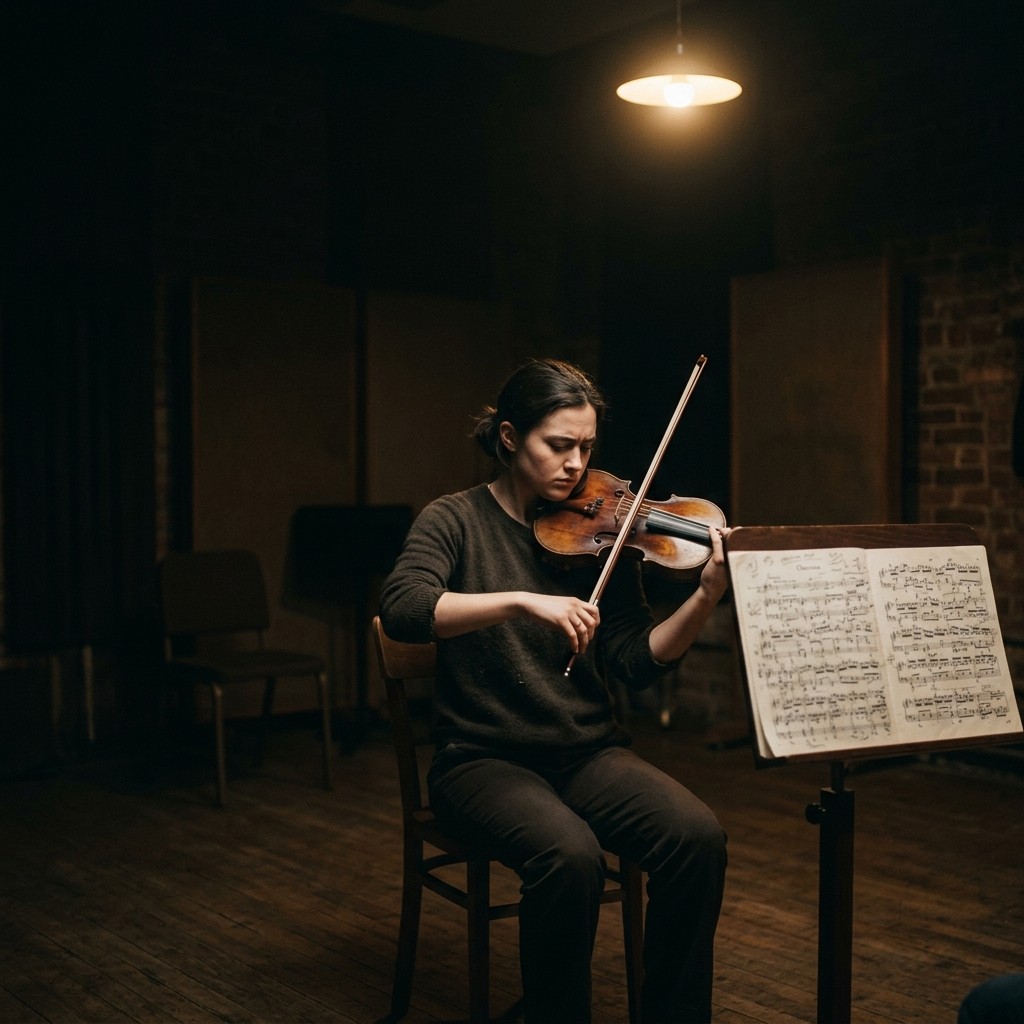
"The right sort of practice carried out over a sufficient period of time leads to improvement. Nothing else." — Anders Ericsson, Peak
You've heard the rule: put in 10,000 hours, and you'll be world-class at anything.
It's one of the most successful ideas in modern popular psychology — repeated in graduation speeches, business books, and motivational posts for nearly two decades. It's tidy, democratic, and quantifiable. It's also, according to the very researcher whose work spawned it, wrong in almost every way that matters.
Anders Ericsson, the Florida State University psychologist whose studies of elite violinists became the basis for the "rule," spent the last years of his life patiently correcting the record. The 10,000 figure was an average, not a threshold — some top performers in his studies had accumulated more, some less, and in many fields mastery takes far more or far less. Ten thousand hours guaranteed nothing. And most importantly: the hours were never the point. The kind of hours was the point.
This distinction is not academic nitpicking. It's the difference between two futures. In one, you spend years repeating what you already know how to do — driving, typing, playing the same songs, running the same meetings — and improve not at all, because sheer experience, past a basic level, does not produce expertise. Research on professionals from physicians to wine judges has repeatedly found that decades of routine experience often leave performance flat or even slightly degraded.
In the other future, you practice the way elite performers practice — and improvement never stops, at any age, in nearly any domain.
This guide is about the second future. You'll learn what Ericsson's research actually showed, where its critics have a point, what separates naive repetition from deliberate practice, and — most practically — how to design practice for your own skills: your craft, your sport, your instrument, your career.
The hours are coming either way. Let's make them count.
Part 1: What the Research Actually Found
The Berlin Violinists
The foundational study, published by Ericsson, Ralf Krampe, and Clemens Tesch-Römer in 1993, examined violinists at a Berlin music academy. Professors divided students into groups: the best (potential international soloists), the good, and those headed for careers as music teachers. The researchers reconstructed, through interviews and diaries, how each student had spent their musical lives.
Total time involved with music — lessons, performing, listening, playing for fun — didn't cleanly separate the groups. What did was time spent in solitary, effortful practice deliberately aimed at improvement. By age twenty, the best violinists had averaged around 10,000 hours of such practice; the good ones around 8,000; the future teachers around 4,000.
Just as striking as the totals was the texture of that practice. It wasn't pleasant. Students rated it as among the most effortful and least inherently enjoyable things they did. The best violinists didn't practice more because they loved practicing more — they napped more, guarded their sleep, and structured their days around recovering from sessions that demanded total concentration, typically in blocks of about an hour and rarely exceeding four or five hours a day in total.
From this and dozens of subsequent studies across chess, music, medicine, sports, and memory, Ericsson built his framework: expert performance is, to a first approximation, the product of accumulated deliberate practice — a specific, demanding, improvement-focused activity that almost nobody does by default.
What Malcolm Gladwell Changed — and What Got Lost
Malcolm Gladwell's 2008 book Outliers turned the Berlin average into "the 10,000-Hour Rule": the magic number of greatness. The simplification traveled brilliantly and distorted badly. Ericsson's own response, elaborated in his book Peak with Robert Pool, identified the key distortions:
- There is no threshold. 10,000 was an average at age twenty for one group in one domain; the same violinists were expected to need many more hours before winning international competitions. Memorizing digit strings can be world-class in a few hundred hours; some domains demand twenty-five thousand or more.
- Hours of the wrong kind count for little. Gladwell's examples (like the Beatles' Hamburg performances) mostly involved performing, which Ericsson considered categorically different from practice designed to improve.
- The rule implies inevitability. Ericsson never claimed 10,000 hours guarantees expertise — only that no one reaches elite levels without massive amounts of the right kind of practice.
The Honest Caveats: What the Critics Showed
Intellectual honesty requires the other side of this story. In 2014, Brooke Macnamara, David Hambrick, and Frederick Oswald published a meta-analysis of 88 studies and found that deliberate practice, as measured, explained on average about 26% of the variance in performance in games, 21% in music, 18% in sports — and much less in education and professions. A large share of what separates performers, in other words, is not logged practice hours: age of starting, genetics, quality of instruction, working memory, opportunity, and factors still unidentified all play roles. Twin studies on music and drawing ability confirm meaningful heritable components, and even the willingness to practice itself appears partly heritable.
Ericsson disputed the meta-analysis's definitions (much of what it counted as "deliberate practice" was, he argued, merely structured experience), and the debate remained unresolved at his death in 2020. But the mature conclusion for you sits comfortably between the camps:
Deliberate practice is not the whole story of expertise — but it is the largest part of the story that you control. Nobody gets to choose their genes or their childhood opportunities. Everybody gets to choose how they practice tomorrow. And across every domain studied, badly structured hours produce a fraction of the improvement that well-structured hours do. That's the leverage point, and it's entirely yours.
Part 2: The Anatomy of Practice That Works
Naive, Purposeful, Deliberate: The Three Levels
Ericsson distinguished three modes of skill activity, and locating yourself on this ladder is the first diagnostic step.
Naive practice is repetition: doing the thing again and hoping that counts. Playing the songs you know. Shooting casual baskets. Writing the way you always write. This is where nearly everyone lives, and it explains the universal plateau — once a skill becomes automatic, further repetition merely entrenches it, errors included. Automaticity, the very thing that makes you competent, is what arrests your growth.
Purposeful practice adds four ingredients: a specific goal for this session, full focus, immediate feedback, and operation just beyond your current comfort zone. This is available to anyone, in any domain, today, and it's where most of your gains will come from.
Deliberate practice, in Ericsson's strict sense, is purposeful practice plus two more assets: a domain with established, refined training techniques, and a teacher or coach who can prescribe the practice activities that develop the right skills in the right order. Fully deliberate practice is only possible in mature fields like music, chess, gymnastics, and certain sports — but its principles transfer everywhere.
Principle 1: Get Outside the Comfort Zone — Slightly
The non-negotiable core: if you can already do it comfortably, doing it again is not practice. Improvement happens only at the edge of current ability, where failure is frequent enough to be informative.
The edge is a band, not a cliff. Work that's too easy produces no adaptation; work that's far too hard produces only flailing and discouragement. Research on learning suggests the productive zone involves substantial challenge with substantial — not certain — success. One line of work on perceptual learning and training (including a 2019 modeling paper by Robert Wilson and colleagues, charmingly titled "The Eighty Five Percent Rule for optimal learning") suggests that error rates around 15% may be near-optimal for certain kinds of learning tasks. Don't treat the exact number as gospel; treat the principle as law: if you're succeeding almost every time, the task needs to get harder. If you're failing most of the time, it needs to get easier.
Principle 2: Make It Specific
"Practice piano for an hour" is not a practice goal. "Play the left-hand passage in measures 30–38 at tempo, five times consecutively without error" is.
Deliberate practice decomposes a skill into components and attacks them individually. The chess player doesn't just play games; she studies specific endgame positions. The comedian doesn't just perform; he dissects which exact phrasing of one bit gets the laugh. Benjamin Franklin, in a famous self-training regimen Ericsson loved to cite, didn't just "write a lot" — he rewrote essays from The Spectator from notes, compared his versions sentence by sentence against the originals, and drilled the specific sub-skills (vocabulary, structure) where his versions fell short.
Before every session, you should be able to answer: What, specifically, am I trying to improve in the next hour, and how will I know if I did?
Principle 3: Feedback, Fast and Honest
Without feedback, practice is guesswork. The feedback loop has to tell you, as immediately as possible, what you did, how it deviated from the target, and ideally why.
The gold standard is a skilled coach — and the research is unambiguous that in domains where expert teachers exist, working with one is the single biggest accelerant available, because a coach sees what you cannot and knows the developmental sequence. But where coaching isn't available, you can engineer feedback:
- Record yourself. Athletes film form; speakers record talks; writers read drafts aloud days later. The gap between what you think you did and what you actually did is where improvement hides.
- Compare against models. Franklin's method: produce your version, set it against an excellent version, itemize the differences.
- Quantify what you can. Times, error counts, accuracy percentages. Numbers resist the self-flattery that memory specializes in.
- Borrow eyes. A peer reviewing your work catches what familiarity hides from you.
Principle 4: Build Mental Representations
Ericsson came to believe that what practice ultimately builds is not faster fingers but better mental representations — rich internal models of the domain that let experts perceive structure invisible to novices. The chess master glances at a board and sees not thirty-two pieces but a handful of meaningful patterns; classic studies by Adriaan de Groot and later by William Chase and Herbert Simon showed masters could reconstruct realistic positions after seconds of viewing, yet were barely better than novices at random piece arrangements. Their advantage wasn't memory; it was meaning.
These representations are both the product of good practice and the engine of further improvement: the clearer your internal image of what excellent looks like, the more precisely you can detect and correct your own deviations from it. This is why studying great work — annotating great writing, watching film of great athletes, analyzing master games — is genuine practice, provided you engage actively: predicting, comparing, explaining, not just admiring.
Mental representations also explain why purely mental practice works at all. Sports psychology has studied mental rehearsal since Deborah Feltz and Daniel Landers's meta-analytic work in the 1980s: vividly simulating performance measurably improves it, particularly for skills with heavy cognitive components, though it supplements rather than replaces physical repetitions. Chess players reading games away from the board, musicians "hearing" through a score on a train, surgeons walking through procedures the night before — all are refining the internal model that will guide the hands later. If your skill has any thinking in it (and it does), some of your practice can happen anywhere.
Principle 5: Use the Coach Well — Being Coachable Is Itself a Skill
Since expert instruction is the strongest accelerant available, it's worth saying something rarely said: most people use coaches and teachers badly. They hire one, attend sessions passively, defend themselves against feedback, and practice between sessions on autopilot — converting a deliberate practice asset back into expensive naive practice.
The high-yield behaviors, visible in every serious training tradition:
- Bring specific questions, not general presence. "Here's where I keep breaking down — watch this part" gets you ten times the value of "teach me."
- Ask for the developmental sequence. A great coach's real knowledge isn't tips; it's the order in which sub-skills must be built. Ask explicitly: what should I master next, and what must wait?
- Treat criticism as coordinates, not verdicts. The feedback that stings most precisely locates your next improvement. Surgeon and writer Atul Gawande, who hired a coach for his own operating-room technique mid-career and described the experience in a famous essay, noted that the discomfort of being observed was the price of seeing what he literally could not see himself.
- Close the loop. Report back what happened when you practiced the prescription. Coaching without that return channel is half a feedback loop.
And if you've plateaued under a good teacher for a long stretch, Ericsson's advice was unsentimental: the masters in his studies often changed teachers as they advanced, because the coach who takes you from beginner to good is frequently not the one who can take you from good to great.
Part 3: Making Practice Stick — The Science of Difficulty
Desirable Difficulties
Here, the deliberate practice literature joins forces with cognitive psychology's most useful body of work: Robert Bjork's research on "desirable difficulties." The recurring, deeply counterintuitive finding: conditions that make practice feel harder and performance look worse during training often produce dramatically better learning and retention. And conditions that feel smooth and productive often produce illusions of competence.
Three difficulties matter most:
Spacing. Massed practice (cramming) beats spaced practice on tomorrow's test and loses badly on next month's. Distributing the same hours across more, shorter sessions — revisiting skills just as they begin to fade — is one of the most replicated effects in learning science. For skill work, this means four 30-minute sessions across a week generally beat one two-hour block.
Interleaving. Practicing skill variants in mixed order (ABCABC) feels worse and tests better than blocked order (AAABBBCCC). In a well-known study by Nate Kornell and Bjork, participants learned to identify painters' styles better from interleaved examples — though most participants insisted blocking had worked better, even after seeing their own scores. Mix your practice problems, your pitch types, your scales.
Retrieval. Testing yourself — generating the answer, the move, the phrase from memory — strengthens learning far more than re-reading or re-watching, a finding established across hundreds of studies by researchers including Henry Roediger and Jeffrey Karpicke. Struggling to retrieve, even unsuccessfully, prepares the mind to learn the correction.
The unifying warning: fluency during practice is a lousy signal of learning. If your practice always feels smooth, it's probably not working. Choose the conditions that feel rougher and test better.
The Plateau Is a Choice
Why do most people stop improving — at typing, at golf, at their jobs — despite endless continued repetition? Journalist Joshua Foer, reporting on Ericsson's work in Moonwalking with Einstein, popularized the term for it: the "OK plateau." Once performance is acceptable, execution goes automatic, attention withdraws, and learning halts.
Ericsson's studies of how experts escape plateaus point to a consistent strategy: convert the automatic back into the deliberate. Typists improve again when they push 10–20% beyond comfortable speed, accept the spike in errors, and isolate the letter combinations that break down. The plateau, in other words, isn't a limit of ability; it's a limit of engagement. You break it by deliberately destabilizing what's comfortable and rebuilding it better — which is exactly as unpleasant as it sounds, and exactly why so few people do it.
Effort Has a Budget: Concentration and Rest
Deliberate practice is defined by full concentration — and full concentration is sharply limited. Across Ericsson's studies, elite performers in many fields converged on remarkably similar rhythms: practice sessions of roughly 45–90 minutes with real breaks between, rarely more than four or five total hours of maximal-concentration work per day, and conspicuous investment in sleep (the Berlin violinists slept more than their lesser peers, including deliberate naps).
Two practical consequences. First, shorter sessions at full intensity beat longer sessions at partial intensity — when focus degrades, stop; mechanical repetitions without attention reinforce sloppiness. Second, rest is not the absence of training; it's half of training. Skill consolidation happens substantially offline, during sleep, when the brain replays and stabilizes what was practiced.
Part 4: Your Practice System
Deliberate Practice for Knowledge Work
Before the system, one translation problem must be addressed honestly, because most readers' "domain" is not violin or chess but knowledge work — and Ericsson himself noted that fields like management and software lack the refined training traditions that make fully deliberate practice possible. Worse, knowledge work's structure is almost perfectly designed to prevent practice: you perform all day (meetings, emails, deliverables) and train almost never. Imagine a tennis player who only played matches and never drilled a stroke — that's the standard modern career, and it's why ten years of experience so often means one year of experience repeated ten times.
The adaptation, argued forcefully by Cal Newport in So Good They Can't Ignore You and Deep Work, is to impose practice structure on yourself, because no one will impose it for you:
- Identify the rare and valuable sub-skills in your field — the things that actually differentiate the people whose careers you want. Writing that persuades. Analysis that holds up. Code that others can build on. Running a meeting that produces decisions.
- Create artificial drills. Rewrite a great practitioner's memo from its summary, then compare (Franklin's method, transplanted). Re-derive an analysis before reading its conclusion. Refactor old code against a master's patterns. Rehearse the high-stakes presentation aloud, recorded, three times.
- Manufacture feedback. Ask for specific critique on specific dimensions ("was the recommendation clear by paragraph two?"), track measurable outputs over time, and find the colleague or mentor willing to be honest — they are rarer and more valuable than any course.
- Protect stretch assignments. The closest thing knowledge work offers to the edge of ability is the project slightly beyond your current competence. Volunteer for them deliberately, at a sustainable rate, and treat the discomfort as the curriculum.
An hour a day of this — genuinely focused, edge-of-ability, feedback-rich — compounds into a career-level advantage precisely because almost no one else in your field is doing any of it.
Step 1: Define the Skill Precisely
"Get better at communication" is unworkable. Decompose it: structuring an argument, opening a talk, handling hostile questions, writing concise emails. Pick one sub-skill at a time. The narrower the target, the faster the feedback, the steeper the improvement curve.
Step 2: Find the Best Available Map
In order of preference: a skilled coach or teacher; a curriculum from a mature training tradition; excellent models you can study and compare yourself against; at minimum, a clear written standard of what good looks like. Don't romanticize self-teaching — in domains with established pedagogy, refusing instruction just means repeating a century of other people's mistakes at full price.
Step 3: Design the Session
Every practice session gets three parts, planned before you begin:
- Target (2 minutes): the one specific weakness this session attacks, and the success criterion.
- Work (30–60 minutes): drills at the edge — hard enough to fail regularly, structured for immediate feedback, with spacing and interleaving built in across the week.
- Review (5 minutes): what happened versus the target, what the error pattern was, and what tomorrow's session should therefore attack. A simple practice journal — date, target, observations, next target — turns isolated sessions into a compounding curriculum.
Step 4: Protect the Conditions
Full focus, no phone, defined endpoint, and scheduled like a meeting that cannot be moved. Three to five genuinely focused sessions a week will outperform any amount of distracted "putting in time." Guard sleep with the same seriousness — it's where the practice gets written to long-term storage.
Step 5: Don't Let Age Be Your Excuse
A persistent myth holds that serious skill-building belongs to the young. The research says otherwise. Ericsson documented adults beginning domains in middle age and reaching impressive levels through properly structured practice, and the broader neuroplasticity literature confirms that the adult brain remains capable of substantial reorganization — the famous studies of London taxi drivers by Eleanor Maguire found measurable hippocampal changes in adults learning "the Knowledge" in their thirties and forties. Adults learning new skills face real disadvantages (less free time, more fear of looking foolish) and real advantages (better metacognition, clearer goals, the ability to design their own practice — everything in this article). What adults mostly lack is not plasticity but permission: a willingness to be a struggling beginner in public. Grant yourself that permission. The plateau you've been on for a decade is not your ceiling; it's just where you stopped practicing.
Step 6: Expect It to Be Uncomfortable — Indefinitely
The most consistent psychological finding about deliberate practice may be the least welcome: it never becomes effortless, because by definition it always operates at the frontier of your ability, and the frontier moves with you. The Berlin violinists at the top of the world still rated practice as hard. What sustains decades of it isn't enjoyment of the practice but commitment to the pursuit — what Angela Duckworth's research frames as grit, and what Ericsson described more simply: experts build their lives around practice and recovery, and they maintain the belief, justified by their own accumulated evidence, that they can keep improving.
That belief is the quiet gift of this whole literature. The research that demolished the 10,000-hour shortcut also demolished something far more imprisoning: the assumption that ability is fixed, that the great were simply born and the rest of us are spectators. Within whatever range your starting materials allow — a range almost no one ever exhausts — you improve precisely as far as your practice is designed to take you, and no farther.
Most people will never act on that. They'll keep logging comfortable hours and calling it experience. You now know better.
Action Steps: Engineer Your Next 100 Hours
Pick one skill and one sub-skill. Choose the skill that matters most to your goals, decompose it into components, and select the single weakest component as your first target.
Schedule three focused sessions this week. Thirty to sixty minutes each, calendar-blocked, phone elsewhere. Stop when concentration breaks — quality of attention is the whole game.
Write a one-line target before every session. What exactly improves today, and how will you measure it? If you can't answer, you're rehearsing, not practicing.
Engineer one honest feedback loop. Hire a coach, record yourself, compare your output against a master's, or quantify your error rate. Choose the most objective option you can afford.
Add one desirable difficulty. Space your sessions across the week instead of massing them, interleave problem types, or practice 10–20% beyond your comfortable speed and study what breaks.
Keep a practice journal. Two minutes after each session: target, what happened, dominant error, next session's target. Review it weekly to make sure difficulty keeps rising as you improve.
Audit your "experience." Identify one activity where you've logged years of repetition without improvement — then convert fifteen minutes of it, each day, from autopilot into a deliberate drill.
Ten thousand hours was never the rule. The rule is this: you become what you repeatedly, deliberately, and uncomfortably practice. Begin tonight.