
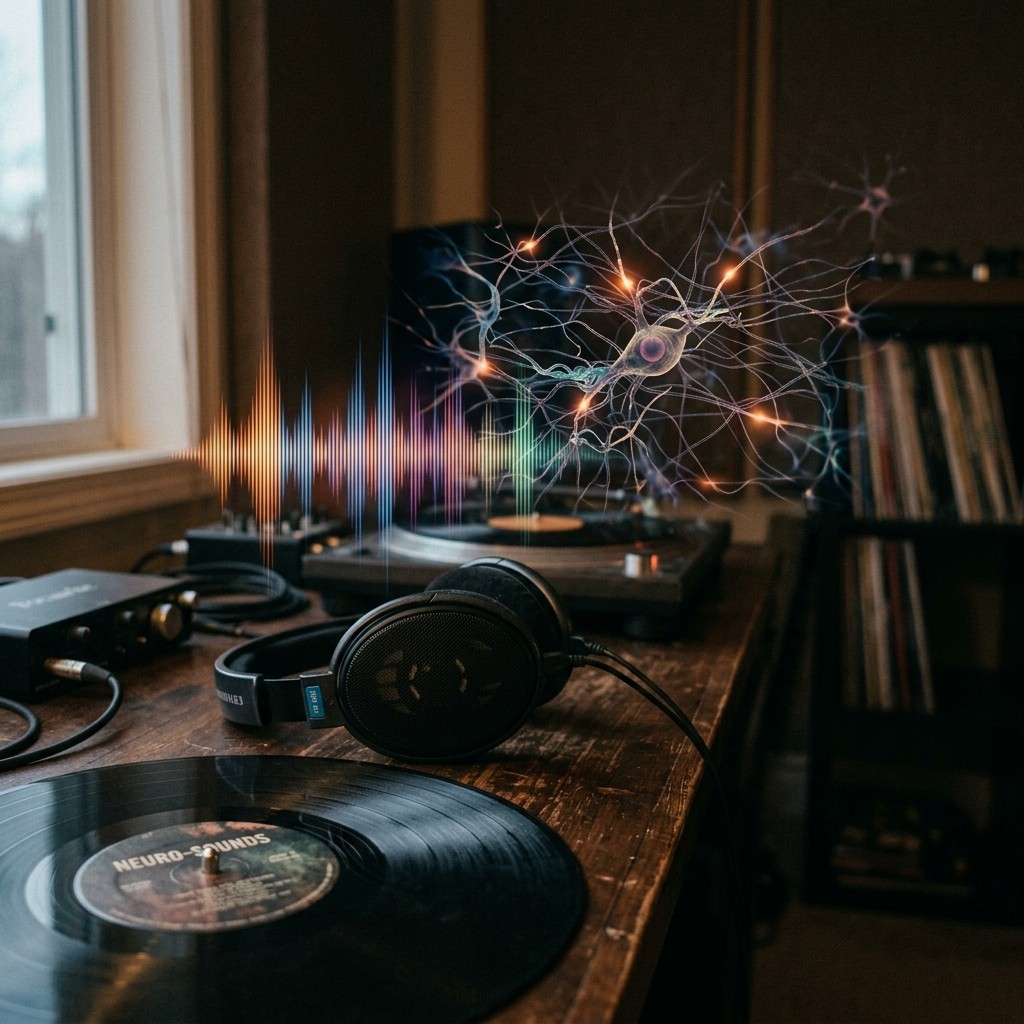
"Music is the shorthand of emotion." — Leo Tolstoy
There is no survival reason for music to exist.
Food keeps you alive. Sex propagates the species. Fear keeps you from danger. But music? Organized patterns of sound that move us to tears, drive armies into battle, soothe infants to sleep, and make strangers dance together — why should a few seconds of melody be able to raise the hairs on your arms?
Charles Darwin puzzled over it, calling our musical faculties "amongst the most mysterious with which [man] is endowed." Steven Pinker once provocatively called music "auditory cheesecake" — a pleasurable byproduct of faculties that evolved for other reasons. Yet the more neuroscientists look, the more remarkable music's grip on the brain appears. When you listen to music you love, brain imaging shows activity sprawling across an astonishing range of regions at once: auditory cortex, of course, but also motor systems, emotional centers, memory structures, and the reward circuitry that drives our deepest motivations. Few human activities recruit so much of the brain simultaneously.
This is not just a curiosity. It means music is a uniquely powerful lever on your mental state — one you already own, carry in your pocket, and can deploy at will. Used carelessly, it's pleasant background noise. Used deliberately, it becomes a precision tool: for sharpening focus, regulating mood, encoding memory, powering through workouts, and easing pain.
This guide draws on the work of neuroscientists like Daniel Levitin, Robert Zatorre, Stefan Koelsch, and others who have spent careers mapping the musical brain. You'll learn what music actually does to your neural machinery, and — crucially — how to use it on purpose to build a better mind.
Part 1: The Musical Brain — Why Sound Moves Us So Deeply
The Reward System Lights Up
The most striking discoveries about music concern the brain's reward system — the same dopamine-driven circuitry involved in food, sex, and addictive drugs.
In a landmark 2011 study published in Nature Neuroscience, Valorie Salimpoor and Robert Zatorre at McGill University used brain imaging to track what happens during musical "chills" — that spine-tingling peak of pleasure a favorite passage can deliver. They found dopamine release in the striatum, and, fascinatingly, the timing split across two structures: the caudate released dopamine in anticipation of the peak moment, while the nucleus accumbens fired at the peak itself.
This is the neuroscience of why music thrills us: it is a game of expectation and resolution. Music sets up patterns, builds tension, makes you anticipate where it's going — and then either satisfies or surprises that prediction. The composer Leonard Meyer argued decades ago that musical emotion arises from this dance of expectation, and modern neuroscience has largely vindicated him. Your brain is a prediction machine, and music is exquisitely designed to play with its predictions.
Music Is Motor, Even When You're Still
Notice how hard it is to keep perfectly still to a strong groove. That's not incidental. Brain imaging consistently shows that simply listening to rhythmic music activates motor regions — the premotor cortex, the cerebellum, the basal ganglia — even when you don't move a muscle. Your brain simulates movement in time with the beat.
This deep coupling between music and motor systems has profound practical consequences. It's why music is such a potent aid to exercise, why rhythm can help people with Parkinson's disease walk more steadily (rhythmic auditory stimulation is an established therapeutic technique), and why a march or a work song can synchronize and energize a group. Music doesn't just enter your ears; it moves through your whole motor system.
A Universal Language Built on Deep Structure
Music appears in every known human culture, past and present — there is no society without it. Ethnomusicologists debate how universal specific features are, but research led by Samuel Mehr and Manvir Singh at Harvard, analyzing music from hundreds of societies, found striking regularities: lullabies, dance songs, healing songs, and love songs recur across wildly different cultures, and listeners can often correctly identify a song's social function even from an unfamiliar culture. There seems to be something deeply shared in how humans make and respond to organized sound.
Part of that shared response is built on the brain's sensitivity to structure. Music is, at bottom, patterned sound — pitch, rhythm, harmony, and timing organized into hierarchies your brain parses much as it parses language. Stefan Koelsch and others have shown that the brain processes musical syntax — the "grammar" of which chords and notes belong where — using resources overlapping with those for language syntax, including regions like Broca's area long associated with speech. This is one reason music and language are so intertwined developmentally, and why musical training appears to benefit some language-related skills. Your brain treats music as a structured, rule-governed system to be predicted and parsed — which is exactly why violations and resolutions of those rules move you so powerfully.
The Memory Connection
Few things retrieve a memory as instantly and vividly as a song. Hear three notes of a track from your teenage years and you're transported — the place, the people, the feeling, all at once.
Neuroscientists attribute this partly to the tight links between auditory processing, emotion, and memory structures like the hippocampus and amygdala. Music encountered during emotionally charged, formative years — adolescence and early adulthood — gets especially deeply encoded, which is why the songs of your youth retain such extraordinary power. Researchers call this the "reminiscence bump."
This memory-binding power is so robust that it survives even profound neurological damage. In people with advanced Alzheimer's disease, familiar music from their youth can sometimes reawaken responsiveness, emotion, and memory when little else can — a phenomenon documented movingly by the late neurologist Oliver Sacks in his book Musicophilia and now harnessed in personalized music programs in dementia care. The musical-memory networks appear to be among the last to be ravaged by the disease.
Part 2: Music and Mood — The Emotional Regulator in Your Pocket
How Music Moves Emotion
Music's most universal use is emotional. We reach for it to celebrate, to grieve, to energize, to calm — and the research confirms it genuinely shifts our emotional and physiological state.
Stefan Koelsch, a leading researcher on music and emotion, has documented how music modulates activity in the brain's core emotional circuitry, including the amygdala, and influences the autonomic nervous system — heart rate, breathing, skin conductance. Pleasurable music has been shown to release not only dopamine but to engage systems involving endorphins and oxytocin, the social-bonding hormone. This last point connects to why making music together — singing in a choir, drumming in a group — produces such powerful feelings of connection and elevated mood, an effect studied by researchers including Robin Dunbar's group at Oxford.
The Paradox of Sad Music
Here's a puzzle music solves beautifully: why do we seek out sad music when we're already sad?
You might expect sad music to deepen sadness. Often it does the opposite. Research suggests that sad music can be cathartic and consoling — it validates and gives shape to our feelings, makes us feel understood and less alone, and, because the sadness is "safe" (no actual loss is occurring), can even be aesthetically pleasurable. Some research implicates prolactin, a hormone associated with comfort, in the response to sad music. The practical upshot: you don't always have to fight a low mood with upbeat music. Sometimes the music that meets you where you are is the music that moves you through.
Music as Active Mood Regulation
The key word is active. Used passively, music is wallpaper. Used deliberately, it becomes one of the most accessible mood-regulation tools you have. Research on music and emotion regulation, including work by Suvi Saarikallio, identifies the specific strategies people use music for: revival (energizing), diversion (distraction from worry), entrainment (matching and then shifting mood), discharge (releasing strong emotion through matching music), and solace.
The most sophisticated technique is the iso principle, drawn from music therapy: match the music to your current emotional state first, then gradually shift the music toward the state you want. To move from agitation to calm, you don't start with whale sounds — you start with something with energy that matches your arousal, then transition progressively toward calmer tracks. The brain follows the music more readily when the music meets it where it is.
Music therapy is, importantly, a serious clinical discipline. Credentialed music therapists use it in evidence-based ways for pain management, stroke rehabilitation, autism support, and mental health. The casual mood-regulation we're discussing here borrows from that science, but the clinical field is deeper than any playlist.
Part 3: Music and Focus — The Double-Edged Sword
Does Music Help You Work? It Depends.
Here we have to be honest, because the popular belief that "music helps concentration" is only sometimes true. The science reveals a nuanced, sometimes counterintuitive picture, and the right answer depends on the task, the music, and the person.
The core principle: music competes for the same limited cognitive and attentional resources as your task. When the task is verbal or complex, music — especially music with lyrics — can interfere, because language-processing demands collide. Studies on reading comprehension and complex problem-solving frequently find that lyrical music impairs performance compared to silence. If you're writing, editing, or studying dense material, lyrics are often a liability.
But for repetitive, monotonous, or low-cognitive tasks — data entry, cleaning, routine email, exercise — music tends to help, largely by lifting mood and arousal and by staving off boredom, keeping you engaged with a task that would otherwise drain motivation.
The Mozart Effect Myth (and What's Actually True)
You've heard that listening to Mozart makes you smarter. This is one of the most overstated claims in popular psychology. The original 1993 finding by Frances Rauscher and colleagues showed only a small, temporary boost on a specific spatial-reasoning task immediately after listening to Mozart — not a lasting increase in intelligence, and not from classical music broadly.
Subsequent research, notably by Glenn Schellenberg, suggested the effect was largely explained by arousal and mood: any stimulus that improves your mood and alertness — including an upbeat pop song, or a passage you simply enjoy — produces similar short-term cognitive bumps. It was never about Mozart. It was about being in a better, more alert state. Which is genuinely useful information: the right music can prime you for cognitive performance by optimizing your arousal — it just doesn't make you permanently smarter.
Practical Rules for Music at Work
Synthesizing the research into usable guidance:
- For demanding, verbal, or novel work: favor silence, ambient sound, or instrumental music without lyrics. Film scores, classical, ambient electronic, and lo-fi instrumental are popular for good reason — they provide pleasant arousal without linguistic interference.
- For repetitive or low-demand tasks: music with lyrics is fine and often helpful. Use it to make the dull bearable.
- For getting started: an energizing track can help overcome the activation barrier of beginning a task, even if you turn it off once you're in flow.
- Beware familiarity vs. novelty: highly novel or attention-grabbing music pulls focus; familiar music you know well tends to interfere less because it doesn't surprise your prediction machinery.
- Know thyself: individual differences are large. Some people genuinely concentrate better with music; introverts and those high in sensitivity to distraction may do worse with it. Experiment and observe your own performance honestly.
A Word on Binaural Beats and "Focus Music"
The wellness market is flooded with binaural beats, "alpha wave" tracks, and apps promising to entrain your brain into focus or calm. The honest scientific verdict: the evidence is mixed and generally weak. Some small studies suggest modest effects on attention or anxiety; others find nothing beyond placebo. There's nothing harmful about them, and if a particular focus track reliably helps you settle into work, the placebo and ritual value is real. Just hold the grand claims with skepticism — the strong, replicated effects of music on the brain are about reward, emotion, movement, and memory, not about magically tuning your brainwaves.
Music, Dopamine, and the Architecture of Motivation
Return for a moment to that dopamine finding, because it has a practical edge most people miss. The reason music can motivate — pull you off the couch and into a workout, carry you through a tedious task, lift you out of inertia — is that it engages the same reward and anticipation circuitry that drives all motivated behavior. A song you love is, neurologically, a small, reliable hit of reward you can summon on demand.
This makes music a uniquely controllable motivational tool. Where most rewards require you to first do the hard thing, music delivers reward during the effort, changing the felt cost of the task itself. Pair an unpleasant chore with music you genuinely enjoy and you've changed the reward math — a principle behaviorists call "temptation bundling." You can deploy this deliberately: reserve a particular album or playlist for the workout you dread, the cleaning you avoid, the admin you put off, so that the music's pull partly offsets the task's resistance. Over time, the association itself becomes motivating — the music becomes a cue that summons the will to begin. Music doesn't just accompany action; through the reward system, it can help generate it.
The Lifelong Brain Benefits of Musical Engagement
Across the lifespan, sustained engagement with music — listening, but especially playing and singing — appears to be good for the brain. In children, musical training is associated with gains in auditory processing, certain language and reading-related skills, and executive function, though researchers like Glenn Schellenberg rightly caution that disentangling cause from the traits of families who pursue music is genuinely difficult.
More striking is the aging end of the spectrum. Studies of lifelong musicians and of older adults who take up instruments suggest that musical activity may help preserve cognitive function and build "cognitive reserve" — the brain's buffer against age-related decline. Group singing, accessible to nearly everyone regardless of training, has been linked in research to improved mood, reduced anxiety, stronger social bonds, and even better respiratory function in some populations. The demands music places on the brain — coordinating hearing, movement, memory, emotion, and prediction in real time — make it a remarkably complete form of mental exercise. Whether you're four or eighty, engaging actively with music is among the richer things you can do for your brain.
Part 4: Music for Performance, Pain, and the Body
The Workout Multiplier
If there's one domain where music's benefits are robust and well-replicated, it's exercise. Sports scientist Costas Karageorghis at Brunel University London has spent decades studying music and physical performance, and the findings are consistent: the right music can improve endurance, increase work output, lower perceived exertion, and make hard effort feel easier and more enjoyable.
Two mechanisms drive this. First, music is distracting in a useful way — it pulls attention away from fatigue and discomfort, lowering your sense of how hard you're working. Second, music is energizing and synchronizing — a strong, well-matched tempo can act as a metronome that organizes movement and drives pace. Karageorghis's research suggests tempo in roughly the 120–140 beats-per-minute range suits many forms of moderate-to-vigorous exercise, though the ideal varies by activity and individual.
The takeaway: a well-built workout playlist isn't a luxury — it's a legitimate performance enhancer, and one of the few that's free, legal, and side-effect-free.
Music and Pain
Music's analgesic effects are real enough to be used clinically. Studies in surgical and clinical settings have found that music can reduce patients' perceived pain and anxiety and, in some cases, reduce the need for sedatives or pain medication. A 2015 systematic review in The Lancet by Catharine Meads and colleagues, analyzing dozens of trials, found that music around the time of surgery reduced post-operative pain, anxiety, and analgesic use.
The mechanisms overlap with everything above: distraction from pain, downshifting of the stress response, and engagement of reward and endorphin systems that have their own pain-dampening effects. You can apply a gentler version of this at home — using music to ease the discomfort of a tough task, a medical procedure, or an anxious moment.
Music as Medicine for the Brain
The therapeutic reach of music extends into serious neurological territory. In aphasia — the loss of speech after stroke or brain injury — some patients who cannot speak can still sing, because singing draws on right-hemisphere and bilateral networks distinct from the damaged left-hemisphere speech areas. Melodic Intonation Therapy harnesses this, using musical contours to help patients recover speech, an approach with a substantial clinical literature. For Parkinson's disease, the rhythmic-auditory-stimulation effect we met earlier helps patients overcome freezing of gait and walk more fluidly, the external beat substituting for impaired internal timing.
And in dementia care, personalized music — the songs of a person's youth, chosen for that "reminiscence bump" — has become a recognized non-pharmacological intervention for agitation and withdrawal, sometimes reaching people who have become unreachable by other means. None of this is magic; it's the predictable consequence of music being woven so widely through the brain that, when one network fails, music can route around it. Music is among the most powerful tools we have for reaching a damaged or struggling brain — and a hint of how potent it can be for a healthy one.
Music and Sleep
Finally, music can be a genuine aid to sleep. Slow, soft, instrumental music (generally below 60–80 beats per minute) used as part of a wind-down routine has been shown in several studies to improve sleep quality, particularly in people with sleep difficulties. The mechanism is parasympathetic: gentle music slows heart rate and breathing and quiets the racing mind. The one caveat — avoid music that's too engaging or that you'll want to keep listening to, and use a timer so it doesn't play all night and fragment your sleep. (As with our circadian guidance: the goal is to help the body downshift, not to add stimulation.)
Part 5: Building Your Deliberate Musical Practice
The thesis of this whole article is that music shifts from pleasant accident to powerful tool the moment you use it on purpose. Here's how to build that practice.
Curate Functional Playlists
Most people have playlists organized by genre or mood. Reorganize at least a few around function — the cognitive or emotional job you want them to do:
- Deep Focus — instrumental only, familiar, low-surprise. Film scores, ambient, lo-fi, certain classical.
- Activation — energizing tracks to break inertia and start hard tasks.
- Workout — high-tempo, motivating, matched to your training pace.
- Wind-Down — slow, soft, instrumental, for the evening and pre-sleep transition.
- Mood Lift — your personal, reliable joy-bringers, for low moments.
- Catharsis — the music that meets you in sadness or anger and moves you through it (the iso principle in playlist form).
The act of curation is itself valuable: it forces you to notice what each kind of music actually does to your state.
Use Music as a Conditioned Cue
Here's a powerful, underused technique rooted in associative learning. If you consistently play the same focus playlist whenever you do deep work — and only then — your brain begins to associate that music with the focused state. Over time, simply starting the playlist becomes a cue that helps trigger concentration, the way a consistent bedtime routine cues sleep. The same applies to a workout anthem or a creative-work soundtrack. You can train music into a state-shifting trigger.
Don't Forget to Make It, Not Just Consume It
Everything above concerns listening. But the deepest brain benefits of music come from making it. Learning an instrument is one of the most demanding and enriching workouts a brain can get — it simultaneously engages auditory, motor, visual, emotional, and memory systems and demands their tight coordination.
Research on musicians, including work by Gottfried Schlaug and others, has found structural and functional brain differences associated with musical training, and studies of music education in children have linked it to gains in certain cognitive and language-related skills (though, as ever, untangling correlation from causation is hard). More relevant for adults: it is never too late. You will not become a concert pianist at 50, but you can absolutely take up an instrument and reap the engagement, the challenge, the joy, and likely some cognitive benefit. In a world of passive consumption, active music-making is a profound gift to your brain.
Protect Your Hearing
One practical caution that's easy to ignore: the tool that delights your brain can damage the ears that deliver it. Prolonged listening at high volumes — especially through earbuds — is a leading and entirely preventable cause of hearing loss. Follow something like the "60/60" guideline (no more than 60 percent volume for no more than 60 minutes at a stretch), take breaks, and use volume-limiting features. A lifetime of music depends on hearing you protect now.
Conclusion: Score Your Life on Purpose
Music may have no obvious survival function, yet it reaches deeper into the human brain than almost anything else we do — into reward and movement and memory and emotion, all at once. That reach is exactly why it's such an extraordinary tool, and exactly why it's a shame to leave it on autopilot, drifting through whatever the algorithm queues up next.
You carry, in your pocket, an instrument that can sharpen your focus, lift or console your mood, power your workouts, ease your pain, soothe you to sleep, and ferry you instantly back across decades of memory. The only thing standing between you and that power is intention.
Stop letting music happen to you. Start scoring your life on purpose.
Action Steps: Use Music as a Cognitive Tool
Build three functional playlists this week. Make a Deep Focus list (instrumental, familiar, no lyrics), an Activation list (energizing starters), and a Wind-Down list (slow, soft, for evenings). Organize by job, not just genre.
Match music to the task. Use lyric-free or silent conditions for demanding verbal work; save lyrical, energizing music for repetitive or low-focus tasks and workouts. Stop sabotaging hard cognitive work with songs you want to sing along to.
Condition a focus cue. Pick one focus playlist and play it only during deep work for two weeks. Let your brain learn the association until pressing play becomes a trigger for concentration.
Engineer your workouts. Build a high-tempo (roughly 120–140 BPM) workout playlist and notice how it lowers perceived effort and lifts output. Treat it as the free performance enhancer it is.
Practice the iso principle. Next time you're stuck in a difficult mood, match the music to where you are first, then gradually shift the tracks toward where you want to be. Make a Catharsis playlist for this.
Add a wind-down soundtrack. Use slow, soft instrumental music with a sleep timer as part of your evening routine, and notice the effect on how easily you settle.
Make music, don't just stream it. Take one concrete step toward playing rather than only listening — pick up an old instrument, download a learning app, or sign up for a lesson. Give your brain the full workout. And protect your hearing while you do.
The instrument is already in your pocket. Start playing it deliberately.