
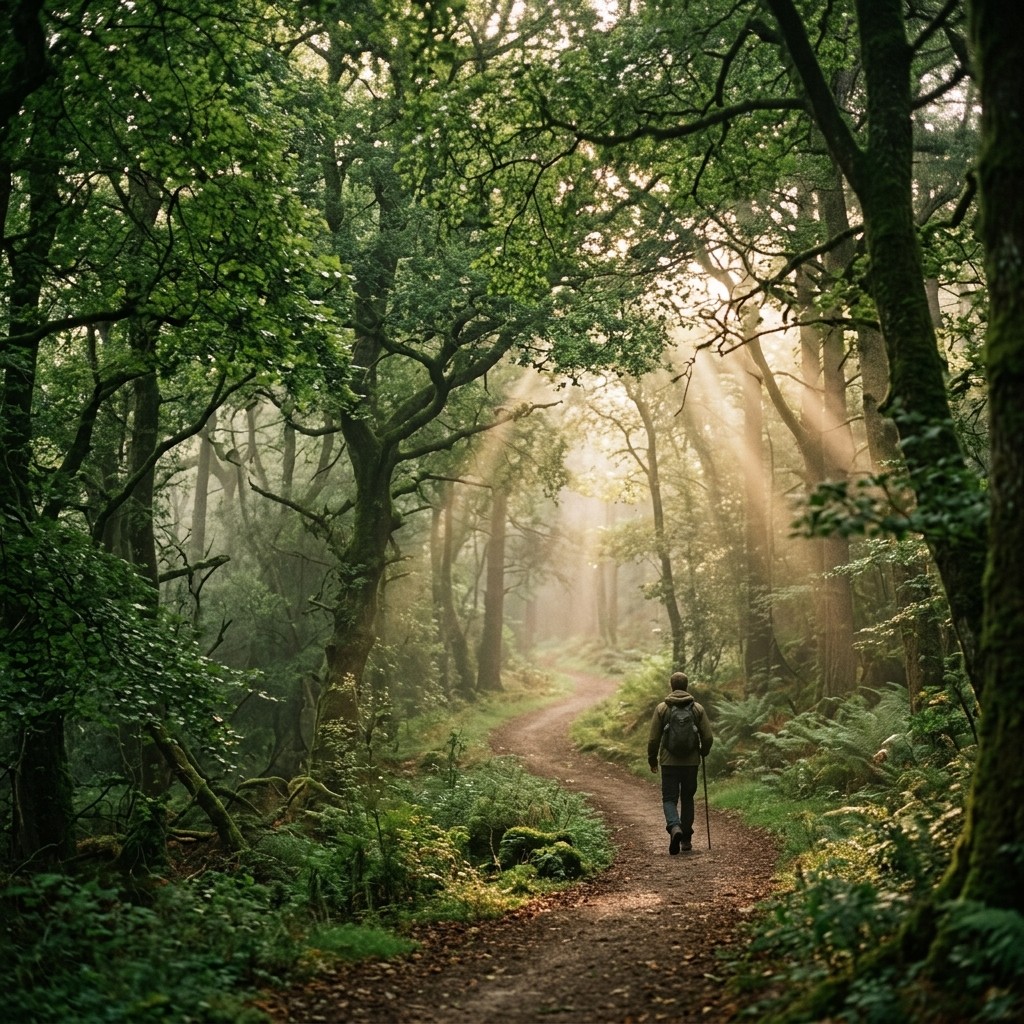
"In every walk with nature one receives far more than he seeks." — John Muir
In 1984, the journal Science published a study that should have changed architecture forever.
Roger Ulrich, an environmental psychologist, had examined the records of patients recovering from gallbladder surgery in a Pennsylvania hospital. The patients were essentially identical in every way that mattered — same procedure, similar ages and health profiles, the same nurses on the same ward. They differed in one detail: some recovery rooms looked out on a small stand of deciduous trees. Others faced a brown brick wall.
The patients with the tree view went home sooner. They requested fewer doses of strong painkillers. Nurses' notes recorded fewer negative comments about their condition.
A view of trees — not a walk among them, not a wilderness expedition, just photons reflected off leaves passing through a window — measurably changed the course of surgical recovery.
In the four decades since, an entire field has grown up around Ulrich's question: what exactly does nature do to us? The answers, drawn from neuroscience labs, epidemiological datasets covering millions of people, and randomized experiments on forest trails, are remarkably consistent. Time in green space lowers stress physiology, restores depleted attention, lifts mood, and is associated with better long-term mental and physical health — with effects large enough that researchers now talk seriously about "nature prescriptions."
Most of us are running a severe nature deficit without knowing it. Estimates from the U.S. Environmental Protection Agency's activity-pattern surveys suggest Americans spend roughly 90 percent of their lives indoors. We evolved in savannas and woodlands; we live in boxes, lit by screens.
This guide walks you through what the science actually shows, why nature works on the brain the way it does, and — most practically — how to dose it: how much, what kind, and how to get the benefits even in the middle of a city.
Part 1: The Evidence — What Happens to You in Green Space
Your Stress Physiology Stands Down
The most immediate and best-documented effect of nature exposure is a downshift in the stress response.
Japanese researchers have studied this systematically for decades under the banner of shinrin-yoku — "forest bathing," a term coined in the 1980s by Japan's forestry agency. In a series of field experiments led by researchers including Yoshifumi Miyazaki of Chiba University and Qing Li of Nippon Medical School, participants who walked in forests, compared to matched walks in city environments, showed lower cortisol, lower blood pressure, lower pulse rate, and a shift toward parasympathetic ("rest and digest") nervous system activity.
Li's work added an intriguing immune dimension: in small studies, participants who spent two or three days in forest environments showed increased activity of natural killer cells — immune cells involved in fighting infection and tumor surveillance — with elevations that persisted for days afterward. Li attributes part of the effect to phytoncides, the airborne compounds trees emit. The immune findings come from small samples and deserve hedging, but the cardiovascular and cortisol findings have been replicated many times across cultures.
The dose can be surprisingly small. A 2019 study by MaryCarol Hunter and colleagues in Frontiers in Psychology tracked salivary cortisol in urban dwellers who took regular "nature pills" — short sits or walks in any place that felt natural. Around 20 to 30 minutes was the sweet spot for the steepest drop in cortisol. Not a weekend in the mountains. Twenty minutes near trees.
Your Attention Comes Back Online
The second major effect targets something modern life relentlessly drains: your capacity to focus.
In the 1980s, psychologists Rachel and Stephen Kaplan at the University of Michigan developed Attention Restoration Theory. Their insight: directed attention — the effortful focus you use to write reports, resist distractions, and navigate traffic — is a depletable resource. Nature restores it because natural environments engage the mind in a different mode the Kaplans called soft fascination. Clouds drifting, leaves rustling, water moving — these hold attention gently, without demanding it, giving the brain's effortful control circuits a chance to recover.
The theory has held up well in testing. In a now-classic 2008 study in Psychological Science, Marc Berman, John Jonides, and Stephen Kaplan sent participants on a 50-minute walk through either an arboretum or downtown Ann Arbor, then tested their working memory and attention. The nature walkers improved markedly on backwards digit-span performance; the urban walkers did not. Strikingly, the effect held even when the arboretum walk happened in January in Michigan, in weather no one would call pleasant. Even viewing photographs of nature produced a smaller but measurable restoration.
Cognitive neuroscientist David Strayer at the University of Utah has pushed this further with what he calls the "three-day effect": in one small study with Ruth Ann Atchley and Paul Atchley, backpackers immersed in wilderness for several days, fully disconnected from devices, performed roughly 50 percent better on a creative problem-solving task. The study couldn't separate nature's effect from digital disconnection — and the authors said so — but the combination, at least, is potent.
Your Mood Lifts — and Rumination Quiets
If you've ever walked into a forest churning with worry and walked out lighter, there is now a brain-imaging study that mirrors your experience.
In 2015, Gregory Bratman and colleagues at Stanford published a study in PNAS in which participants took a 90-minute walk through either a natural area near campus or along a busy road. The nature walkers reported less rumination — that repetitive, self-critical loop of negative thought that is a known risk factor for depression — and showed reduced activity in the subgenual prefrontal cortex, a brain region associated with brooding self-focus.
The epidemiology agrees at scale. A 2019 study in PNAS led by Kristine Engemann used Danish registry data covering nearly one million people and found that children who grew up with the lowest levels of green space around their homes had meaningfully higher risk of developing psychiatric disorders in adolescence and adulthood, even after adjusting for socioeconomic factors, urbanization, and family history. The association was dose-dependent: more childhood green space, lower risk.
And in a striking 2008 paper in The Lancet, Richard Mitchell and Frank Popham analyzed mortality data across England and found that income-related health inequalities were substantially narrower in greener areas — suggesting green space may disproportionately protect those under the most socioeconomic stress.
Correlation caveats apply to all observational work, but the pattern is unusually robust: across countries, ages, and methods, more nature tracks with better mental health.
The Long Game: Green Space and Physical Health
The benefits extend well past mood and attention. A 2018 meta-analysis by Caoimhe Twohig-Bennett and Andy Jones at the University of East Anglia, published in Environmental Research, pooled data from over 140 studies covering hundreds of millions of people and found that higher green-space exposure was associated with lower salivary cortisol, lower heart rate and blood pressure, reduced incidence of type 2 diabetes, and lower all-cause and cardiovascular mortality.
One of the most compelling single datasets comes from the Nurses' Health Study: epidemiologist Peter James and colleagues at Harvard tracked more than 100,000 women over eight years and found that those living in the greenest surroundings had a roughly 12 percent lower rate of non-accidental mortality than those in the least green areas. Intriguingly, mediation analysis suggested a large share of the benefit flowed through mental health — lower depression — along with more physical activity, more social engagement, and less air pollution.
The honest caveat: people who live near parks differ from people who don't, and no statistical adjustment is perfect. But the dose-response gradients, the consistency across countries, and the emerging experimental evidence from greening trials together tell a coherent story. Green space behaves like a genuine health exposure — a low-grade, continuous input your biology registers and rewards.
The Dose Threshold: 120 Minutes a Week
How much do you actually need? In 2019, environmental psychologist Mathew White and colleagues at the University of Exeter analyzed survey data from nearly 20,000 people in England, published in Scientific Reports. The pattern was clean: people who spent at least 120 minutes a week in nature were significantly more likely to report good health and high well-being than those who spent none. Below two hours, the benefits weren't reliably detectable; the curve rose to a peak somewhere around 200–300 minutes and then plateaued.
Crucially, it didn't matter how the time was accumulated — one long Saturday hike or a series of short park visits worked equally well. Two hours a week. That is the emerging baseline of a minimum effective dose.
Part 2: Why Nature Works — The Mechanisms Behind the Effect
The Biophilia Hypothesis: You Were Built for This
The biologist E.O. Wilson proposed in 1984 that humans possess biophilia — an innate, evolved affinity for living things and natural environments. The logic is evolutionary: for hundreds of thousands of years, the ability to read landscapes — to recognize fertile ground, fresh water, safe refuge — was survival-relevant. Environments signaling resources and safety produced positive affect; that machinery is still in you, responding to greenery the way it responds to a smile.
Ulrich's own stress recovery theory builds on this: natural scenes containing water, vegetation, and open vistas with refuge trigger fast, pre-cognitive positive responses that interrupt stress arousal. You don't decide to relax in nature. The relaxation arrives before thought.
Fractals and the Effortless Eye
Part of the mechanism may be literally geometric. Natural forms — fern fronds, branching trees, coastlines, clouds — are fractal: patterns that repeat at different scales. Physicist Richard Taylor at the University of Oregon has shown that people show reduced physiological stress markers when viewing mid-range fractal patterns of the kind nature overwhelmingly produces, an effect he calls fractal fluency. The visual system, tuned by evolution to process these statistics, handles them with an ease that straight-edged, high-contrast built environments don't allow.
This may explain why nature restores attention rather than taxing it: the scenery is computationally cheap for your brain, freeing resources that city streets — with their signs, hazards, and decisions — constantly consume.
The Soundscape, the Microbiome, and the Light
Nature reaches you through every channel:
Sound. Lab studies, including work from Emil Stobbe and colleagues at the Max Planck Institute for Human Development, have found that listening to birdsong reduces anxiety and paranoia-related thoughts, while traffic noise does the opposite. Water sounds reliably rank among the most restorative in soundscape research.
Air and microbes. Beyond phytoncides, researchers in the "old friends" hypothesis tradition — building on work by immunologist Graham Rook — argue that exposure to the diverse, benign microorganisms of soil and vegetation helps train immune regulation, potentially reducing inflammatory dysregulation linked to depression. This line of evidence is younger and more speculative, but biologically plausible.
Light. Outdoor light, even on an overcast day, is an order of magnitude brighter than indoor lighting. That light anchors your circadian rhythm, boosts daytime alertness, and supports serotonin signaling. Some of nature's benefit is simply that nature happens outside, under real sky. (If you've read our guide to the circadian advantage, you'll recognize this as a two-for-one prescription.)
Awe. Psychologist Dacher Keltner at Berkeley has spent years studying awe — the emotion you feel before something vast, a canyon or a starfield. His research links awe experiences to reduced self-focus, increased generosity, and lower levels of pro-inflammatory cytokines in some studies. Nature is the most reliable, accessible awe generator humans have.
Part 3: The Nature Deficit — What Indoor Life Is Costing You
The Extinction of Experience
Ecologist Robert Pyle coined a haunting phrase: the extinction of experience. Each generation grows up with less contact with nature, and — having never known richer contact — doesn't miss it. Journalist Richard Louv popularized the consequences for children as "nature-deficit disorder" in his book Last Child in the Woods. It isn't a clinical diagnosis, but it names something real: as childhood moved indoors, rates of myopia surged (time outdoors is one of the best-documented protective factors against nearsightedness in children, per multiple cohort studies in East Asia and Australia), and unstructured outdoor play — with its benefits for motor development, risk calibration, and attention — contracted sharply.
Adults fare no better. The combination of indoor work, indoor leisure, and screen-saturated downtime means many people's daily nature exposure rounds to zero. You can be deficient in nature the way you can be deficient in sleep or vitamin D — and the symptoms are similarly diffuse: irritability, poor focus, low mood, a wound-up nervous system that never quite settles.
Cities Aren't the Enemy — Designed-Out Nature Is
It's tempting to read this research as an argument against urban living. It isn't. Cities offer enormous well-being advantages — opportunity, culture, the social connection that is itself a longevity factor. The problem is not the city; it is the biological monotony of badly designed urban space.
The research consistently shows that urban green infusions work. Frances "Ming" Kuo's studies of Chicago public housing in the 1990s and 2000s found that residents of buildings surrounded by trees and grass reported less aggression, better concentration, and stronger community ties than residents of identical buildings surrounded by concrete — a natural experiment, since residents were effectively randomly assigned. More recently, the Green Heart Louisville project — a controlled trial that planted thousands of mature trees in selected neighborhoods — reported reductions in residents' blood inflammation markers compared to non-greened areas, early evidence that greening itself, not just who chooses to live near green, drives the effect.
Street trees, pocket parks, green roofs, riverside paths: the dose is available in cities for those who learn to seek it.
The Children's Case for Nature
If the adult evidence is compelling, the case for children is arguably stronger and more urgent. Beyond the myopia protection noted above, time in nature is associated in numerous studies with better attention regulation in children — including reductions in the symptoms of attention difficulties. A frequently cited line of research by Andrea Faber Taylor and Frances Kuo found that children with ADHD concentrated better after activities in green settings than in built ones, and that the greener a child's everyday play environment, the milder their symptoms tended to be.
Nature also offers children something increasingly rare: unstructured, exploratory, slightly risky play — climbing, building, splashing, getting muddy — that supports motor development, risk calibration, creativity, and resilience. (This is where the nature prescription overlaps with the science of play.) Richard Louv's concept of "nature-deficit disorder," while not a clinical term, captures a real generational shift as childhood has moved indoors and onto screens. For families, the prescription is simple and consequential: get children outside, into green and wild places, as a regular, protected part of growing up. The habits and the benefits both compound over a lifetime.
Blue Space Counts Too
Green gets the headlines, but water — "blue space" — may be at least as potent. Mathew White's research group at Exeter has found that coastal and waterside environments often outperform parks in reported restoration, and census-based studies in England found better mental health among people living nearer the coast, with the effect strongest in lower-income groups. If you have access to a river, lake, or shoreline, weight it heavily in your nature portfolio.
Attention, Awe, and the Quieting of the Self
It's worth dwelling on one of nature's subtler gifts, because it may be among the most important: the way it gets you out of your own head. So much modern distress is self-referential — the looping, evaluative inner monologue of worry, comparison, and self-criticism that researchers link to anxiety and depression. The Stanford rumination study we met earlier showed nature literally quieting the brain region tied to this brooding self-focus.
Dacher Keltner's work on awe sharpens the point. Awe — the response to vastness that nature so reliably triggers, whether a mountain range, an old-growth forest, or a sky full of stars — produces what Keltner calls a "small self": a momentary dissolution of the ego's preoccupations in the face of something larger. In his studies, awe experiences increased generosity, humility, and a sense of connection to others, and were associated in some work with lower markers of inflammation. People reliably report that awe makes their personal troubles feel smaller and more manageable.
This is a profound and underrated mental-health mechanism. The relentless inward focus of modern life is exhausting, and nature offers an antidote that costs nothing: an outward pull, a reminder of scale, a quieting of the anxious narrator. Part of why you feel better after time outside is simply that, for a while, you stopped being the center of your own attention. In an age of curated self-presentation and endless self-monitoring, that relief is not small.
Part 4: The Nature Prescription — Protocols for Real Life
Doctors in several countries now literally prescribe nature — Park Rx programs in the United States, green social prescribing in the United Kingdom, nature prescriptions trialed in Scotland by the RSPB. You don't need to wait for a prescription pad. Write your own.
Protocol 1: The Daily Minimum — 20 Minutes of Soft Fascination
Based on the cortisol-dose research, anchor your day with at least one 20-to-30-minute outdoor session in the greenest place you can conveniently reach. Rules that matter, drawn from the study conditions:
- No phone, or phone in pocket on silent. Attention restoration requires that your attention actually goes to the environment. A nature walk spent on email is a corridor with better air.
- No hard exercise required. Walking or sitting both worked in the research. This is not a workout; it's a nervous-system intervention. (Exercise in nature — "green exercise" — is excellent too, but don't let the absence of workout clothes become an excuse.)
- Engage the senses deliberately. Forest-bathing practice formalizes this: notice five things you can see, four you can hear, three you can touch, the smell of the air, the temperature on your skin. This isn't mysticism — it's directing attention into the soft-fascination channel that drives the effect.
Protocol 2: The Weekly Dose — Hit 120 Minutes
Track your weekly nature minutes the way you'd track workouts. The Exeter data suggests it doesn't matter how you split it:
- The commuter route: re-route your walk or cycle through a park, even if it adds ten minutes. Ten minutes twice a day, five days a week, is your entire dose.
- The weekend block: one two-hour hike, garden session, or long park afternoon.
- The lunch reclaim: three 40-minute green lunches per week.
If you adopt only one habit from this article, make it this: two hours a week, in the greenest or bluest place available, attention outward.
Protocol 3: The Monthly Immersion and the Quarterly Deep Dose
Layer in longer exposures for the deeper effects:
- Monthly: a half-day immersion — a proper forest walk, a coastal day, a long ramble somewhere you can't hear traffic. Aim for the conditions of the shinrin-yoku studies: unhurried pace, frequent stops, no agenda.
- Quarterly: if at all possible, a multi-day dose — camping, a cabin, a walking holiday — ideally with sharply reduced screen time, in the spirit of Strayer's three-day effect. Treat it as cognitive maintenance, the way you'd service a car.
Protocol 4: Bring Nature Indoors (It Helps More Than You'd Think)
Indoor nature is not a full substitute, but the research on "micro-doses" is encouraging:
- A view matters. Ulrich's hospital patients only had a window. If you can orient your desk toward any vegetation — even a single street tree — do it. Rachel Kaplan's research on workplace and home window views found they predicted higher satisfaction and well-being.
- Plants in the room. Studies show modest but real effects of indoor plants on perceived stress and attention; at minimum, they add visual complexity of the fractal kind your visual system favors.
- Nature sounds and images. Lab work shows even photographs, videos, and recorded birdsong produce partial restoration effects. On a brutal day, ten minutes of a nature video with headphones is a legitimate intervention — a nicotine patch for the nature-deprived, not the cure, but better than nothing.
- Light first. Whatever else you do indoors, get outdoor light in the morning. It's the cheapest overlap between nature exposure and circadian health.
Protocol 5: Stack Nature With What You Already Do
The most durable habits piggyback on existing ones:
- Walking meetings for any call that doesn't need a screen — routed through the greenest available streets.
- Exercise outside at least once a week. Studies of green exercise, including work by Jo Barton and Jules Pretty at the University of Essex, suggest mood and self-esteem benefits appear quickly, with even the first five minutes outdoors producing measurable lift.
- Social time outdoors. Merge your social fitness training with your nature dose: walk with the friend instead of sitting in the café. Two longevity interventions, one hour.
- Gardening, if you have any patch of soil or even containers. It combines nature contact, light exercise, purpose, and — in community gardens — social connection, which is likely why gardening shows up repeatedly in well-being research as an outsized contributor.
Part 5: Tuning the Prescription — Quality, Season, and Mindset
Not All Green Is Equal
Research on environmental quality suggests a rough hierarchy of restorative potency. Biodiverse, mature, "wilder" environments — old woodland, varied coastline — tend to outperform manicured monoculture lawns. Richard Fuller and colleagues found that park users' reported psychological benefits scaled with the biodiversity of the park: more plant and bird species, more restoration. Water adds power. Quiet adds power; traffic noise subtracts it.
So when choosing between options, prefer: water over no water, trees over lawn, birdsong over traffic, winding paths over straight ones. But never let the perfect drive out the good — Berman's participants were restored by a January walk in Michigan, and Hunter's by patches of urban green.
Winter and Weather Are Not Disqualifiers
The benefits do not hibernate. Cold-weather nature exposure works — the Berman study proved restoration in freezing temperatures, and Scandinavian cultures institutionalize outdoor life year-round under the Norwegian concept of friluftsliv ("open-air living"). The practical rule, often attributed to a Scandinavian proverb: there's no bad weather, only bad clothing. Buy the rain jacket. The dose matters more than the comfort.
Mindset Multiplies the Dose
Finally, attention is the active ingredient. Research by Holli-Anne Passmore at the University of British Columbia's Okanagan campus found that simply instructing people to notice nature in their daily routine — photographing or jotting down natural things that caught their eye and how they felt — significantly boosted well-being over two weeks compared to controls. Participants weren't asked to add a single minute outdoors. They were asked to notice what was already there.
Nature exposure is not just a place you go. It is a mode of attention you bring. The tree on your street has been offering its dose all along.
Honest Caveats: Allergies, Access, and the Limits of the Evidence
A balanced prescription acknowledges side effects and constraints. If you have pollen allergies, time your doses around pollen counts and favor coastal or post-rain outings. In tick or sun-exposed regions, take the standard precautions — long trousers, repellent, sunscreen; none of these meaningfully blunt the psychological benefits.
Access is the harder problem. Green space is unevenly distributed, usually along income lines — the very populations the Mitchell and Popham data suggest would benefit most often have the least nearby. If that describes your situation, the research still offers leverage: street trees count, balconies with plants count, indoor nature and even digital nature deliver partial doses, and a longer weekly journey to a proper park remains one of the highest-yield uses of free time the literature can point to. And when your city debates a park budget, you now know what's actually on the ballot: a public health intervention.
Finally, hold the science with appropriate confidence. Effect sizes in individual experiments are typically modest; nature is a contributor to mental health, not a cure for clinical conditions, and no one should swap therapy or medication for a forest without medical guidance. But as a near-free, zero-risk adjunct with evidence across dozens of methods and millions of people, it has few rivals.
Conclusion: Go Outside Like Your Health Depends on It
Forty years after Ulrich's gallbladder patients healed faster looking at trees, the evidence has only deepened: your nervous system, your immune system, your attention, and your mood are all listening for nature — and modern life has gone quiet on that channel.
The prescription is almost suspiciously simple. Twenty minutes most days. Two hours a week. A deeper immersion when you can manage it. Attention outward, phone away, senses on.
No co-pay. No side effects. Available at every latitude, in every season, at the end of nearly every street.
You evolved outdoors. Visiting isn't a luxury — it's maintenance.
Action Steps: Fill Your Nature Prescription
Schedule your daily 20. Pick a specific time — morning coffee, lunch, after dinner — and a specific green spot within reach. Twenty minutes, phone silenced, attention on the environment. Start tomorrow.
Hit 120 minutes this week. Tally your weekly nature time in your notes app or journal. If Sunday arrives and you're short, take the long walk. Treat two hours as the floor, not the goal.
Re-route one routine. Find the greenest version of a journey you already make — commute, school run, gym route — and make it your default path this month.
Greenify your line of sight. Move your desk toward a window with any vegetation in view, or place two or three plants where you spend the most hours. Add a nature image or birdsong track for the hardest days.
Book the immersion. Put a half-day nature outing on the calendar within the next four weeks, and a multi-day, low-screen trip within the next three months. Unbooked intentions evaporate; booked ones happen.
Take one workout and one friendship outside each week. Green exercise and outdoor social time stack three evidence-backed well-being interventions into single hours.
Practice noticing for 14 days. Once a day, photograph or write one sentence about something natural that caught your attention and how it made you feel. You're training the mode of attention that makes every future dose stronger.
The trees are already outside your door. Go meet them.