
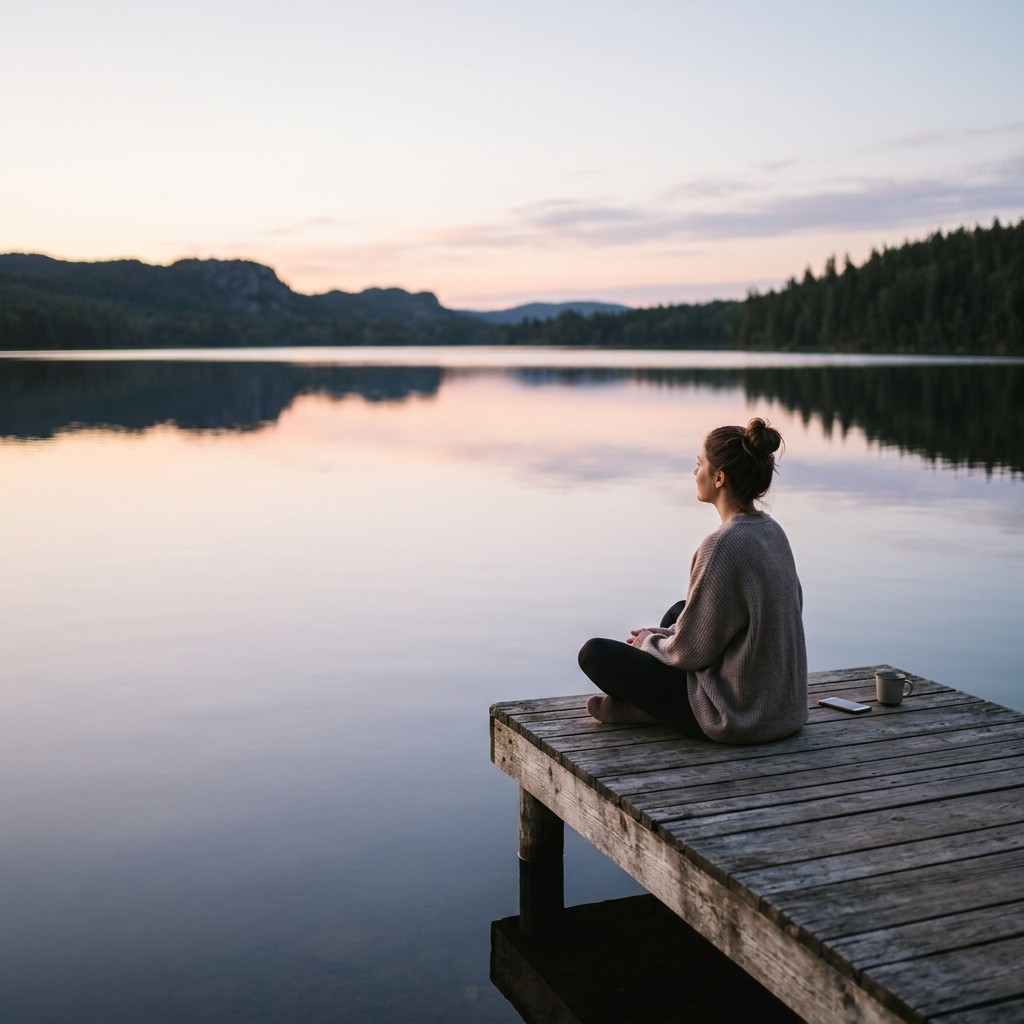
"All of humanity's problems stem from man's inability to sit quietly in a room alone." — Blaise Pascal
In 2014, psychologist Timothy Wilson and his colleagues at the University of Virginia published a study that said something uncomfortable about all of us.
Participants were asked to do one simple thing: sit alone in a plain room for six to fifteen minutes with nothing but their own thoughts. No phone, no book, no task. Most found it difficult and unpleasant. So the researchers added a twist. They gave participants the option to administer themselves a painful electric shock — one they had already experienced and said they would pay money to avoid — as the only available distraction.
Sixty-seven percent of the men and twenty-five percent of the women shocked themselves rather than simply sit with their minds. One participant shocked himself 190 times.
Pascal made his observation in the 1600s. It took until the smartphone era for us to prove him right in a laboratory.
Here is the strange contradiction of our moment: loneliness is rightly treated as a public health crisis — the research linking chronic loneliness to depression, cardiovascular disease, and early mortality is robust and sobering. And yet, at the very same time, genuine solitude — chosen, comfortable, fruitful time alone — has nearly vanished from ordinary life. We are increasingly lonely and decreasingly alone. Every queue, commute, bathroom break, and quiet evening is now filled with other people's voices streaming through a glass rectangle.
These are not the same thing, and confusing them is costing you something important. Loneliness is the pain of unwanted isolation. Solitude is the gift of chosen aloneness. One corrodes health; the other, a growing body of research suggests, is essential to emotional regulation, creativity, self-knowledge, and the very ability to be good company — for others and for yourself.
This guide is about recovering that lost capacity: what solitude actually does for your mind, why it feels so hard at first, and how to rebuild a deliberate practice of being alone — not as withdrawal from life, but as one of its deepest supports.
Part 1: Alone vs. Lonely — Getting the Distinction Right
Two Different States, Two Different Outcomes
The scientific literature is unambiguous that chronic loneliness is harmful. The late John Cacioppo of the University of Chicago, who pioneered the field, showed that loneliness functions like a biological alarm — a signal, akin to hunger or thirst, that a fundamental need (connection) is unmet. Left blaring for years, that alarm is associated with elevated stress hormones, inflammation, worse sleep, and meaningfully increased mortality risk; a widely cited meta-analysis by Julianne Holt-Lunstad placed the health impact of social disconnection in the same league as major lifestyle risk factors.
But notice what defines loneliness: it is subjective and unwanted. It's the gap between the connection you have and the connection you want. You can be lonely in a crowded office or a marriage; you can be profoundly un-lonely on a solo week in the mountains.
Solitude is a different axis entirely: the objective state of being alone, which can be experienced as deprivation or as freedom depending on one factor above all — choice. Research consistently finds that self-chosen time alone, undertaken for positive reasons, relates to better well-being, while aloneness that is imposed, or chosen only to escape social anxiety, relates to worse. The same empty room is a cell or a sanctuary depending on whether you hold the key.
The Deactivation Effect
Some of the most careful modern work on solitude comes from psychologist Thuy-vy Nguyen of Durham University, who has run a series of experiments asking what fifteen minutes of simply being alone, without devices, actually does to emotional state.
The consistent finding — replicated across several studies she conducted with Netta Weinstein and Richard Ryan — is what they call the deactivation effect: solitude reliably reduces high-arousal emotions. The exciting edge of joy comes down, but so do anger, anxiety, and agitation. In their place, low-arousal states — calm, relaxation, and sometimes mild boredom — rise. Solitude, in other words, functions as a kind of emotional pressure valve: it doesn't make you happy so much as it makes you settled.
That reframe matters enormously for expectations. If you walk into solitude expecting bliss, the quiet flatness can feel like failure. Understood correctly, that down-regulation is the benefit: a nervous system given a chance to come off high alert. Nguyen's work also suggests the effects improve with framing and practice — people who view time alone as valuable, and who choose it freely, get more from it.
Solitude Deprivation
Cal Newport, the computer scientist and author of Digital Minimalism, gave a useful name to our modern condition: solitude deprivation — a state in which you spend close to zero time alone with your own thoughts, free from input from other minds. His definition of solitude is instructive: it's not physical isolation, but freedom from inputs. You can be in solitude on a crowded train if you're alone with your thoughts; you are not in solitude alone in the woods with a podcast playing.
By that definition, many people now experience essentially no solitude at all — every interstitial moment is filled. The generation that came of age with smartphones is the first in human history able to banish solitude entirely, and Newport, drawing on researchers like Jean Twenge, has argued this may be one thread in rising anxiety among heavy users — though it's fair to say the causal science on screens and mental health remains contested and complicated.
What's not contested is the arithmetic: the average person now spends several hours a day on a phone, largely harvested from precisely the moments — walks, waits, commutes, falling asleep — where unstructured thought used to live. Whatever solitude was doing for every previous generation of human minds, we have, in about fifteen years, almost entirely stopped doing it. The rest of this article is about what that "something" is.
Part 2: What Solitude Does for Your Mind
The Default Mode: Your Brain's Background Work
When you stop focusing on external tasks and inputs, your brain doesn't idle. A network of regions — the default mode network (DMN), first characterized by neuroscientist Marcus Raichle in 2001 — becomes more active. The DMN is associated with the mind's most distinctively human work: autobiographical memory, imagining the future, taking others' perspectives, moral reflection, and weaving experience into a coherent sense of self.
Researcher Mary Helen Immordino-Yang and colleagues, reviewing this literature, argued that constructive internal reflection — the kind that happens during rest and mind-wandering — is critical for consolidating memory, deriving meaning from experience, and developing identity, and they warned that environments demanding constant external attention may shortchange it. The brain seems to need offline time the way a city needs night: it's when the maintenance crews come out.
This is also the engine of the famous "shower insight." Research on incubation effects — including studies by Benjamin Baird and Jonathan Schooler — has found that stepping away from a problem into undemanding activity that permits mind-wandering improves subsequent creative output on that problem, more than either continued grinding or demanding distraction. The mind, freed from the steering wheel, keeps driving — and often takes better roads. Sandi Mann's playful experiments at the University of Central Lancashire found that participants first bored deliberately (copying phone numbers, reading the phone book) later generated more creative ideas than controls. Boredom, that state we now reflexively anesthetize, appears to be one of creativity's raw materials.
Every time you reach for your phone in a dull moment, you are interrupting your brain's R&D department.
Restoring Depleted Attention
A second, distinct benefit comes from the environments where solitude often happens. Attention restoration theory, developed by Rachel and Stephen Kaplan at the University of Michigan, holds that directed attention — the focused, effortful kind your work demands — is a depletable resource, and that it recovers in settings rich in "soft fascination": natural environments that gently hold the eye without demanding anything. Studies by Marc Berman and colleagues found that a walk in an arboretum improved memory and attention performance significantly more than an equivalent walk down city streets.
Solitude and nature aren't the same intervention, but they stack beautifully: a solo walk in a park delivers input-freedom for the default mode network and restorative softness for the attention system at once. It is probably the single highest-value forty-five minutes of "doing nothing" available to a modern person.
Self-Knowledge and the Inner Voice
There is also a quieter, longer-term return on solitude: it is where you find out what you actually think.
Social life — for all its irreplaceable value — is also a continuous performance under observation, and a continuous stream of other people's opinions, expectations, and emotional weather. Developmental psychologists going back to Donald Winnicott, who wrote of the "capacity to be alone" as a developmental achievement, and researchers like Reed Larson, who studied adolescents' time alone, have observed that solitude serves identity: Larson's experience-sampling studies found that teenagers who spent a moderate amount of time alone (not none, not most) were better adjusted than their peers, and that time alone — though rated as less pleasant in the moment — was followed by improved mood.
Writing deepens this function. James Pennebaker's decades of research at the University of Texas on expressive writing — fifteen to twenty minutes of private writing about emotionally significant experiences, repeated over several days — have documented modest but real benefits to mood, health markers, and even immune function across many (though not all) studies. The mechanism appears to be exactly what solitude offers in general: the chance to translate raw, looping experience into language and narrative, where it can be examined, organized, and set down.
Without solitude, you outsource the question of who you are to whoever happens to be loudest in your feed.
The Creative Record
Beyond the laboratory, there's the testimony of the people whose output speaks for itself. The psychiatrist Anthony Storr, in his classic book Solitude: A Return to the Self, surveyed the lives of history's most creative minds and mounted a sustained argument against his own profession's assumption that intimate relationships are the sole hinge of a meaningful life. Newton, Kant, Kierkegaard, Beethoven in his deafness, Emily Dickinson, Wittgenstein — again and again, the deepest creative work emerged from lives structured around protected aloneness. Storr's point was not that relationships don't matter; it was that the capacity for solitude is a second, equally legitimate axis of human fulfillment, and that our culture's relentless framing of aloneness as pathology impoverishes us.
The pattern persists among moderns who could choose any working style they want. Picasso said that "without great solitude, no serious work is possible." The composer Gustav Mahler worked in tiny one-room huts built specifically for isolation. Maya Angelou rented bare hotel rooms to write in. Susan Cain's Quiet, drawing on decades of research on introversion, documents how many breakthroughs — from the theory of evolution to the personal computer — were incubated in deliberate withdrawal, and psychologist Mihaly Csikszentmihalyi, who studied creative eminence for decades, observed bluntly that adolescents who cannot tolerate being alone often fail to develop their talents, because the hardest skill-building is almost always done solo.
None of this proves solitude causes genius. But the convergence is hard to dismiss: deep work and deep originality seem to require sustained periods where no other mind is in the room — because only then does your own mind stop harmonizing with the chorus and find its actual pitch.
Part 3: Why It Feels So Hard — and How to Begin
The Discomfort Is the Doorway
Return to Wilson's shock study. Why would sitting quietly be so aversive that pain beats it?
Part of the answer is simple deconditioning: attention, like any capacity, adapts to its diet, and a mind fed continuous stimulation for years finds stillness intolerable at first — the same way a body off the couch finds a jog intolerable. Part is content: an unoccupied mind drifts toward unresolved things — the awkward conversation, the dodged decision, the fear you've been outrunning with busyness. Constant input isn't just entertainment; for many of us it is avoidance, and the first minutes of real solitude are when the avoided material knocks.
Both problems yield to the same treatment: graded exposure. You don't begin with a silent weekend. You begin with minutes, and you expect them to feel itchy. The itch is not a sign that solitude isn't working — it's the withdrawal symptom of an overstimulated attention system, and it passes, usually faster than you fear. Nguyen's research suggests even brief sessions deliver the emotional deactivation effect, and that comfort grows with repetition and with simply understanding what solitude is for.
One caution, offered honestly: solitude is not for every moment or every mind-state. If you're in the grip of serious depression, time alone can curdle into rumination — the repetitive negative thought loops that Susan Nolen-Hoeksema's research showed deepen low mood. The practices below favor structured solitude (walking, writing, observing) over formless brooding for exactly this reason. And if being alone consistently makes things darker rather than calmer, treat that as information worth bringing to a professional, not a personal failing.
The Starter Protocol: Reclaiming the Gaps
Begin not by adding solitude to your schedule but by uncovering the solitude your schedule already contains:
Week 1 — Naked moments. Choose three daily situations where you reflexively reach for your phone — the queue, the kettle, the elevator, the walk to the car — and simply don't. Stand there. Look around. Let the mind do what it does. This costs zero minutes and begins retraining the reflex.
Week 2 — The unplugged walk. Three times this week, take a 15–30 minute walk with no phone, no podcast, no companion. Green space if you can get it. No agenda beyond noticing where your mind goes. This is the workhorse practice — input-free, mildly physical, structurally protected from rumination by motion and scenery.
Week 3 — The sitting session. Add one 15-minute daily sit: a chair, a notebook within reach, nothing else. You may think, plan, remember, or stare. If a thought wants keeping, jot it. This is harder than walking; that's why it comes third.
Week 4 — The solo block. Take yourself somewhere alone for two to three hours — a hike, a museum, a café with only a notebook, a long drive without audio. Many people haven't done this in years and are startled by how much happens inside it.
Journaling: Solitude With a Handrail
If raw mental drifting feels unbearable or unproductive, write. Three structures, each backed by its own research lineage:
- Expressive writing (Pennebaker): 15–20 minutes on something emotionally significant, continuous writing, for your eyes only, three or four days running. Best for processing difficult experiences.
- Morning pages: three longhand pages of whatever crosses the mind, on waking. Unscientific in origin (Julia Cameron's The Artist's Way) but functionally a daily mind-clearing and a gentle on-ramp to inner quiet.
- Evening examination: five minutes on three questions — What happened today that mattered? What did I do well or badly? What does tomorrow need from me? — a practice as old as the Stoics; Seneca described reviewing his entire day each night.
Part 4: Building a Life With Solitude in It
Solitude for Decisions: The Leader's Case
There's a specific, hard-nosed application worth separating out: judgment. Raymond Kethledge, a federal judge, and Michael Erwin, an army officer and psychologist, interviewed dozens of leaders for their book Lead Yourself First and found a consistent practice beneath the best decisions: deliberate withdrawal to think. Eisenhower drafting his thoughts alone before D-Day. Lincoln working through Emancipation in solitary hours. The pattern matches what the cognitive research predicts: first-rate decisions require distinguishing your actual assessment from absorbed consensus, and consensus is precisely what a connected mind marinates in all day.
Social psychology has documented the pressure side of this since Solomon Asch's famous conformity experiments in the 1950s, where a substantial share of participants denied the plain evidence of their own eyes rather than contradict a unanimous group. You are not exempt; nobody is. Every meeting, every thread, every feed exerts a quiet gravitational pull on your judgment. Solitude is the only reliable counterweight — the room where you find out what you think before the group tells you what to think.
The practical version for ordinary working life: never make a significant decision in the meeting where it's discussed. Take the question for a walk first — alone, unplugged, even just twenty minutes. Write your position in a notebook before reading anyone else's. You'll be startled how often the solitary answer differs from the one you'd have nodded along to — and how much better you can defend whichever answer you ultimately choose.
Solitude Is Not Meditation (and Doesn't Have to Be)
A common point of confusion deserves clearing up: solitude is not a meditation practice, and you don't have to meditate to do it. Meditation typically involves a specific attentional technique — following the breath, noting thoughts, sustaining a focus. Solitude has no technique. It is simply your mind, unplugged from inputs, allowed to go where it goes: planning, remembering, daydreaming, problem-chewing, drifting.
Both are valuable; they're just different tools. Meditation trains attention itself and has its own deep evidence base. Solitude gives the default mode network free rein — the very network many meditation styles quiet. If meditation has always felt like a struggle, that's no barrier here: a phoneless walk requires no technique, no posture, and no instruction beyond leave the earbuds at home. And if you already meditate, solitude is the complement, not the substitute — the unstructured counterpart where consolidation and incubation get their hours.
The Daily Architecture
Sustainable solitude isn't a retreat you take; it's a rhythm you keep. A realistic adult dose:
- Morning buffer (10–15 min): the first minutes after waking, before the phone — coffee at a window, a short journal entry, silence. How you spend the first quarter-hour determines whether you start the day as the author of your attention or its tenant.
- One unplugged transition (15–45 min): a walk, a commute leg without audio, lunch alone without a screen, twice a day if you can manage it once you've tasted the difference.
- Evening closure (10 min): journaling or quiet review before sleep, instead of scrolling until unconsciousness.
That's well under an hour, mostly carved from time currently donated to your phone. Protect it like a meeting; call it thinking time if "solitude" sounds too monastic for your culture.
The Weekly and Seasonal Doses
Add one half-day solo block per month at minimum — the hike, the long walk through the city, the unaccompanied museum. And if you can manage it once a year, take twenty-four fully offline hours. People who do this regularly describe the same arc: agitation, then boredom, then — somewhere past the boredom — a quality of thinking and ease they'd forgotten they had. Friedrich Nietzsche, Virginia Woolf, and nearly every contemplative tradition arrived at the same prescription by experience; the research above merely explains why it works.
A note on the social friction you'll meet: our culture reads aloneness as a problem to be solved. Eat alone in a restaurant and someone may pity you; block out solo time and colleagues may assume you're available "since you're not doing anything." Research on what's been called the "inhibited sociality" effect — studies by Nicholas Epley and Juliana Schroeder on commuters, and work by Rebecca Ratner on solo activities — shows people systematically overestimate how awkward or unenjoyable doing things alone will be, and so deprive themselves of concerts, museums, and meals they'd actually enjoy. Treat the awkwardness as a forecast error, not a fact. Go anyway. The data say you'll enjoy it more than you predict — and the second time, the forecast corrects itself.
Solitude in Service of Connection
A final reframe, because the deepest misunderstanding about solitude is that it competes with relationships. The evidence and the lived testimony both point the other way. Emotional regulation built in solitude is what you bring home to your family on a hard day. The self-knowledge built in reflection is what makes your commitments chosen rather than drifted-into. Winnicott observed that the capacity to be alone is paradoxically the foundation of mature intimacy — only the person who doesn't need constant company can freely give and receive it.
The poet Rainer Maria Rilke, in Letters to a Young Poet, described love itself as two solitudes that "protect and border and salute each other." That's the goal — not a fortress, but a well. You go alone to the well so that you have something to pour when you return.
The room Pascal wrote about is still there. It's been waiting four hundred years, and it's quieter than ever. Go sit in it.
Action Steps: Reclaim Your Solitude
Strip three daily moments naked. Pick three habitual phone-grab situations — queues, kettles, elevators — and face them input-free starting today. The itch is the exercise.
Walk unplugged three times this week. Fifteen to thirty minutes, no phone or one left in your pocket on silent, no audio, green space when possible. Treat it as a non-negotiable appointment.
Move your phone out of arm's reach at the edges of the day. Charge it outside the bedroom; don't touch it for the first fifteen minutes after waking. The morning buffer is your daily minimum dose of solitude.
Start a ten-minute journal. Choose one structure — expressive writing for something heavy, an evening three-question review otherwise — and do it daily for two weeks before judging it.
Schedule one solo block this month. Two to three hours, alone, phone off or absent: a hike, a museum, a café with a notebook. Put it in the calendar now, not "sometime."
Distinguish your states honestly. When alone, ask: chosen or stuck? Settling or spiraling? If solitude consistently turns to dark rumination, add structure (walking, writing) — and if that doesn't shift it, talk to someone qualified.
Tell the people close to you what you're doing. Solitude sustained in secret looks like withdrawal; solitude explained becomes something your relationships can support — and benefit from.
You are the one person you will never be apart from. It's worth learning to enjoy the company.