
Most travellers treat Kanyakumari like a photograph rather than a district.
They arrive overnight on a train or swing down for an afternoon from Kovalam, rush onto the shore for sunrise, queue for the ferry to Vivekananda Rock Memorial, glance at the Thiruvalluvar Statue, buy a seashell key-ring near the promenade, and depart by dusk convinced they have seen Land's End.
It is one of the quietest travel mistakes in southern India.
For centuries, Kanyakumari district was not a sleepy border town—it was the heartland of Venad and Travancore, wedged between the Western Ghats and three seas. Drive twenty minutes inland from the salt spray and the scenery flips completely: coconut groves give way to nutmeg gardens, granite hills hide 9th-century Jain caves, and a palace built almost entirely of rosewood and teak rises quietly under the shadow of Veli Hills.
Here are eleven places across Kanyakumari district that turn a hurried half-day stop into one of the richest short journeys in India—grouped cleanly so you can explore them without spending half your week in traffic.
1. Padmanabhapuram Palace: A Kerala Palace Standing on Tamil Soil
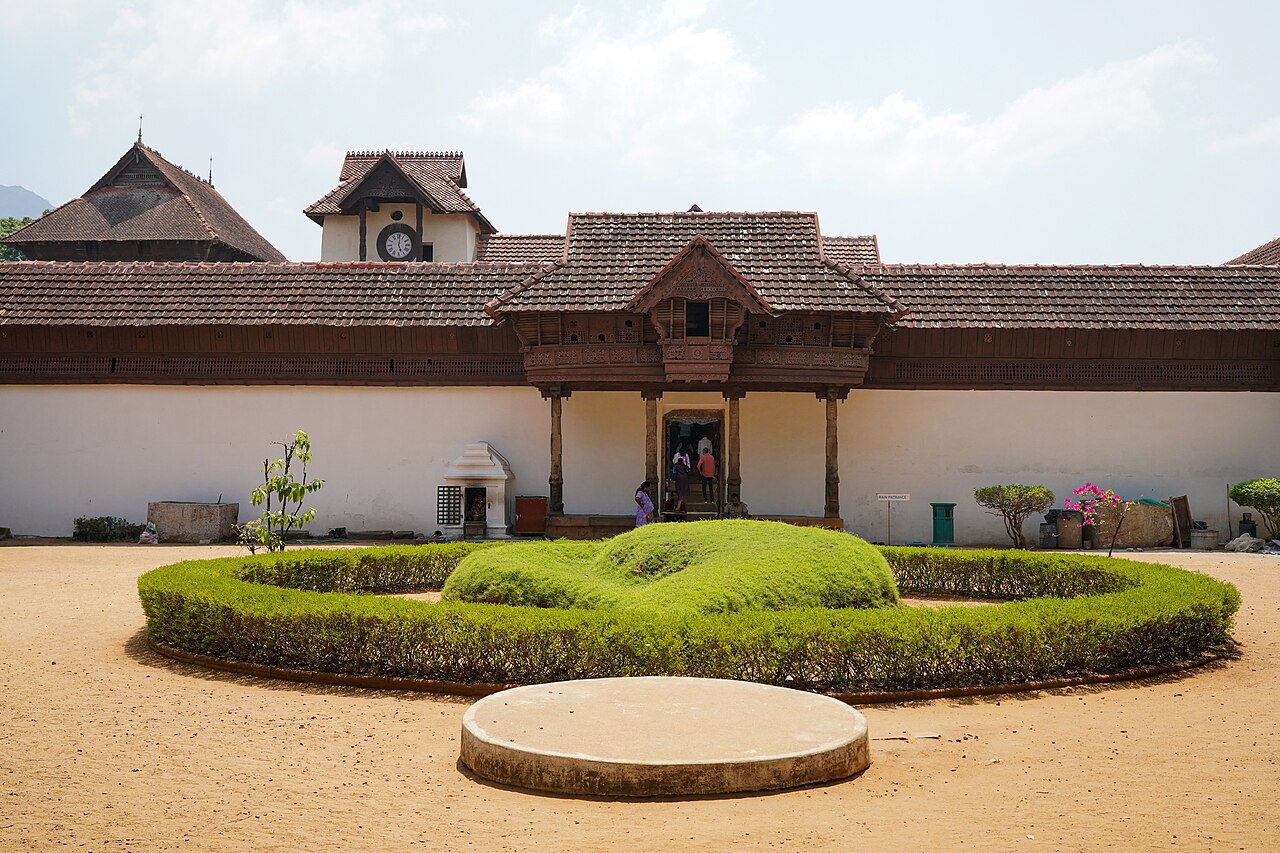
Walk barefoot across the polished black floor of Padmanabhapuram Palace at Thuckalay (about 35 km north-west of Kanyakumari) and you immediately understand why the Travancore kings resisted moving their capital until the late 18th century.
Built from the late 16th century onward—starting with the Thai Kottaram (Mother Palace)—this is among the largest surviving wooden palaces in Asia. Teak, jackfruit wood, and rosewood are joined without iron nails across four-storey council halls, secret underground escape passages, Belgian mirrors, and coffered ceilings carved with ninety-plus distinct lotus rosettes. Even on a blistering April afternoon, the dark timber corridors feel naturally air-conditioned.
Curiously, although Padmanabhapuram sits squarely inside Tamil Nadu's Kanyakumari district, it is still owned and maintained by the Government of Kerala under post-independence state reorganization agreements.
- Practical note: Closed on Mondays. Open 09:00–12:30 and 14:00–16:30 (entry around ₹50 for Indian adults and ₹500 for foreign visitors). Arrive right at 09:00 before school buses pull in. Read the full architectural story in Teak, Mirrors, and Secret Passages: Inside Padmanabhapuram Palace.
2. Thanumalayan Temple, Suchindram: Granite That Sings
Thirteen kilometres north of Kanyakumari sits a temple whose very name stitches India's Hindu trinity into a single word: Sthanu (Shiva), Mal (Vishnu), and Ayan (Brahma).
Crowned by a towering 134-foot white gopuram, Suchindram's Thanumalayan Temple carries layers of Chera, Pandya, Nayak, and Travancore stonework. Inside its Alankara Mandapam, monolithic stone columns carved from single blocks of granite produce distinct musical notes—sa, re, ga, ma—when gently tapped (today protected behind railings to preserve the stone). Near the entrance stands an immense 22-foot monolithic Hanuman figure, while quiet corridors echo with temple bells at dawn.
- Practical note: Traditional or modest attire is expected; men are commonly asked to remove shirts inside the inner precincts, and interior photography is restricted. Visit between 06:30 and 09:30 AM before midday closure (roughly 11:30–17:00).
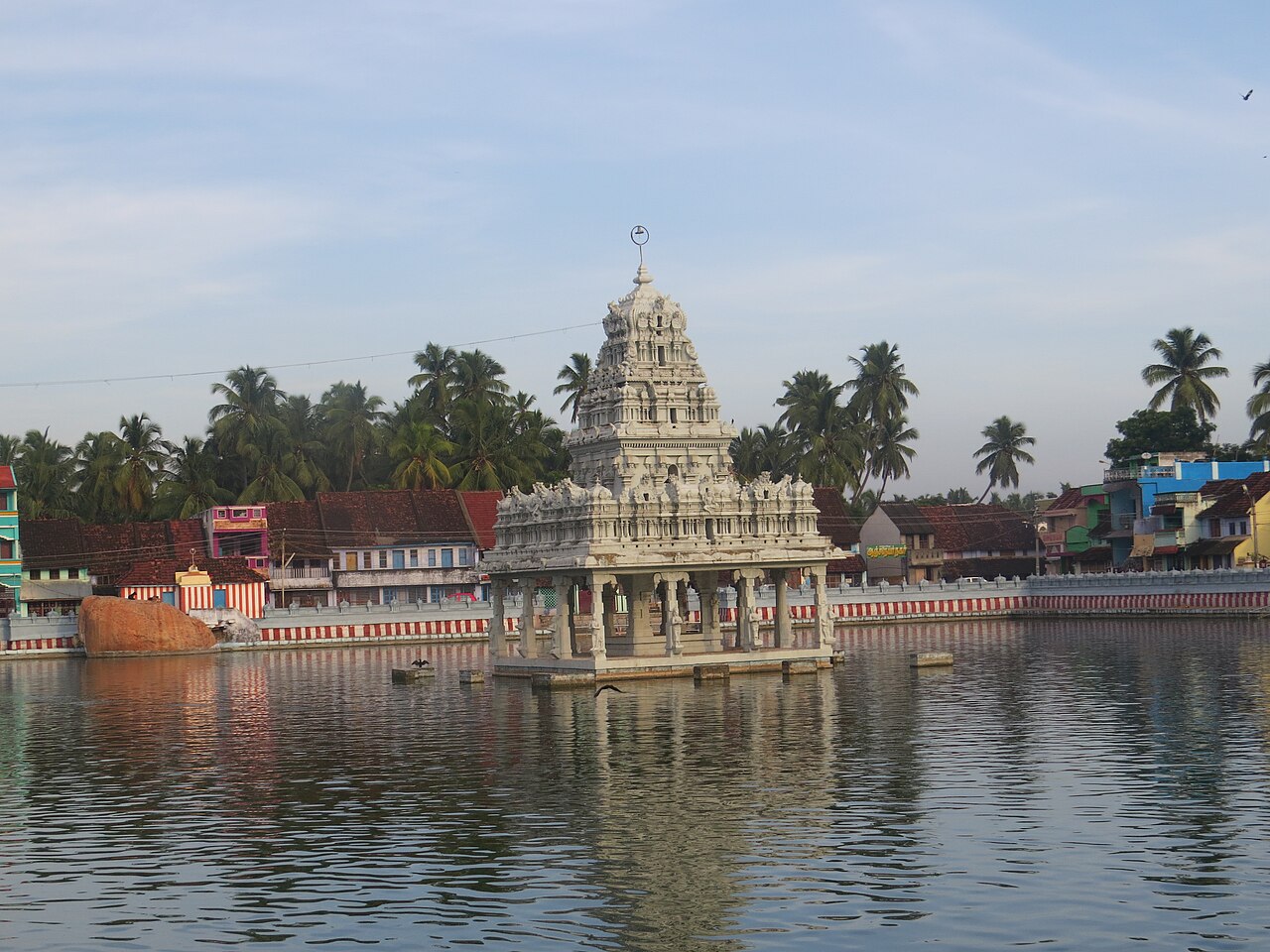 The carved seven-storey gopuram of Thanumalayan Temple in Suchindram. Photo: Vinayaraj, CC BY-SA 4.0, via Wikimedia Commons.
3. Vattakottai Fort: Where Granite Ramparts Meet Black Sand
Just 7 km north-east of Kanyakumari town stands Vattakottai ("Circular Fort"), an 18th-century granite sea bastion constructed for the Travancore kingdom and later fortified under Captain Eustachius De Lannoy.
Unlike crowded coastal viewpoints, Vattakottai feels blissfully spacious. Climb onto the broad stone ramparts and look left: the blue hills of the Western Ghats sweep down almost to the shore. Look right: breakers crash against black-mineral sands and a projecting stone watchtower washed by high tide.
- Practical note: Protected by the Archaeological Survey of India (ASI). Confirm daylight gate hours locally (usually around 08:00–17:00; some listings note Friday closures). Late afternoon light turns the granite warm amber.
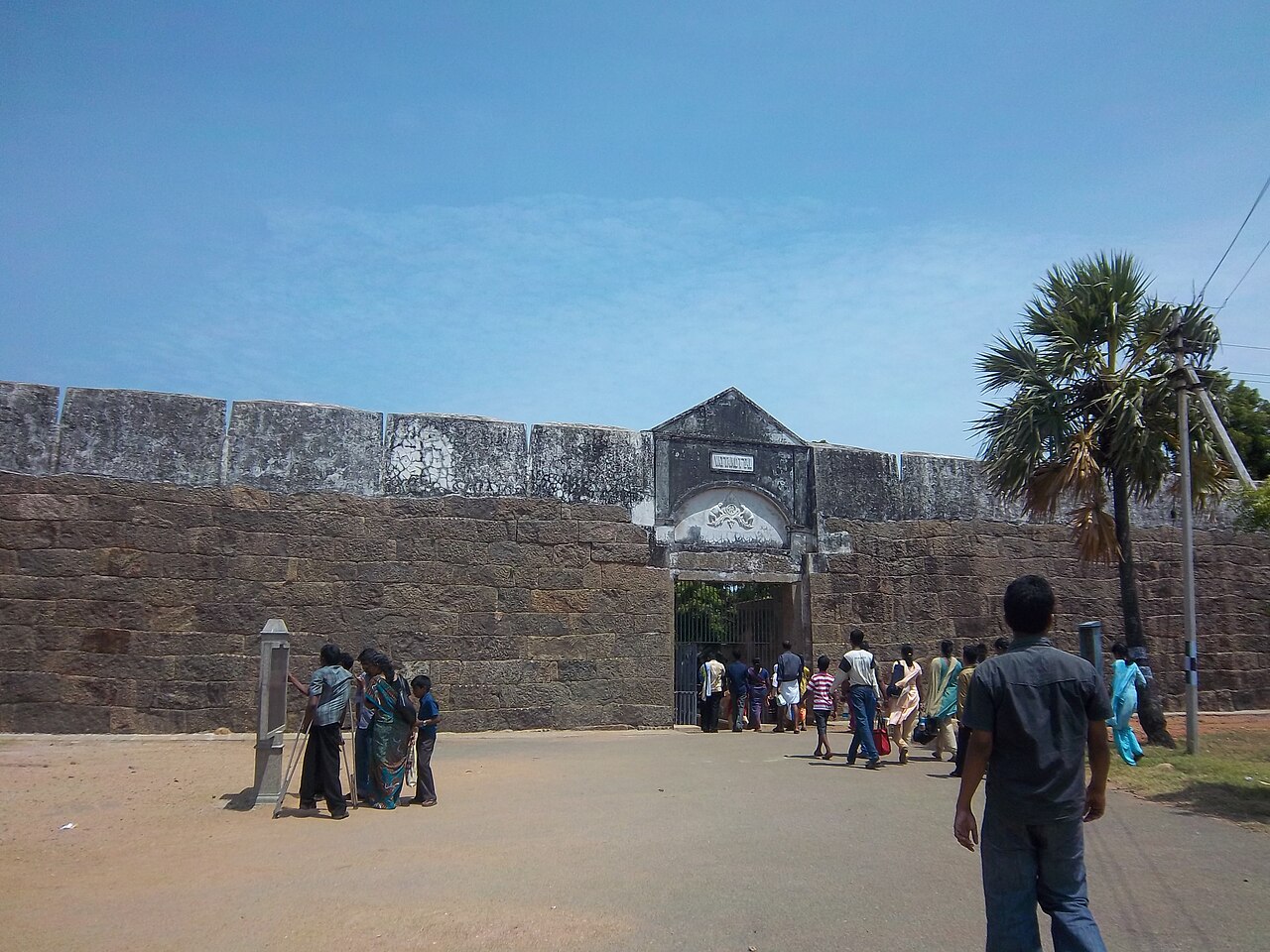 Ramparts of Vattakottai Fort overlooking the coast and the southern tail of the Western Ghats. Photo: Devasyapratimah, CC BY-SA 3.0, via Wikimedia Commons.
4. Mathur Hanging Aqueduct: Walking Above Coconut Canopies
Imagine an elevated concrete river channel suspended 115 feet above a lush valley, carrying water across a deep gorge between two hills on twenty-eight towering pillars.
Built in 1966 as an irrigation lifeline across the Pahrali river valley (about 45 km from Kanyakumari), Mathur Aqueduct is the longest and tallest trough bridge of its kind in South Asia. Visitors walk along the narrow footway directly beside the rushing aqueduct water—looking straight down onto endless waves of rubber trees, jackfruit canopies, and distant mist rolling off the Ghats.
- Practical note: There is zero shade on top of the trough; bring a hat and water, and avoid mid-afternoon glare. Pair it cleanly on the same day loop with Padmanabhapuram Palace and Thirparappu Falls.
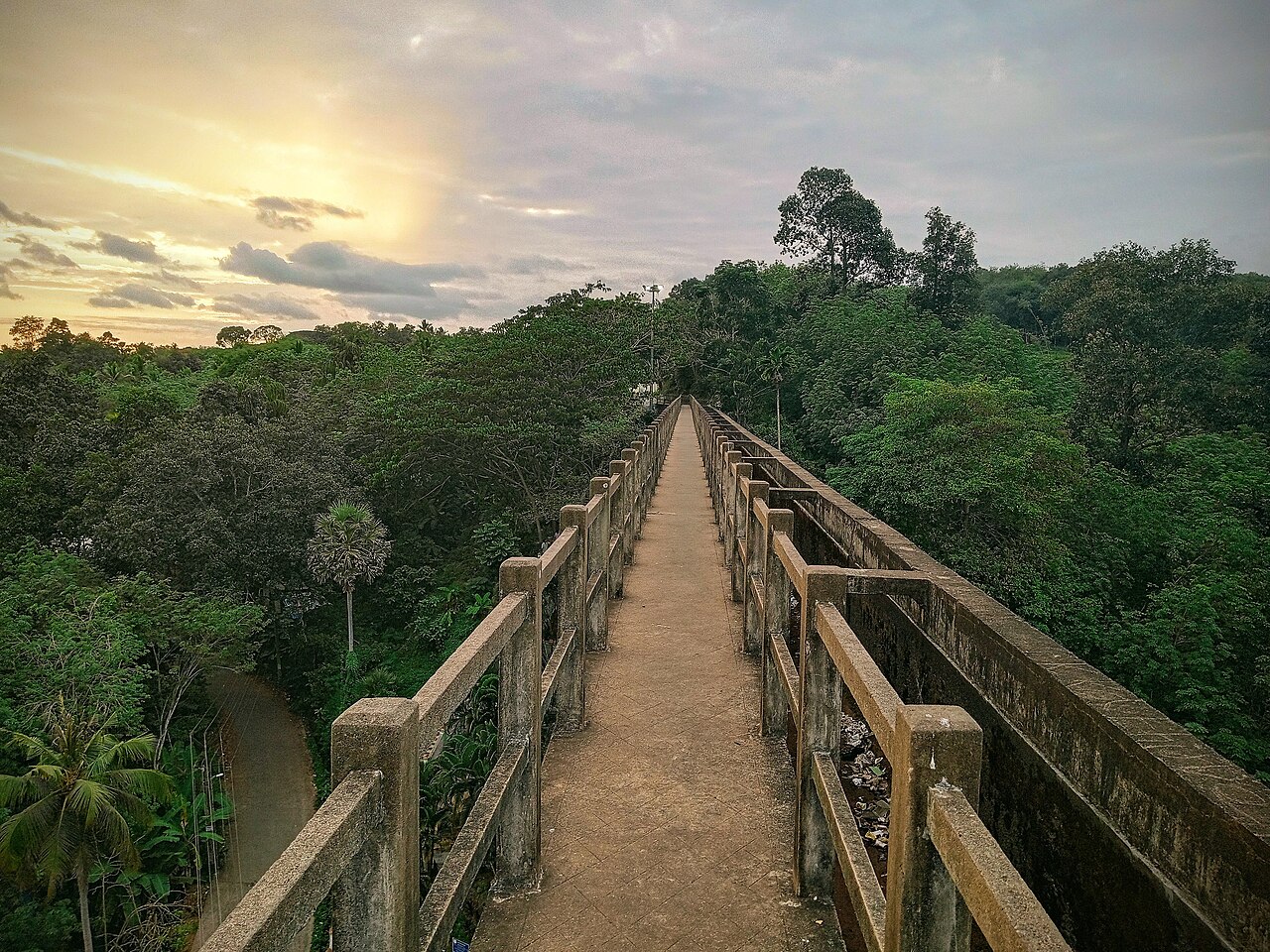 The Mathur Aqueduct carrying irrigation water high over the Pahrali valley. Photo: Hellowikidoc, CC BY-SA 4.0, via Wikimedia Commons.
5. Chitharal Jain Monuments: A 9th-Century Hilltop Sanctuary
Drive past Marthandam and climb a gently winding granite path up Thirucharanathumalai ("Hill of the Ascetics") and the bustle of the highway vanishes into cicada song.
Under a dramatic overhanging boulder at the summit lie 9th-century Jain rock-cut bas-reliefs—Tirthankaras including Mahavira and Parsvanatha, plus Padmavati Devi—carved during the reign of the Ay king Vikramaditya Varaguna. Centuries later, a Bhagavati shrine was added beside the rock shelter, creating a quiet hilltop monument where Jain minimalism and southern temple ritual sit side by side above sweeping valley views.
- Practical note: Roughly 55 km from Kanyakumari town. Wear gripping walking shoes for the short stone climb and go early morning before the granite heats up.
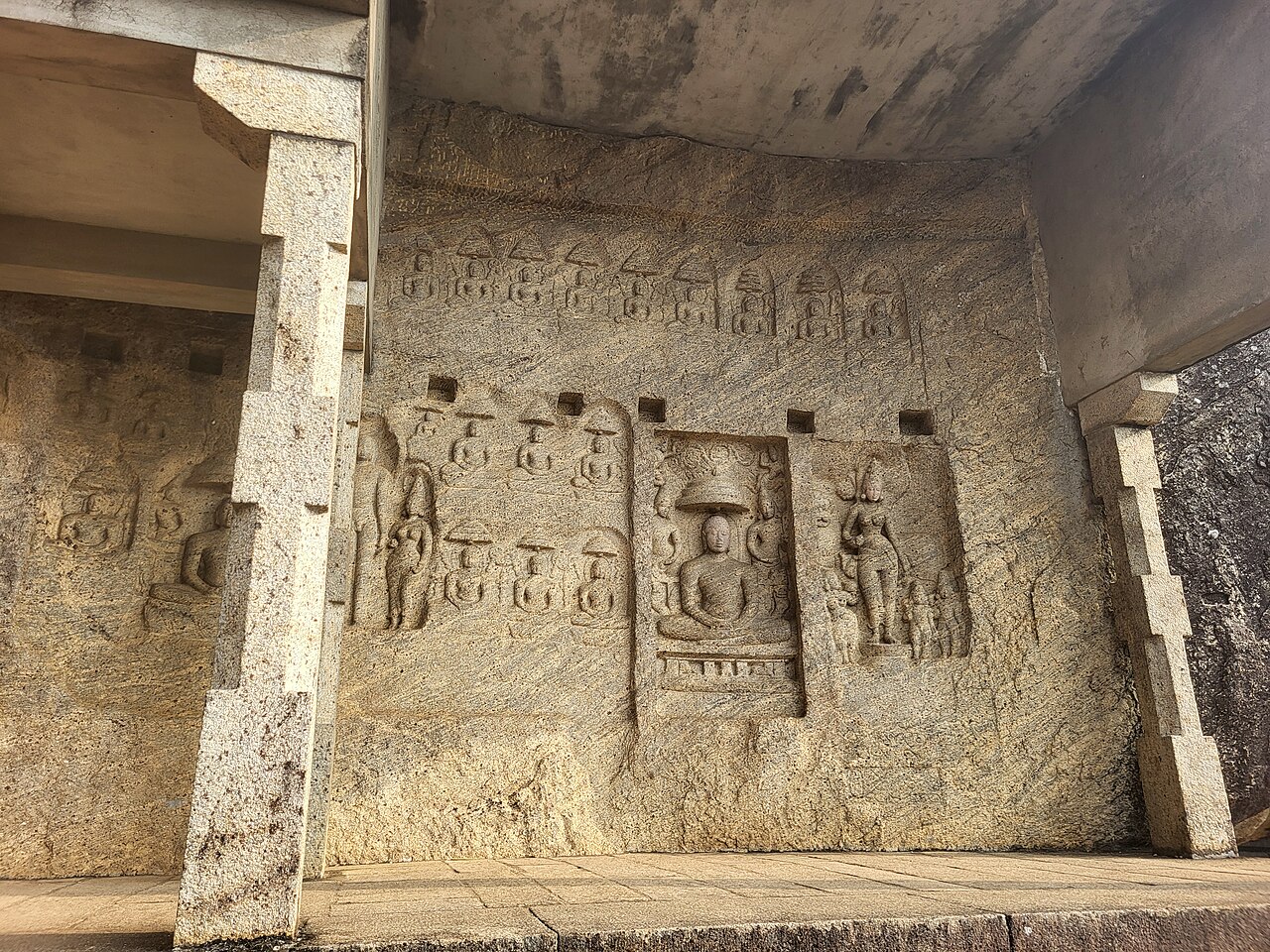 Rock-cut Jain sculptures nestled beneath a natural granite overhang at Chitharal. Photo: Athulvis, CC BY-SA 4.0, via Wikimedia Commons.
6. Udayagiri Fort and De Lannoy's Tomb
Only a couple of kilometres from Padmanabhapuram Palace sits Udayagiri Fort, a sprawling 18th-century hillside fortification rebuilt by Maharaja Marthanda Varma after he defeated the Dutch East India Company at the Battle of Colachel in 1741.
Inside the quiet, tree-shaded fort walls lies a small stone chapel-tomb inscribed in Latin and Tamil: the resting place of Eustachius De Lannoy, the captured Belgian-born Dutch commander who entered Travancore service, modernized its army, and came to be known affectionately as Valiya Kappithan (Great Captain).
7. Thirparappu Falls: The Gentle River Curtain
Unlike narrow mountain plunges that dry to a trickle outside monsoon season, Thirparappu Falls spills across a wide 300-foot stepped rocky ledge along the Kodayar river, right beside an ancient Mahadeva (Shiva) temple.
- Practical note: Expect heavy weekend family crowds; visit on a Tuesday or Wednesday afternoon after Padmanabhapuram Palace, when light softens over the river.
8. Kumari Amman Temple and Gandhi Mandapam
Right on the town promenade where three seas meet stands the 3,000-year-old shore tradition of Kumari Amman—the virgin goddess whose diamond nose-ring legend once guided mariners past the dangerous shoals of Cape Comorin. Two minutes away rises Gandhi Mandapam, built in Oriya-style pink stonework over the spot where Mahatma Gandhi's ashes rested in 1948, pierced by a roof oculus engineered so a shaft of noon sunlight strikes the central pedestal every October 2.
9. Muttom Beach and Lighthouse
Roughly 30 km west of Kanyakumari town lies Muttom, a working fishing hamlet framed by dramatic red laterite cliffs, weathered black sea boulders, and a 19th-century striped lighthouse. Come at late afternoon to watch wooden catamarans return through the surf while the Arabian Sea turns molten copper.
10. Sothavilai Beach: Four Kilometres of Unhurried Sand
If Kanyakumari's main confluence beach feels too rocky and crowded for a long walk, drive 12 km west to Sothavilai. Backed by wind-sculpted dunes and casuarina trees, its four-kilometre shoreline stays remarkably quiet—perfect for barefoot walking at dusk (though strong undertow makes it a beach for walking, not swimming).
11. Suchindram-Theroor Wetlands & Muppandal Wind Plains
Inland between Nagercoil and Suchindram, the Suchindram-Theroor Wetland Complex—designated a Ramsar site in April 2022—draws nearly 170 species of painted storks, pelicans, and winter migratory waterbirds between November and March. Further north at the Aralvaimozhi pass, Muppandal greets travellers with hundreds of giant wind turbines spinning silently against the purple wall of the Western Ghats.
How to Stitch These Places Into Three Effortless Days
Instead of crisscrossing the district randomly, group your days geographically:
- Day 1 (Land's End & Shore): Early ferry to Vivekananda Rock Memorial + Glass Bridge → Kumari Amman → Gandhi Mandapam → Vattakottai Fort at late afternoon → Sunset Point.
- Day 2 (The Travancore Royal Trail — Avoid Mondays): 09:00 AM Padmanabhapuram Palace → Udayagiri Fort → Chitharal Jain Hill → Thirparappu Falls & Mathur Aqueduct.
- Day 3 (Temples, Birds & Coast): Dawn Suchindram temple → Suchindram-Theroor Wetlands → Sothavilai Beach → Muttom Lighthouse sunset.
Want every gate, guide, and drive timed around temple closures and tides? See our complete five-day circuit in The Southern Crown and The Stone and the Teak heritage trail.