
"Even if the heavens should fail to rain, let a person hold fast to virtue—for virtue outlasts everything else." — Thiruvalluvar, Thirukkural
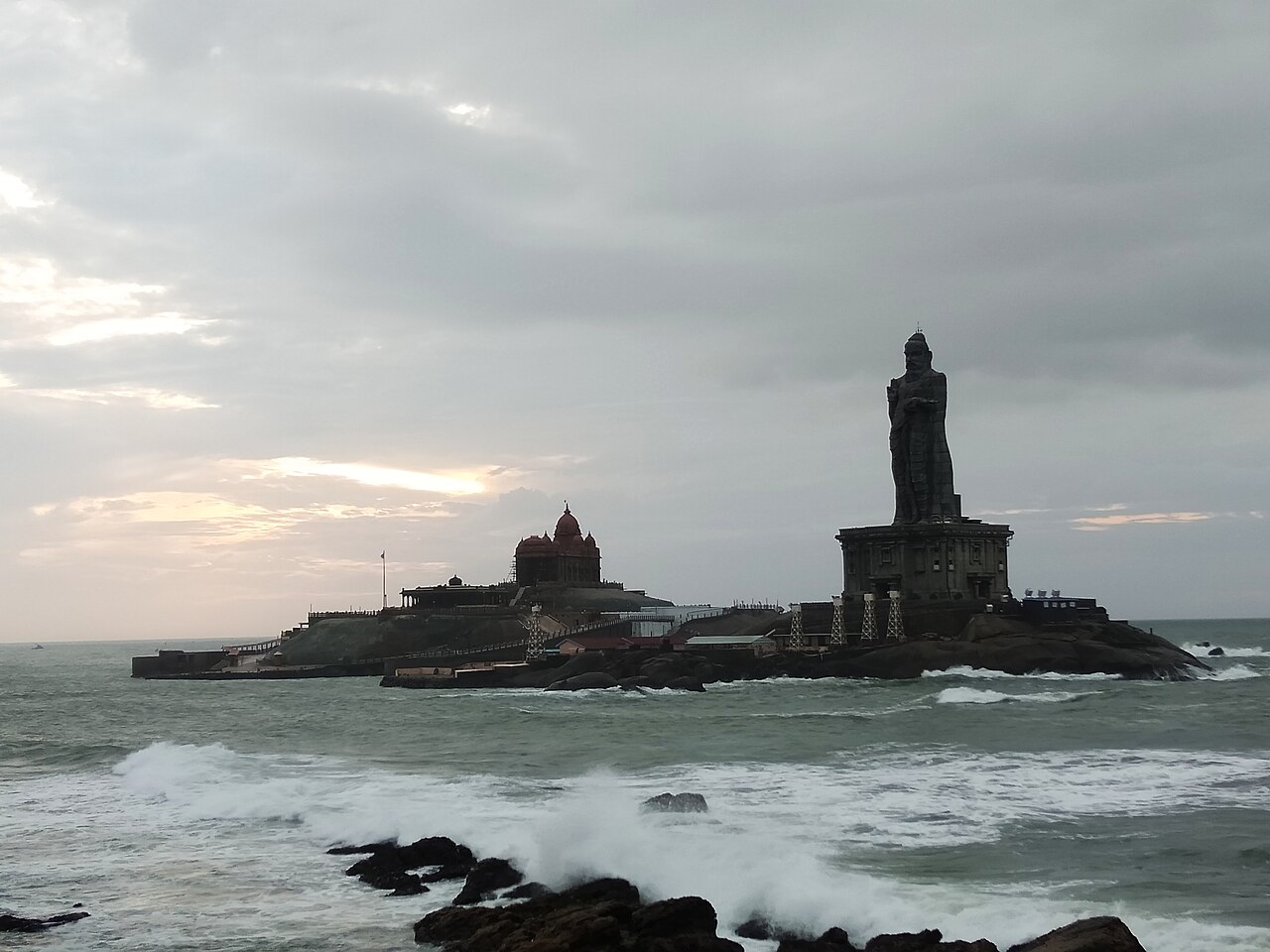
For twenty-four years, the two offshore rocks of Kanyakumari were separated by less than eighty metres of water—and an ocean of logistical trouble.
On the larger rock stood the Vivekananda Rock Memorial, crowded from morning to afternoon. On the smaller, steeper rock beside it rose the Thiruvalluvar Statue: 133 feet of hand-carved grey granite silhouetted against the sky. Yet for decades, travellers who rode the Poompuhar ferry out to the memorial often found the second jetty closed by swell, low tide, or sea spray. You could stare across the channel at the poet-philosopher from thirty yards away, unable to set foot on his stone.
On December 30, 2024, that separation ended. Engineers completed a 77-metre-long, 10-metre-wide bow-arched glass bridge suspended directly over the churning sea channel, joining the two islands into a single continuous walk. Overnight, one of South India's most photographed landmarks became an experience you literally walk through—feeling emerald waves boil beneath your boots while two thousand years of Tamil ethics tower overhead.
Who Was Thiruvalluvar, and Why 133 Feet?
Nothing about the Thiruvalluvar Statue is accidental geometry. Every measurement encodes the structure of the Thirukkural, the classical Tamil masterpiece of 1,330 crisp, seven-word couplets written sometime between the 1st century BCE and the 5th century CE.
Unlike religious scriptures tied to a single sect, the Thirukkural reads like a universal manual for human conduct—concise enough to memorize, sharp enough to sting a king's conscience. Thiruvalluvar divided the book into 133 chapters (athikarams) of ten couplets each, organized across three great pillars of life:
- Aram (Virtue — 38 chapters): Represented by the statue's 38-foot granite pedestal. Virtue is literally the foundation; without it, everything above collapses.
- Porul (Wealth, Governance & Society — 70 chapters) and Inbam (Love — 25 chapters): Combined into the 95-foot standing figure of the poet above the pedestal.
- Total Height:
38 + 95 = 133 feet— one foot for every chapter of the Thirukkural.
Look closely at the base of the pedestal if you visit early before the walkway fills. Inside the mandapam hall below the poet's feet, all 1,330 couplets are inscribed in Tamil along with translations, accompanied by sculpted elephants symbolizing the eight cardinal directions. Look at Thiruvalluvar's right hand: three fingers point upward, a quiet reminder of those three human pursuits—virtue, wealth, and love—held in proportion.
For readers of Better Tomorrow interested in practical philosophy, the Thirukkural sits naturally beside Marcus Aurelius's Meditations (read our Stoic self-mastery guide). Both treat character as daily engineering rather than abstract theory. "Guard your tongue," Valluvar warns in one couplet; "a burn from fire heals, a scar from bitter speech never does."
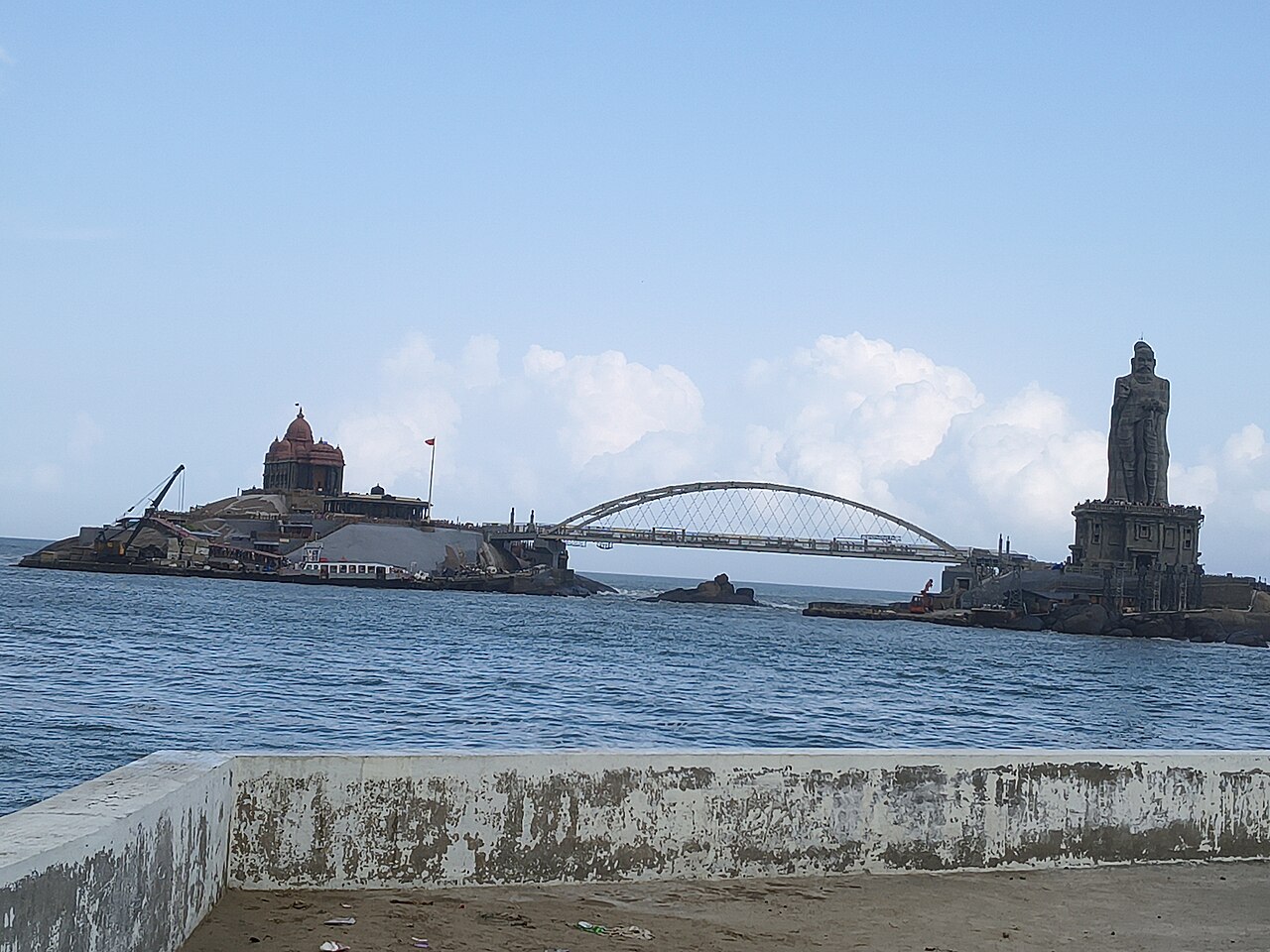 The sea channel and stone landmarks at Kanyakumari: Vivekananda Rock Memorial beside the granite islet of the Thiruvalluvar Statue. Photo: Thenerdatul, CC BY-SA 4.0, via Wikimedia Commons.
Carving 7,000 Tons of Granite in Open Ocean
When the statue was unveiled on January 1, 2000, by then-Chief Minister M. Karunanidhi, it represented one of the most daring traditional stone-engineering projects of modern India.
Sculptor and architect V. Ganapati Sthapati—trained in the classical Shilpa Shastra lineage—refused to cast the monument in concrete and paint it to look like stone. He wanted solid granite that could outlast centuries of salt wind.
The numbers behind the build still read like a myth:
- 3,681 individual stones were quarried and hand-carved across workshops in Kanyakumari, Ambasamudram, and Sholinganallur.
- The combined structure weighs roughly 7,000 tonnes, with individual blocks fitted together using interlocking joints rather than relying solely on modern mortar, designed to flex microscopically against cyclone-force gusts.
- Because the rock sits in a violent marine confluence, workers battled salt corrosion, shifting tides, and crane barges just to hoist multi-ton blocks onto the islet.
- Even more remarkably, on December 26, 2004, when the Indian Ocean tsunami slammed into Kanyakumari coast and swept away coastal structures, the 133-foot granite philosopher stood completely unmoved above the surge.
There is something quietly grounding about standing beneath a monument built to withstand tsunamis by a man who spent his life writing two-line truths about patience, truthfulness, and self-control.
Walking the Glass Bridge: What It Actually Feels Like
If you arrive after the December 2024 bridge opening, your ferry drops you at Vivekananda Rock Memorial first. After spending quiet time inside the Dhyana Mandapam, you follow the stepped stone path toward the eastern edge of the island—and suddenly the ocean opens beneath a steel-and-glass bow arch.
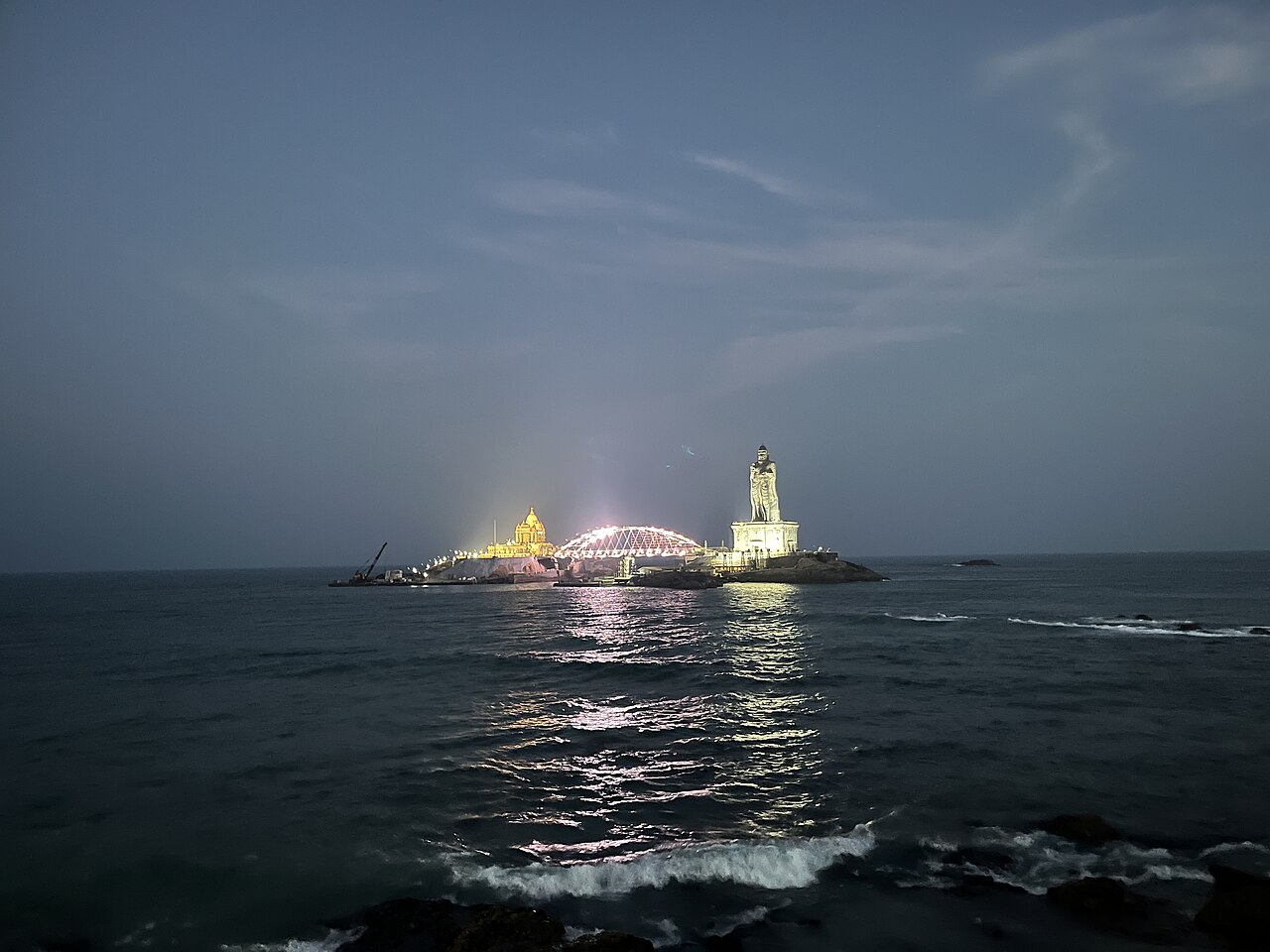 The 77-metre bow-arched glass bridge linking Vivekananda Rock Memorial and the Thiruvalluvar Statue illuminated after dusk. Photo: Shantham11, CC BY-SA 4.0, via Wikimedia Commons.
Walking the 77-metre span plays an odd trick on your balance. Through the thick transparent deck panels in the centre lane, you watch dark Atlantic-green water slam into submerged granite ledges twenty feet below, throwing bursts of white foam up toward your shoes. Sea wind tears across the strait even on calm mornings—strong enough to rattle loose hats straight into the Indian Ocean.
When you step onto the Thiruvalluvar platform at the far end, turn around and look back. For the first time in modern history, travellers get an uninterrupted side profile of Vivekananda Rock Memorial framed across open water, with the distant lighthouse and Kumari Amman temple gopuram rising along the mainland behind it.
At dusk, seen from the shore or from an upper-floor balcony along East Car Street, the lit-up arch glows like a golden suspension thread linking India's two great southern symbols: inner awakening on one rock, ethical life on the other.
Visitor Notes: Timing, Safety, and Photography
- Hours & Ferry Dependency: The glass bridge operates on the same schedule as the Poompuhar ferry (roughly 08:00 AM to 04:00 PM, extended slightly on peak holiday evenings when sea conditions permit). Because there is no mainland road onto the rock, if rough weather halts ferries, the bridge is unreachable too.
- Morning vs. Midday: Cross the bridge as close to 08:30–09:00 AM as possible. By 11:00 AM, tour queues bottle-neck on the narrow glass lane, and the sun reflects sharply off the panels.
- What Not to Carry: Secure sunglasses, caps, and phone straps—the crosswind in the 77-metre channel between the two rocks accelerates like a wind tunnel.
- Footwear & Etiquette: Keep your shoes handy for the bridge walk after leaving Vivekananda's sanctum; standard temple-precinct modesty and care apply inside the Thirukkural pedestal hall.
To weave the statue and bridge into a calm five-day journey without rushing from queue to queue, see The Southern Crown: Five Days in Kanyakumari, or read Places to Visit in Kanyakumari Beyond the Rock to discover what waits thirty minutes inland once your ferry returns to shore.