
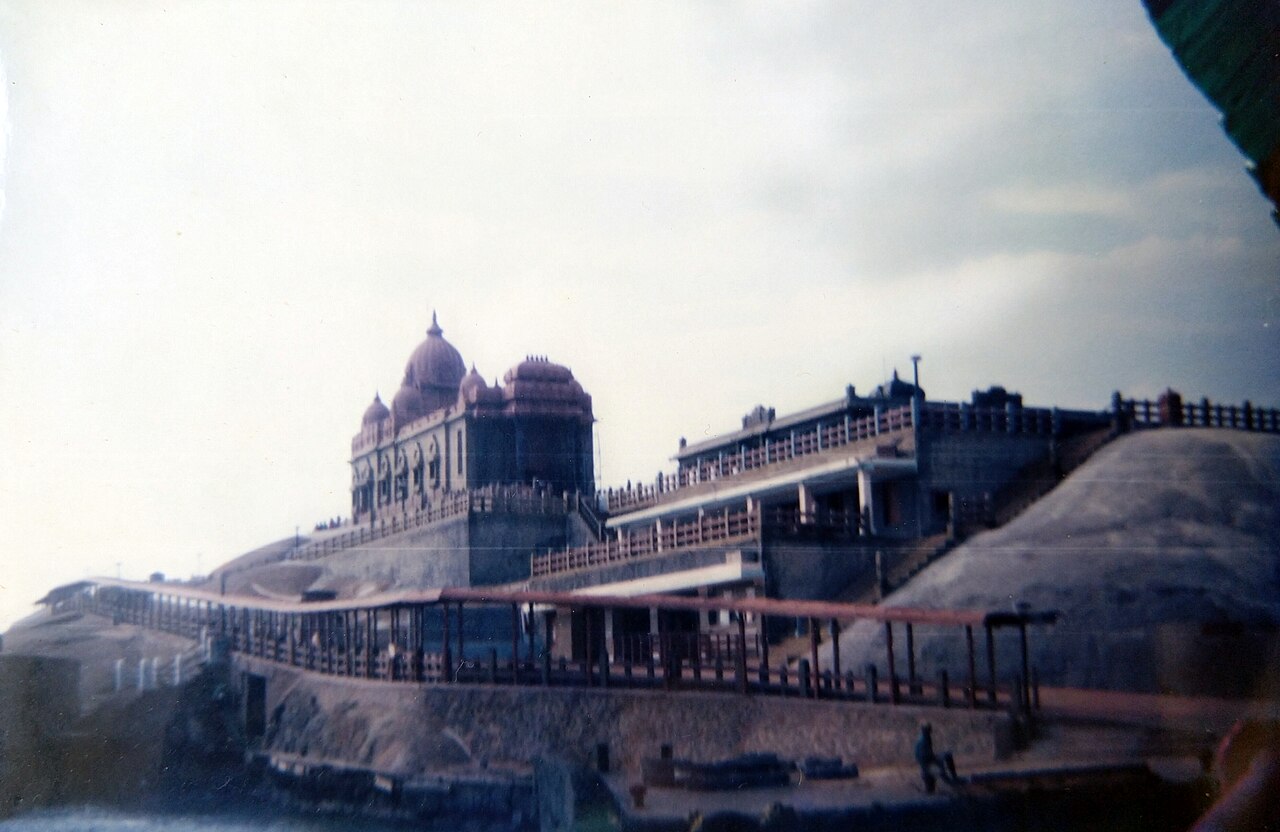
"At Cape Comorin sitting in Mother Kumari's temple, sitting on the last bit of Indian rock, I hit upon a plan..." — Swami Vivekananda, letter to Swami Ramakrishnananda (19 March 1894)
On a December afternoon in 1892, a young wandering monk in tattered ochre robes stood at the very bottom edge of India and stared across five hundred metres of churning water.
He was twenty-nine years old. His name was Narendranath Datta, though the world would soon know him as Swami Vivekananda. Behind him lay two years of walking across the length of the Indian subcontinent on foot and in third-class train carriages—sleeping in railway waiting rooms, eating whatever villagers offered, witnessing both the quiet dignity and the crushing poverty of a colonized land. In front of him lay a black granite shelf rising out of the sea, split by the surf where the Arabian Sea, the Indian Ocean, and the Bay of Bengal collide.
He had almost nothing left in his cloth bundle. When he asked the local fishermen to ferry him across to the twin rocks—known locally as Sripada Parai, the rock bearing the footprint of the goddess Devi Kanyakumari—they asked for a few copper coins. He did not have them.
So the monk did what desperate men and visionaries have always done when the boat refuses to launch: he stepped down into the surf and swam.
Fishermen watched in alarm as he fought the cross-currents—waters notorious even then for jagged underwater boulders and patrolling sharks—until he hauled himself onto the sun-baked granite, salt drying on his skin. For three nights and three days, from December 25 to December 27, 1892, he sat alone on that stone with nothing between him and the Southern Ocean except wind and spray.
Nine months later, that same young man would stand on a stage in Chicago and open the Parliament of the World's Religions with five words—"Sisters and Brothers of America"—sparking a two-minute standing ovation that altered how East and West spoke to one another.
Every December since, tens of thousands of travellers make the same 500-metre crossing—no longer by swimming, thankfully, but on the white-and-blue Poompuhar boats—searching for a glimpse of whatever clarity visited that rock over a century ago.
Why This Rock Draws Millions Every Winter
Search interest in Vivekananda Rock Memorial follows the calendar like a tide. Every year between late December and mid-January, searches surge globally—peaking right around the anniversary of those three December nights in 1892.
Part of that draw is pilgrimage. Part is geography: standing at 8°04'N, you are quite literally at the tip of the peninsula, with nothing south of you except ocean all the way to Antarctica. And since December 30, 2024, when a 77-metre bow-arched glass bridge opened to connect the memorial directly to the adjacent 133-foot Thiruvalluvar Statue, the two offshore rocks have become the defining architectural spectacle of South India.
Yet most visitors miss the real power of the island because they arrive at noon, herd off the ferry behind a thousand cameras, race through the hall in four minutes, and queue back up for the return boat.
To understand what you are standing on, it helps to read the stone before you board.
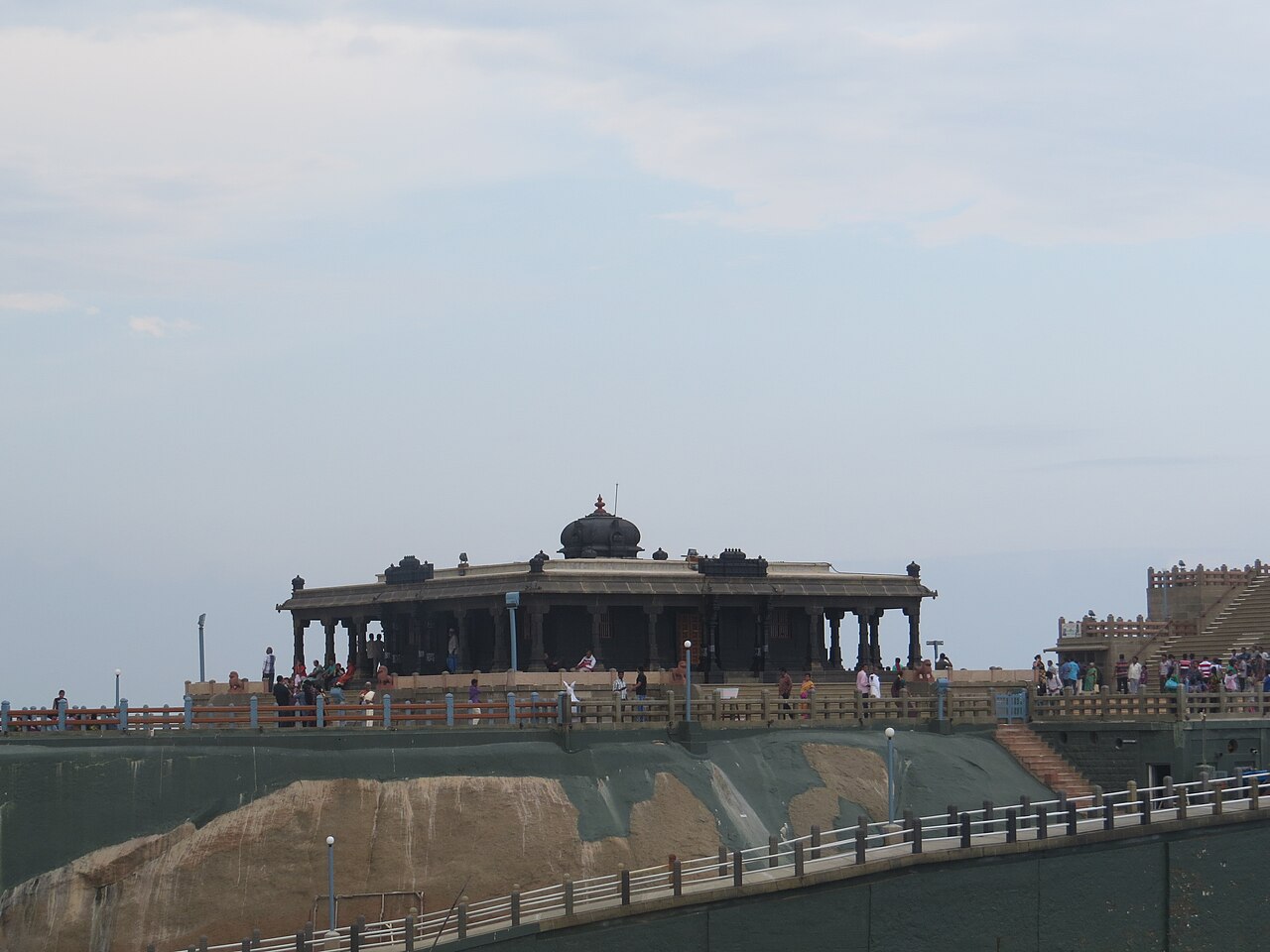 A ferry crossing the surf toward Vivekananda Rock Memorial. Photo: Vinayaraj, CC BY-SA 4.0, via Wikimedia Commons.
The Making of the Memorial: Six Years and 6,000 Stonecutters
For seventy years after Vivekananda's death in 1902, the rock remained bare stone washed by salt spray. When the centenary of his birth approached in 1963, a committee led by Eknath Ranade set out to build a permanent monument on the exact spot where he had meditated.
It was an audacious piece of logistics. Nothing—no freshwater, no electricity, no crane—existed on that sea-lashed granite islet. Every block of red and black stone had to be dressed on the mainland and ferried across rough water. Ranade turned the fundraising into a mass movement, collecting small-denomination donations from millions of ordinary Indian citizens alongside contributions from state governments across political lines.
Designed by architect S.K. Achari, the Vivekananda Mandapam was deliberately built as a synthesis of India's great architectural traditions:
- The central Dhyana Mandapam (meditation hall) echoes the Belur Math architecture of Bengal.
- The Sabha Mandapam draws from the Pallava and Chola pillared halls of Tamil Nadu.
- The entrance arch borrows from the rock-cut caves of Ajanta and Ellora.
- Adjacent to it stands the Shripada Mandapam, built over the rock indentation where local tradition holds the Virgin Goddess Kanyakumari performed austerity on one foot—the very legend that originally made the islet sacred before 1892.
When the memorial was inaugurated in September 1970, it was not meant to be a museum of plaques. Its heart was meant to remain silent.
Inside the Dhyana Mandapam: What Silence Feels Like Over Three Seas
Step off the bright granite terrace and leave your shoes at the stand. The moment you duck through the doorway into the Dhyana Mandapam, three things happen at once.
First, the blinding glare off the ocean disappears. The hall is dim, cool, and anchored by six dark granite pillars framing a quiet backlit Om. Second, the temperature drops by several degrees; sea wind whistles thinly through the stone latticework, carrying salt without heat. Third—if you are fortunate enough to catch an early morning crossing—the roar of the crowd outside thins to a low ocean hum.
In Better Tomorrow's essay on the science of solitude, we explored how deliberate isolation differs from loneliness: solitude strips away social performance long enough for buried thoughts to surface cleanly. What Vivekananda did on this rock in 1892 was a radical version of that reset. He arrived overwhelmed by a question too large for polite conversation—why has an ancient civilization fallen asleep, and what can wake it?—and sat with it without distraction until an answer crystallized.
You do not need three days on the stone to borrow a fraction of that stillness. Sit on the floor of the Dhyana Mandapam for ten unhurried minutes. Keep your camera stowed (photography is strictly prohibited inside the meditation hall anyway). Listen to the surf vibrating through the bedrock beneath your spine. Most visitors spend sixty seconds there. Giving it ten minutes changes the entire trip.
How to Visit Vivekananda Rock Memorial Without Fighting the Crowd
Practical timing makes the difference between a hurried ferry queue and an unforgettable morning at Land's End.
1. Catch the First Poompuhar Ferry (08:00 AM)
The state-run Poompuhar Shipping Corporation operates the only passenger ferries from the Kanyakumari jetty. Boats generally run from 08:00 AM to 04:00 PM, though cut-offs are occasionally extended during peak holiday weeks.
- Arrive at the jetty by 07:30–07:45 AM (or book tickets online ahead of time through the official Tamil Nadu tourism / Poompuhar portal when available).
- On the 08:00 AM boat, you reach the island before midday tour buses pull in from Madurai, Rameswaram, and Thiruvananthapuram.
- If you are staying along East Car Street (as recommended in our Kanyakumari hotels guide), you can watch sunrise at 06:00 AM, walk down for breakfast, and still make the first crossing.
2. Respect the Sea State
Remember that the confluence is not a calm lagoon. Rough swells regularly force Poompuhar to suspend ferry operations without much notice—particularly during the south-west monsoon (June–September) and during rough winter swells (such as the high-wave alerts issued in February 2025 and February 2026). Never schedule Vivekananda Rock Memorial as a tight two-hour layover before a departing train; give yourself at least two mornings in town so you have a weather buffer.
3. Walk the Glass Bridge While You Are There
Until the end of 2024, visiting the Thiruvalluvar Statue on the neighboring rock required a separate boat stop that frequently closed in low tide or swell. Today, the 77-metre glass-floored sea bridge connects both islands directly. Cross early before mid-morning heat and foot traffic build up.
4. Pair the Rock With the Shore Below
Once the ferry brings you back to the mainland around 10:30 AM, walk five minutes along the promenade to the Kumari Amman Temple (which pauses for midday closure around 12:30 PM; note modest dress and shirt-removal rules for men in the inner sanctum) and Gandhi Mandapam just up the lane. For a complete hour-by-hour arc of town, read Things to Do in Kanyakumari: From Sunrise to Midnight.
A Question Worth Carrying Off the Island
Most memorials invite you to look backward at someone else's greatness. Vivekananda Rock Memorial quietly asks a harder question: What is the swim you have been waiting to make because nobody would lend you a boat?
Whether you come for history, architecture, devotion, or simply to watch three oceans collide against black stone, step onto the island slowly. Leave the phone in your pocket for ten minutes inside the Dhyana Mandapam. And if you want the entire five-day Travancore circuit arranged—first-ferry timing, private historian, and quiet cliffside nights at Kovalam—explore The Southern Crown luxury itinerary.