
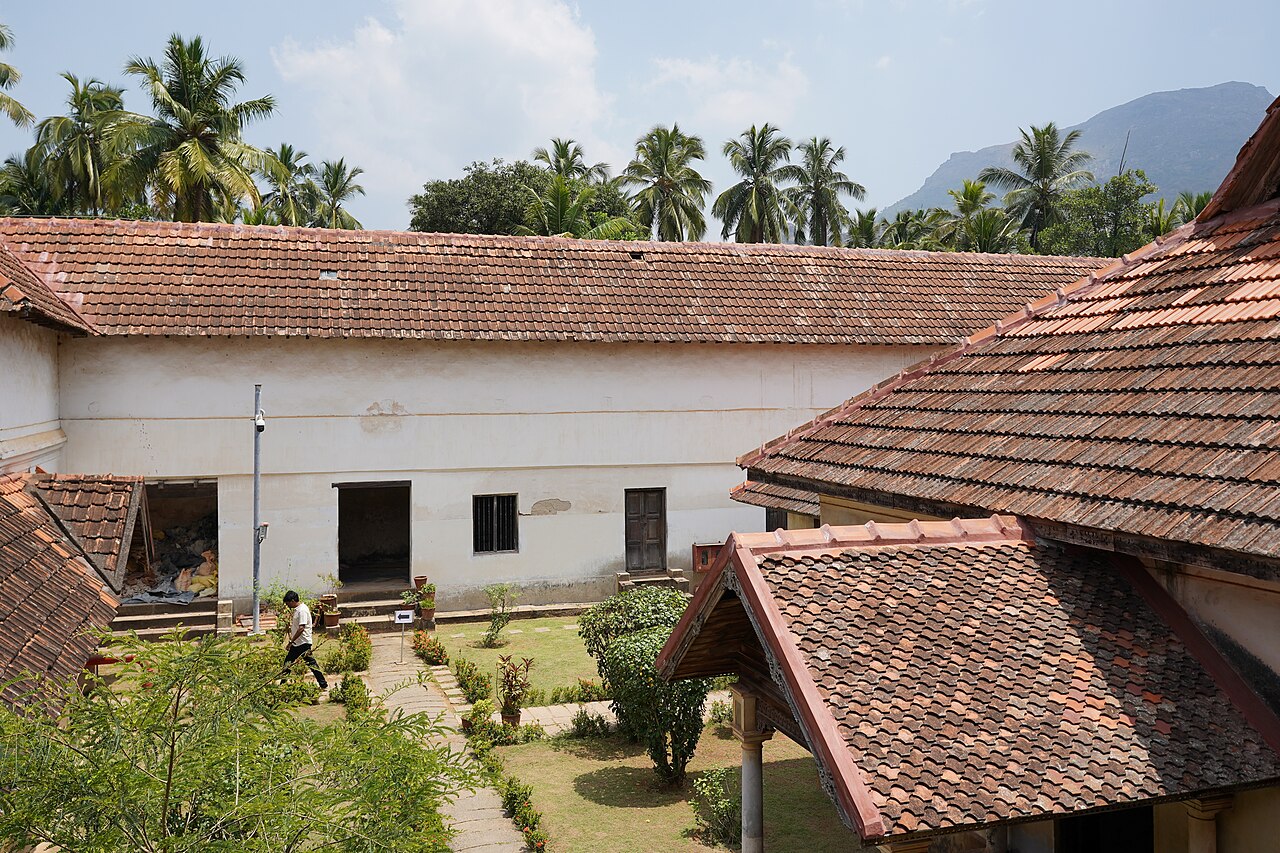
Step barefoot over the granite threshold of Padmanabhapuram Palace at nine o'clock in the morning and the first thing that surprises you is not the carving. It is the floor.
It looks like polished black marble—so glossy you see the carved rosewood ceiling beams reflected upside down beside your ankles. Yet there is no marble anywhere in the building. Four hundred years ago, Travancore masons ground burnt coconut shells, river sand, lime, jaggery, and egg whites into a secret plaster paste, spread it across the courtyard chambers, and burnished it by hand until it hardened into a cool, obsidian-black mirror that still refuses to crack.
Five minutes earlier, you were driving past roadside tea stalls in Tamil Nadu's Kanyakumari district. Inside these whitewashed walls—at the foot of Veli Hills near Thuckalay—you step straight into the 16th-century capital of the Kingdom of Travancore, preserved inside one of the largest wooden palaces on Earth.
Why a Kerala Palace Stands Inside Tamil Nadu
Every visitor notices the bilingual signboards at the ticket counter and asks the same question: why are the attendants speaking Malayalam and wearing Kerala-style uniforms inside Tamil Nadu?
Before India's linguistic states were redrawn in 1956, Kanyakumari district—then known as South Travancore—belonged to the princely state of Travancore-Cochin. Padmanabhapuram (originally Kalkulam) served as the royal capital from roughly 1601 CE until the late 18th century, when Maharaja Dharma Raja shifted court northward to Thiruvananthapuram. When Kanyakumari merged into Tamil Nadu in 1956, an interstate agreement left the palace itself under the ownership and meticulous conservation of the Kerala State Department of Archaeology.
The result is a living architectural time capsule: a palace that never suffered modern concrete renovations because a neighbouring state treated it like an heirloom.
Walking the Rooms: Architecture Designed for Stillness
Leave your shoes outside and move slowly through the seven-acre compound. Unlike Rajasthani forts built to intimidate from afar with sandstone towers, Padmanabhapuram was built for tropical quietude, airflow, and intimate craft:
- The Thai Kottaram (Mother Palace): Dating to the late 16th century, this is the oldest heart of the complex. A single massive wooden pillar carved from jackfruit wood holds the central hall, accompanied by traditional ekanthamandapam (chamber of solitude) rooms where kings withdrew from court noise.
- The Mantrasala (Council Chamber): Look up at the wooden ceiling and down at the mica-inlaid windows. Coloured mica panes filter fierce tropical glare into soft jewel tones while slatted timber louvers draw cool hill breezes straight across the floor.
- The Uppirika Malika (King's Four-Storey Quarters): Climb the narrow, steep wooden staircases (designed defensively so only one armed intruder could ascend at a time) to find the famous four-poster medicinal bed carved from sixty-four varieties of Ayurvedic wood, presented to the king by Dutch merchants—plus 18th-century murals glowing softly along the walls of the royal worship room.
- The Secret Underground Tunnel: Beneath the inner quarters lies a concealed stone staircase leading toward an emergency escape passage said to connect toward Charode miles away—a quiet reminder that even contemplative kings kept an exit route ready.
In an era of glass towers that require megawatts of air conditioning just to stay habitable, Padmanabhapuram stands as a masterclass in passive architecture: steep Mangalore-tiled eaves shedding monsoon torrents, thick granite plinths holding night coolness, and dark teak absorbing light without glare.
Five Minutes Away: The Captured Dutch Captain Who Changed Travancore
Do not drive away from Thuckalay without stopping two kilometres down the road at Udayagiri Fort—because the story inside its walls explains why Travancore survived long enough for this palace to endure.
In 1741, the Dutch East India Company—then one of the wealthiest naval powers on Earth—landed troops at Colachel on the Kanyakumari coast to break Maharaja Marthanda Varma's spice monopoly. Instead, Travancore forces surrounded the Dutch garrison and won the Battle of Colachel, one of the rare decisive defeats of a European colonial power by an Asian kingdom in the 18th century.
Among the captured officers was a young Flemish/Belgian-born commander named Eustachius De Lannoy. Impressed by his engineering and artillery discipline, Marthanda Varma spared his life on one condition: train the Travancore army in European fortifications and modern drill.
De Lannoy never returned to Europe. He served Travancore faithfully for thirty-six years until his death in 1777, rising to Valiya Kappithan (Great Captain), rebuilding Udayagiri and Vattakottai forts in massive interlocking granite, and earning a quiet Christian chapel-tomb inside Udayagiri's green grounds where bilingual Latin and Tamil inscriptions still mark his grave.
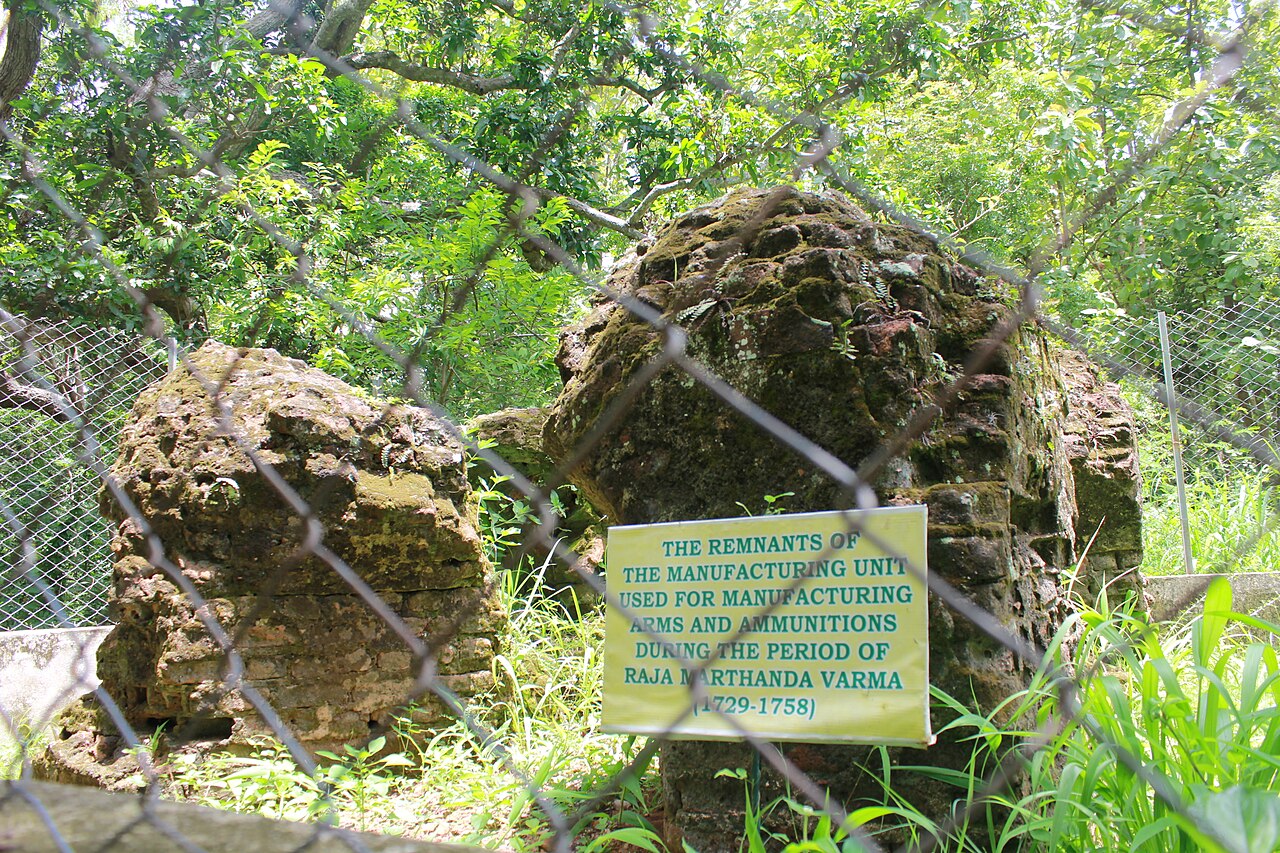 The quiet stone chapel and tomb of Eustachius De Lannoy inside Udayagiri Fort near Thuckalay. Photo: Adsamarnalkar, CC BY-SA 4.0, via Wikimedia Commons.
Standing beside De Lannoy's tomb under spreading banyan shade—with Padmanabhapuram's red gables rising behind the palm trees—you feel how deeply global history tangled itself around this tiny corner of India.
Visitor Protocol: How to Time Your Visit Properly
Because Padmanabhapuram is fragile heritage timber rather than a casual park, timing matters:
- Closed Every Monday (plus select public holidays). Plan your Kanyakumari arrival for Tuesday or Wednesday so Monday never blocks both Padmanabhapuram and Thiruvananthapuram's Kuthiramalika Palace.
- Hours: 09:00 AM – 12:30 PM and 02:00 PM – 04:30 PM (double-check locally on festival days).
- Entry Fees (checked Nov 2026): Roughly ₹50 for Indian adults and ₹500 for foreign adults, with separate small camera/parking tickets.
- Beat the Heat & Groups: Arrive at 08:50 AM before tour buses roll in from Trivandrum and Kanyakumari. Hire a licensed heritage guide at the gate—half the palace's best details (the clock tower built by a local blacksmith, the Belgian mirrors, the Ayurvedic bed woods) sit unmarked without context.
- Pair It Cleanly: Combine Padmanabhapuram + Udayagiri Fort in the morning, pause for a banana-leaf sadya near Thuckalay, and spend the afternoon at Thirparappu Falls and Mathur Aqueduct.
To explore all fifteen Ay, Chera, Venad, and Travancore monuments mapped into three effortless drives, read The Stone and the Teak heritage trail, or book the full Southern Crown five-day itinerary.