
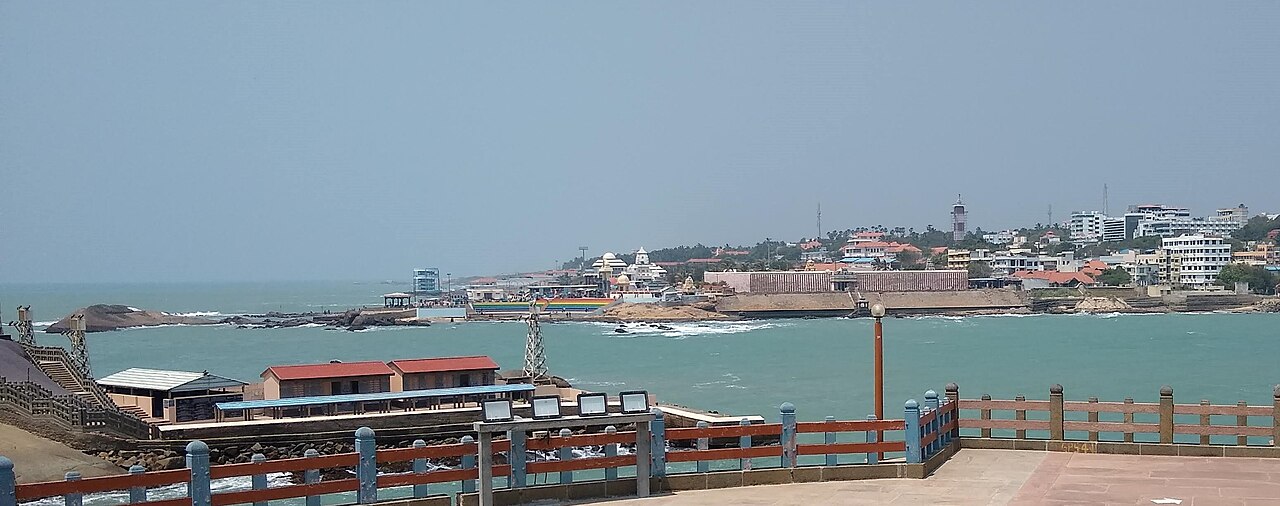
In the first century CE, an anonymous Greek-speaking Egyptian merchant sailed down the Malabar coast and jotted a brief entry into his maritime logbook, the Periplus of the Erythraean Sea.
Beyond the pepper ports of Muziris, he wrote, lay a windy headland called Komari—sacred to a virgin goddess who guarded the southern tip of the world, where devotees bathed in converging swells before rounding the cape toward pearl fisheries and Ceylon. Nearly two thousand years later, visitors still step out of trains before dawn, walk down to the exact same granite steps at Triveni Sangam, and stand motionless staring south into empty ocean.
Nothing visually announces this is the end of a continent. There is no neon border line, no dramatic waterfall off the edge of the Earth. There is only wet stone, salt spray on your glasses, and three vast waters—the Arabian Sea, the Indian Ocean, and the Bay of Bengal—folding together under an unbroken 270-degree sky.
So why does standing there rearrange people?
Cape Comorin in Memory: Two Millennia at 8°04' North
Human beings have always built shrines at geographic edges. Psychologists and historians recognize a simple pattern: where landscape runs out of certainty—cliff rims, desert horizons, mountain passes, river mouths—the ordinary ego loses its scale.
At Kanyakumari, that edge was celebrated centuries before modern tourism:
- In classical Sangam Tamil literature, Kumari marks the southern anchor of the Tamil world, praised alongside the Pahruli river and ancient Pandyan pearl ports.
- For medieval Arab, Venetian, and Portuguese navigators, rounding Cape Comorin marked the decisive hinge between the western Indian Ocean trade winds and the Bay of Bengal routes toward Malacca and China.
- In December 1892, Swami Vivekananda swam across this very channel seeking clarity away from mainland noise.
- In 1948, Mahatma Gandhi's ashes were brought to this confluence so they could enter all three surrounding waters at once.
Every era read its own meaning into the cape, yet the underlying sensory experience never changed: you stand on the last solid stone, and the horizon takes over.
What Happens to Your Brain at Triveni Sangam
Modern emotion neuroscience has a surprisingly precise name for what visitors feel at Land's End.
In Better Tomorrow's essay on the science of awe, we examined UC Berkeley psychologist Dacher Keltner and Jonathan Haidt's definition of awe. According to two decades of lab and field research, awe fires when two triggers collide: perceived vastness (something vastly larger than your daily frame) and a need for accommodation (your brain must stretch its existing mental map to absorb what it sees).
Stand at Triveni Sangam at 5:55 AM and both triggers fire simultaneously:
- Visual Vastness: Most beaches show you a single flat seam of horizon. At Kanyakumari's V-shaped tip, ocean wraps around three sides of your peripheral vision while offshore granite islands anchor the middle distance.
- Temporal & Cognitive Stretch: Your mind knows—even before you articulate it—that there is no mainland south of your shoes for thousands of miles of open sea. Simultaneously, watching eastern daylight illuminate the Thiruvalluvar Statue while western shadows still linger behind Kumari Amman creates a subtle perceptual recalibration.
Neuroimaging studies by Michiel van Elk and colleagues suggest awe reliably quiets the brain's Default Mode Network—the neural neighbourhood responsible for rumination, inbox anxiety, and endless self-referential chatter. Keltner calls the resulting shift the "Small Self" effect: you do not feel worthless; you feel accurately rescaled, like a single note inside a vast coastal chord.
And in research by Melanie Rudd, Kathleen Vohs, and Jennifer Aaker, even brief experiences of awe measurably expanded participants' subjective sense of available time—quietly curing the chronic hurry that follows ambitious travellers off the plane.
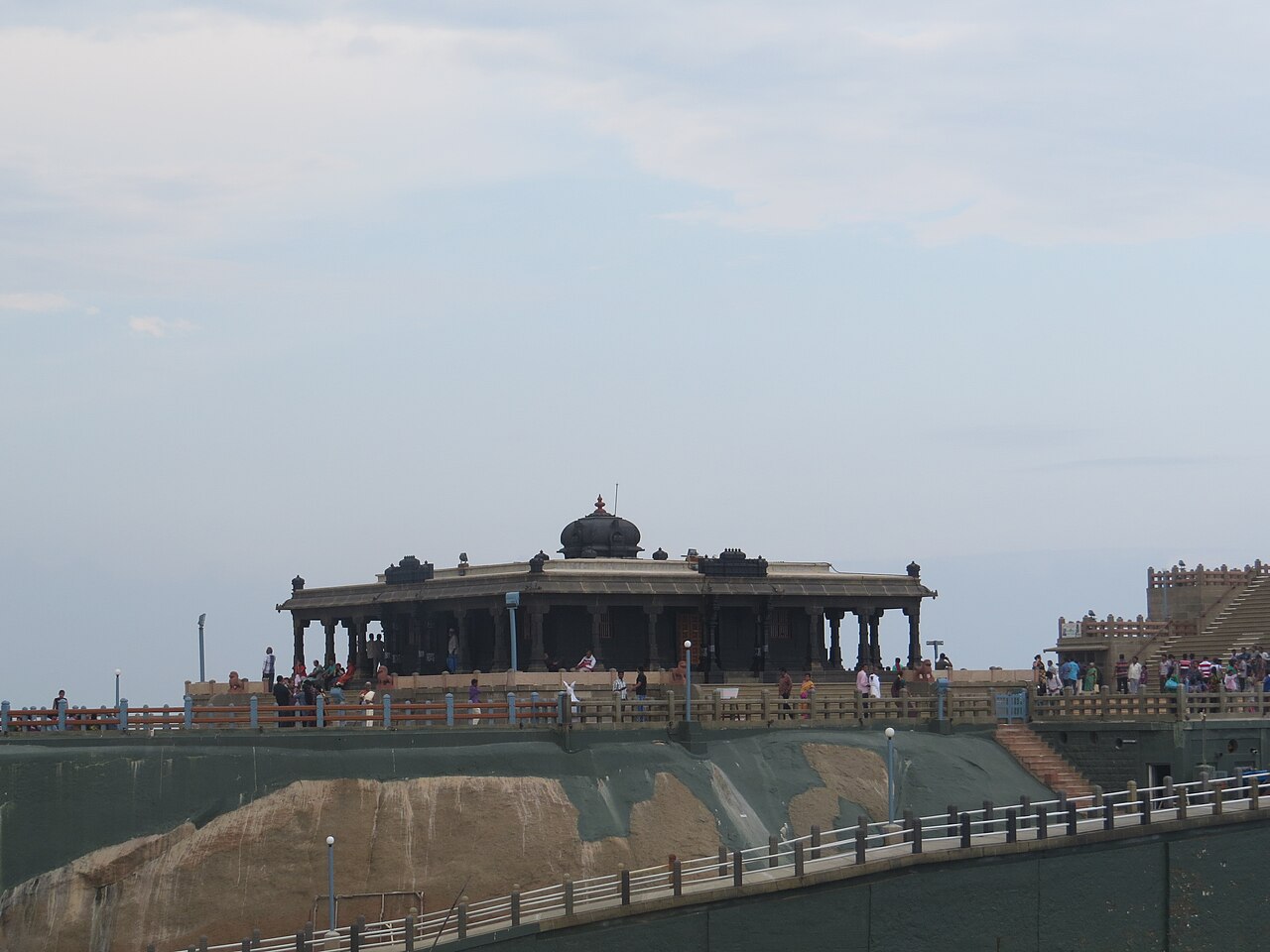 Morning swell washing past the granite islets off Triveni Sangam. Photo: Vinayaraj, CC BY-SA 4.0, via Wikimedia Commons.
How to Actually Feel Awe Instead of Just Photographing It
Here is the irony of modern travel: you fly across a country to experience vastness, then spend the critical fifteen minutes staring at a six-inch phone screen trying to balance exposure for an Instagram reel.
Try a different protocol on your first morning in Kanyakumari:
1. Choose Elevation Over the Crowd Rail
At sunrise and sunset, the stone promenade right beside Triveni Sangam fills with hundreds of people and whistling marshals. If you want stillness, either book an upper-floor sea-facing room along East Car Street (see our Kanyakumari hotels guide) or walk seven kilometres east to the open granite ramparts of Vattakottai Fort where you have the horizon nearly to yourself.
2. Follow the "Five Minutes, Zero Lens" Rule
When the sun breaks the horizon—or when evening gold hits the 77-metre glass bridge—keep your camera in your pocket for five full minutes. Notice three physical sensations: the wind velocity shifting between the Bay of Bengal side and the Arabian Sea side, the rhythmic low-frequency thump of wave interference beneath the rock shelf, and the gradual drop in shoulder tension.
3. Pair the Shore With Inland Silence
Do not stop at the water's edge. Spend an afternoon climbing the quiet stone path up Chitharal Jain Hill, walking the cool timber verandas of Padmanabhapuram Palace, or sitting inside the Dhyana Mandapam on Vivekananda Rock before midday tours arrive.
Why Better Tomorrow Writes About Places Like Kanyakumari
Most self-improvement libraries treat human growth as something that happens exclusively inside journals, spreadsheets, and morning routines. Yet anyone who has stepped off a night train at 5:00 AM, watched an ocean horizon turn coral, and suddenly seen a thorny life decision with effortless clarity knows better.
Geography is one of the oldest mindset tools we have. Rest—taken deliberately, unhurried, and close to water, history, and sky—changes the person who returns home.
If you want to plan a restorative five-day journey built around early mornings, historic palaces, quiet beaches, and zero queue stress, explore The Southern Crown—or browse our complete Rest & Wellbeing archive before you pack.